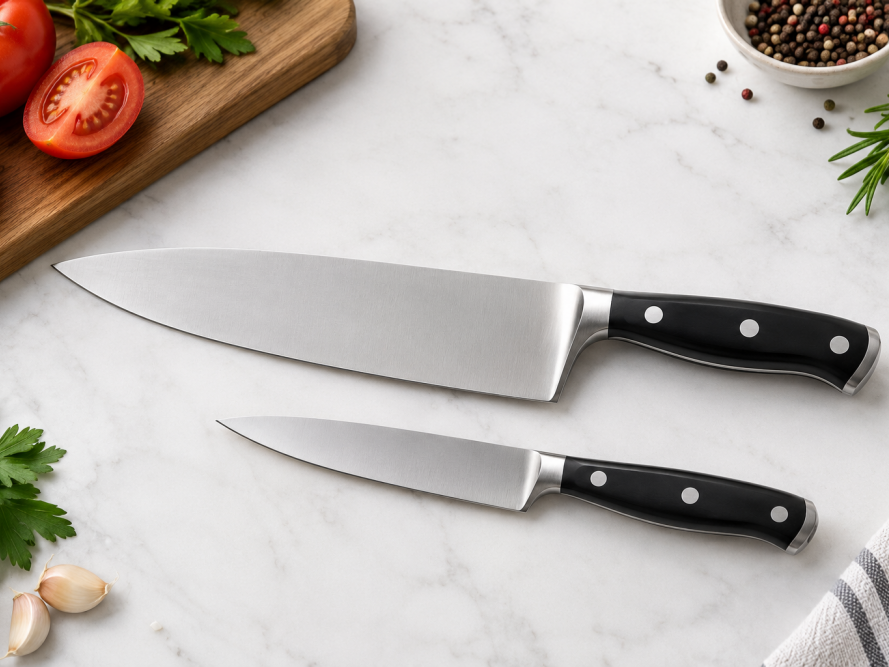



What Is 5Cr15MoV Steel? Properties, Hardness, Uses & Kitchen Knife Guide
What Is 5Cr15MoV Steel? Properties, Hardness, Uses & Kitchen Knife Guide
Published by FASAKA | Kitchen Knife Steel Guide
If you are comparing kitchen knife materials, you may have come across the term 5Cr15MoV steel. This stainless steel is widely used in kitchen knives, household cutting tools, and other applications where a practical balance of sharpness, corrosion resistance, durability, and manufacturing cost is important.
But what exactly is 5Cr15MoV steel? Is 5Cr15MoV stainless steel good for kitchen knives? How hard is it, how well does it hold an edge, and why do manufacturers use it for different types of kitchen knives?
Understanding these characteristics can help consumers choose the right knife and help importers, distributors, supermarkets, and private label brands select suitable steel for different market segments.

What Is 5Cr15MoV Steel?
5Cr15MoV is a chromium-molybdenum-vanadium stainless steel commonly used for knives and cutting tools. It is designed to provide a practical combination of hardness, corrosion resistance, wear resistance, and ease of sharpening.
The name itself provides information about the steel composition. In the commonly used designation, “5Cr” indicates a relatively moderate carbon and chromium classification, while “MoV” refers to the addition of molybdenum and vanadium.
The exact chemical composition and performance can vary depending on the applicable standard, steel producer, heat-treatment process, and manufacturing specification. Therefore, buyers should evaluate the complete material specification rather than judging a knife only by its steel name.
For kitchen knives, the practical value of 5Cr15MoV comes from its balanced performance rather than extreme hardness or maximum edge retention.
Key Characteristics of 5Cr15MoV
- Stainless steel construction: Provides good resistance to rust and corrosion under normal kitchen conditions.
- Balanced hardness: Offers practical cutting performance without becoming excessively difficult to sharpen.
- Good corrosion resistance: Suitable for frequent contact with food and moisture when properly maintained.
- Good machinability: Supports efficient knife manufacturing and edge processing.
- Practical toughness: Suitable for everyday kitchen applications where impact resistance and easy maintenance matter.
- Cost-effective performance: Provides a useful balance for mid-range and mass-market kitchen knife products.
5Cr15MoV Stainless Steel Composition
The performance of 5Cr15MoV stainless steel comes from its combination of carbon, chromium, molybdenum, vanadium, and other alloying elements.
Each element contributes differently to the final properties of the steel. However, the actual performance of a finished kitchen knife depends not only on chemical composition but also on heat treatment, blade geometry, grinding, edge angle, and manufacturing quality.
| Element | Main Function | Importance for Knives |
|---|---|---|
| Carbon | Contributes to hardness and wear resistance | Helps the blade form and maintain a useful cutting edge |
| Chromium | Improves corrosion resistance | Important for stainless kitchen knife applications |
| Molybdenum | Supports corrosion resistance and steel performance | Helps maintain performance in demanding environments |
| Vanadium | Contributes to wear resistance and edge performance | Supports cutting durability |
It is important to remember that alloy composition alone does not determine knife quality. Two knives made from the same steel can perform differently because of differences in heat treatment, hardness, blade thickness, edge geometry, grinding quality, and final inspection.
How Hard Is 5Cr15MoV Steel?
The hardness of 5Cr15MoV kitchen knives depends heavily on heat treatment and the manufacturer's production specification. In practical kitchen knife applications, it is commonly processed into a moderate hardness range that balances edge retention, toughness, and ease of sharpening.
For many commercial kitchen knife applications, manufacturers may target approximately 54–58 HRC, although the actual specification can vary by product design and heat-treatment process.
This moderate hardness is one reason 5Cr15MoV is attractive for everyday kitchen knives. It does not attempt to maximize hardness at the expense of toughness and maintenance.
What Does HRC Mean?
HRC refers to the Rockwell C hardness scale, which is commonly used to evaluate the hardness of knife steels. A higher HRC value generally means a harder blade, but higher hardness does not automatically mean a better kitchen knife.
Harder steels can provide stronger edge retention, while softer steels can be easier to sharpen and may offer greater resistance to certain types of impact. The ideal hardness depends on the intended application.
For a more detailed explanation of kitchen knife hardness, see our guide: Kitchen Knife Hardness Explained: HRC Guide .
Is 5Cr15MoV Steel Good for Kitchen Knives?
Yes. 5Cr15MoV steel is a practical choice for many kitchen knives, particularly when the goal is to balance cutting performance, corrosion resistance, durability, maintenance, and manufacturing cost.
It may not offer the extreme edge retention of premium powder steels or some high-hardness Japanese knife steels, but kitchen knives do not always require the highest possible hardness.
For everyday household cooking, food preparation, supermarket knife sets, and many mid-range retail products, a well heat-treated 5Cr15MoV blade can provide reliable performance.
Advantages of 5Cr15MoV Kitchen Knives
- Good corrosion resistance for normal kitchen environments
- Easy to maintain compared with many high-hardness steels
- Relatively easy to sharpen when the edge becomes dull
- Balanced toughness and hardness for everyday cutting
- Suitable for mass-market and mid-range products
- Good manufacturing efficiency for large-volume production
Potential Limitations
- Edge retention may be lower than some premium high-hardness steels
- Not designed for maximum wear resistance
- Performance depends strongly on heat treatment and blade geometry
- May not be the first choice for premium ultra-hard Japanese-style knives
If you are comparing different kitchen knife steels, you can also read our guide to 5Cr15MoV vs 3Cr13 vs 420J2 Kitchen Knife Steel to understand their performance differences.
5Cr15MoV Steel Corrosion Resistance
One of the main reasons 5Cr15MoV stainless steel is used for kitchen knives is its good corrosion resistance. Kitchen knives are frequently exposed to water, food acids, salt, and moisture, so resistance to rust is an important consideration when selecting blade steel.
The chromium content in 5Cr15MoV helps the steel form a passive oxide layer on the surface. This layer provides protection against corrosion during normal use.
However, stainless steel does not mean completely rust-proof. Leaving a kitchen knife wet for extended periods, exposing it to acidic foods, using harsh chemicals, or storing it in a damp environment can still cause staining or corrosion over time.
How to Maintain a 5Cr15MoV Kitchen Knife
- Wash the knife after use and dry it thoroughly.
- Avoid leaving the blade submerged in water for long periods.
- Use a suitable cutting board instead of hard surfaces such as glass or stone.
- Store the knife in a dry and protected location.
- Follow the manufacturer's instructions regarding dishwasher use.
For buyers targeting humid regions or high-volume household use, corrosion resistance can be an important selling point when selecting stainless steel kitchen knives.
Does 5Cr15MoV Hold an Edge Well?
5Cr15MoV steel offers moderate edge retention that is suitable for many everyday kitchen applications. It can maintain a useful cutting edge during normal food preparation, while still being relatively easy to resharpen when necessary.
Edge retention is affected by much more than the steel itself. Blade hardness, edge angle, heat treatment, grinding quality, cutting board material, and the type of food being prepared all influence how long a knife remains sharp.
For example, a properly heat-treated 5Cr15MoV blade with an appropriate edge geometry can outperform a poorly manufactured knife made from a theoretically higher-performance steel.
5Cr15MoV Sharpness vs. Ease of Sharpening
One advantage of 5Cr15MoV is its practical balance between edge retention and sharpening convenience. When the blade eventually becomes dull, it can generally be resharpened without requiring highly specialized equipment.
This makes it particularly suitable for household users and commercial buyers who value easy maintenance rather than maximum edge retention.
What Are 5Cr15MoV Kitchen Knives Used For?
The balanced characteristics of 5Cr15MoV make it suitable for a wide range of everyday kitchen knives. Manufacturers can use this steel for different blade shapes and product configurations depending on the target market.
| Knife Type | Typical Application | Why 5Cr15MoV Can Be Suitable |
|---|---|---|
| Chef Knife | Chopping, slicing and dicing | Balanced sharpness, toughness and corrosion resistance |
| Santoku Knife | Vegetables, meat and fish | Suitable for lightweight everyday cutting |
| Utility Knife | General food preparation | Easy maintenance and practical durability |
| Paring Knife | Peeling and precision cutting | Easy to sharpen and suitable for fine cutting |
| Kitchen Knife Sets | Household and retail applications | Good balance of performance and production cost |
Because of its balanced properties, 5Cr15MoV can be particularly useful for kitchen knife collections aimed at everyday household users, supermarkets, retailers, distributors, and private label brands.
5Cr15MoV vs 3Cr13 vs 420J2
When sourcing kitchen knives, buyers often compare 5Cr15MoV with other commonly used stainless steels such as 3Cr13 and 420J2. Each material has different characteristics, and the right choice depends on the product positioning and intended application.
| Feature | 5Cr15MoV | 3Cr13 | 420J2 |
|---|---|---|---|
| Corrosion Resistance | Good | Good | Good |
| Edge Retention | Moderate | Moderate | Moderate |
| Ease of Sharpening | Good | Good | Good |
| Typical Positioning | Mid-range / Everyday | Entry / Mass Market | Everyday / Value Market |
| Common Applications | Kitchen knives and cutting tools | Kitchen knives and household tools | Kitchen knives and utility blades |
These comparisons should be treated as general guidance rather than absolute rankings. Actual knife performance depends strongly on steel composition, heat treatment, hardness, blade geometry, edge angle, and manufacturing quality.
Is 5Cr15MoV Good for Mass-Market Kitchen Knives?
For many retail applications, 5Cr15MoV stainless steel offers a useful balance between product performance and manufacturing efficiency. This is especially relevant when buyers need to develop kitchen knife products for supermarkets, department stores, online retail, or large-volume distribution.
A mass-market kitchen knife does not necessarily need an ultra-premium steel. Retail buyers often need a combination of acceptable sharpness, corrosion resistance, durability, easy maintenance, attractive appearance, and controlled production costs.
- Suitable for high-volume kitchen knife production
- Good corrosion resistance for everyday kitchen use
- Relatively easy to sharpen and maintain
- Works with different handle materials and blade designs
- Suitable for different retail price positions
For buyers developing a new private label knife collection, steel selection should therefore be considered together with blade design, handle construction, packaging, target price, expected usage, and market positioning.
If you are developing a retail kitchen knife line, see our guide: How Many Kitchen Knives Does a Retailer Need in a Product Line?
How to Choose 5Cr15MoV Kitchen Knives for Different Markets
For kitchenware importers, distributors, supermarkets, and private label brands, choosing the right knife steel is not simply a technical decision. The steel should match the target customer's expectations, retail positioning, usage environment, and product price range.
5Cr15MoV stainless steel can be a practical option when the goal is to offer reliable everyday cutting performance without moving into the highest-cost premium steel category.
| Target Market | Recommended Product Position | Potential 5Cr15MoV Advantage |
|---|---|---|
| Supermarkets | Everyday kitchen knife sets | Balanced performance and maintenance |
| Household Retail | Chef knives and utility knives | Easy sharpening and corrosion resistance |
| Distributors | Multi-model kitchen knife collections | Flexible product positioning |
| Private Label Brands | Customized knife collections | Compatible with different designs and handle options |
| Food Preparation | General-purpose kitchen knives | Good balance of cutting performance and corrosion resistance |
5Cr15MoV Steel for OEM & ODM Kitchen Knives
For OEM and ODM projects, material selection should be considered together with the complete knife design. A professional manufacturer can adjust blade thickness, edge geometry, handle construction, heat treatment, surface finishing, and packaging according to the target market.
For example, the same 5Cr15MoV steel can be developed into different products by changing the blade profile and handle design.
- 8-inch chef knives for everyday household cooking
- Santoku knives for lightweight and precise food preparation
- Utility knives for general-purpose kitchen applications
- Paring knives for detailed fruit and vegetable preparation
- Multi-piece knife sets for supermarket and retail programs
FASAKA supports customized kitchen knife development for distributors, wholesalers, supermarkets, and private label brands, including blade material selection, handle design, logo application, packaging, and bulk production.
Learn more about FASAKA OEM & ODM kitchenware manufacturing for customized kitchen knife sourcing solutions.

What Should Buyers Check Besides 5Cr15MoV Steel?
When sourcing kitchen knives, steel grade is only one part of the quality evaluation. Buyers should examine the complete product specification before placing a bulk order.
- Heat treatment: Proper heat treatment is essential for achieving the intended hardness and blade performance.
- Blade thickness: Thickness should match the knife's intended application and cutting style.
- Edge geometry: Edge angle and grinding quality have a direct effect on cutting performance.
- Handle construction: Ergonomics, grip stability, and durability affect the user experience.
- Surface finishing: Polishing, satin finishing, coating, or other treatments influence appearance and maintenance.
- Quality control: Consistent hardness, dimensions, sharpening, assembly, and appearance are important for bulk orders.
- Compliance: Buyers should confirm applicable food-contact and market requirements for their destination market.
How to Maintain a 5Cr15MoV Kitchen Knife
Although 5Cr15MoV has good corrosion resistance and is relatively easy to maintain, proper care can extend the useful life of a kitchen knife and help preserve its cutting performance.
- Clean the knife after use and dry the blade thoroughly.
- Avoid prolonged exposure to water, salt, and acidic food residues.
- Use a suitable wood, plastic, or other knife-friendly cutting board.
- Sharpen the knife when the cutting edge begins to lose performance.
- Avoid using the knife for tasks it was not designed to perform.
- Store knives safely to prevent edge damage and accidental contact.
For a complete maintenance reference, see our guide: How to Maintain Kitchen Knives and Keep Them Sharp .
5Cr15MoV Steel: Is It the Right Choice?
There is no single kitchen knife steel that is perfect for every application. The right material depends on the balance between sharpness, edge retention, corrosion resistance, toughness, maintenance, production requirements, and target price.
For buyers looking for an everyday stainless steel with a practical combination of properties, 5Cr15MoV steel can be a strong option for many kitchen knife applications.
It is particularly suitable when buyers prioritize:
- Good corrosion resistance
- Practical everyday sharpness
- Relatively easy sharpening
- Balanced hardness and toughness
- Reliable performance for household use
- Controlled manufacturing costs for larger-volume programs
For premium knife projects that require significantly higher edge retention or specialized cutting performance, buyers may want to consider other steel grades. A professional manufacturer can help compare available materials based on the intended product specification.
You can also explore FASAKA's kitchen knife collection for different blade materials, handle designs, and knife configurations.
Frequently Asked Questions About 5Cr15MoV Steel
Is 5Cr15MoV good steel for kitchen knives?
Yes. 5Cr15MoV is a practical stainless steel for many everyday kitchen knives because it offers a useful balance of corrosion resistance, hardness, sharpening convenience, toughness, and manufacturing efficiency.
Is 5Cr15MoV stainless steel rust resistant?
5Cr15MoV has good corrosion resistance for normal kitchen use. However, like other stainless steels, it should be cleaned and dried properly because prolonged exposure to moisture, salt, or acidic substances can still cause staining or corrosion.
How hard is 5Cr15MoV steel?
The hardness depends on the manufacturer's heat-treatment process and product specification. Kitchen knives made from 5Cr15MoV are commonly produced in a moderate hardness range, often around 54–58 HRC.
Is 5Cr15MoV easy to sharpen?
Yes. Compared with many harder premium knife steels, 5Cr15MoV is generally relatively easy to resharpen. This makes it suitable for everyday kitchen knives where convenient maintenance is important.
Does 5Cr15MoV hold an edge well?
5Cr15MoV provides moderate edge retention that is suitable for many everyday kitchen applications. Actual edge life depends on hardness, heat treatment, edge geometry, cutting technique, and the materials being cut.
What is 5Cr15MoV steel commonly used for?
5Cr15MoV is commonly used in kitchen knives, household cutting tools, and other applications where balanced corrosion resistance, hardness, wear resistance, and ease of maintenance are important.
Is 5Cr15MoV better than 3Cr13?
Neither steel is universally better. The right choice depends on the product specification, heat treatment, intended use, target market, and cost requirements. 5Cr15MoV can be attractive when buyers want a balanced stainless steel for everyday kitchen knives.
Can 5Cr15MoV be used for OEM kitchen knives?
Yes. 5Cr15MoV can be used for a variety of OEM kitchen knife products, including chef knives, Santoku knives, utility knives, paring knives, and multi-piece knife sets. Manufacturers can combine the steel with different blade designs, handles, finishes, and packaging.
Looking for 5Cr15MoV Stainless Steel Kitchen Knives?
FASAKA supports kitchen knife OEM and ODM projects for wholesalers, distributors, supermarkets, retailers, and private label brands. Discuss your required steel, blade design, handle material, packaging, and target market with our team.
OEM & ODM Solutions Contact FASAKAConclusion
5Cr15MoV steel is a practical stainless steel option for kitchen knives where balanced performance, corrosion resistance, ease of sharpening, and manufacturing efficiency are important.
While it may not deliver the extreme edge retention associated with some premium knife steels, its overall characteristics make it suitable for many household, retail, supermarket, and private label kitchen knife products.
For B2B buyers, the most important consideration is not simply choosing a steel with a higher specification. The better approach is to select the steel, heat treatment, blade geometry, handle construction, and finishing process according to the target market and intended application.
FASAKA can support global kitchenware buyers with customized kitchen knife development, OEM/ODM manufacturing, private label production, and bulk sourcing solutions.