




Kitchen Knife Export Compliance: Food Contact, Chemical and Packaging Documents for the US, EU and UK
Kitchen Knife Export Compliance: Food Contact, Chemical and Packaging Documents for the US, EU and UK
Exporting kitchen knives to the United States, European Union, or United Kingdom involves more than product specifications and shipping paperwork. Importers and private-label brands may also need evidence covering food-contact safety, chemical restrictions, packaging requirements, product traceability, and quality control.
However, there is no single international certificate that automatically makes every kitchen knife compliant in all three markets. The documents required depend on the knife's materials, intended use, packaging, destination, applicable legislation, and the responsibilities of the manufacturer, importer, and brand owner.
This guide explains the documents commonly requested when sourcing kitchen knives from overseas suppliers, which requirements may be legally applicable, and what buyers should confirm before placing a bulk order.
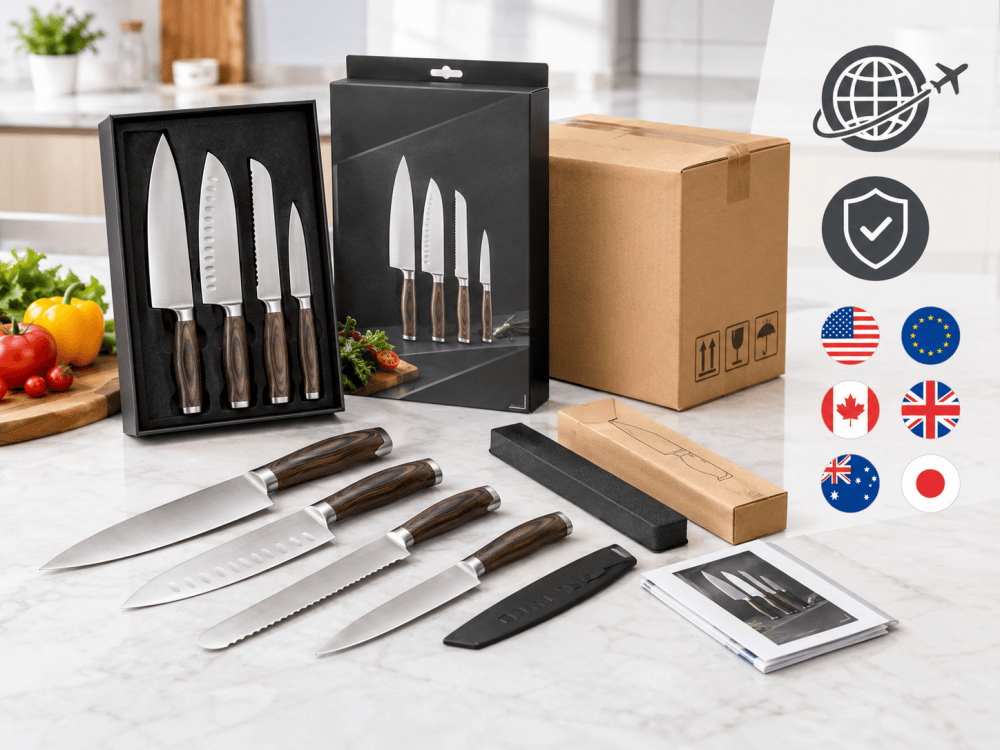
Quick Answer: What Documents Are Commonly Needed?
For kitchen knife exports, start with these document groups:
- Food-contact compliance: material declarations, applicable food-contact compliance statements, supporting test reports, and a supplier's letter of guarantee where appropriate.
- Chemical compliance: material composition information, applicable restricted-substance declarations, and relevant laboratory reports.
- Packaging compliance: packaging material specifications, declarations or test evidence where applicable, and information needed for packaging waste or producer-responsibility obligations.
- Product and shipment records: product specifications, batch traceability, quality inspection records, commercial invoice, packing list, and origin information as required for the shipment.
Not every document is mandatory for every knife. For example, a plastic handle may require different evidence from a wooden handle, while a knife packaged in a printed carton may raise different packaging questions from a knife supplied in a plastic blister pack.
The most reliable approach is to build a compliance file for each product model and destination market, then confirm the final document list with the importer or a qualified compliance specialist.
1. Understand the Main Types of Compliance Documents
1.1 Declaration of Compliance or Material Compliance Statement
A Declaration of Compliance (DoC) or similar supplier statement identifies the applicable requirements and explains how a material or product is intended to comply. Its legal status depends on the material and market.
In the EU, specific rules for plastic food-contact materials require a Declaration of Compliance in applicable cases. A general material statement may also be useful for other knife components, but it should not be confused with a legally required declaration under a specific regulation.
1.2 Laboratory Test Report
A laboratory test report records the results of specific tests on a defined sample. Depending on the material and risk assessment, testing may address migration, restricted chemicals, coating composition, or other relevant properties.
A test report does not automatically prove compliance with every law in a destination market. Check the tested material, model, sample identification, test method, limits, date, and laboratory details before relying on it.
1.3 Supplier Declaration or Letter of Guarantee
A supplier declaration records the manufacturer's or supplier's position on specified requirements. For US food-contact compliance, FDA describes the use of a letter of guaranty for a product's intended food-contact use. Such a letter supports a compliance file but does not replace the underlying legal assessment.
1.4 Technical File and Traceability Records
A technical file is a collection of supporting evidence rather than a single universal certificate. It may include drawings, bill of materials, supplier declarations, test reports, risk assessments, production specifications, inspection records, and batch information.
Keeping these records together helps importers respond to customer audits, regulatory inquiries, product complaints, or changes in material specifications.
2. Food-Contact Compliance Documents for Kitchen Knives
A kitchen knife is intended to cut food, but the food-contact assessment should focus on the materials and surfaces that may contact food during normal or reasonably foreseeable use.
Depending on the design, these may include the blade, surface coating, handle materials, bonded components, and any parts that could transfer substances to food. Packaging that is intended to contact food directly should be assessed separately from retail packaging that only protects the knife.
Common Documents to Request
- Material specification: identifies the blade steel, handle material, coating, and other relevant components.
- Food-contact compliance statement: explains the basis for compliance with applicable requirements for the intended use.
- Migration or chemical test reports: provided where the material, coating, applicable rules, risk assessment, or customer requirements call for testing.
- Supplier letter of guarantee: may document the supplier's assurance for the specified product and intended food-contact use.
- Traceability records: link the finished knife to its materials, supplier information, and production batch.
These are common evidence categories, not a universal mandatory checklist. A test should be selected for the actual material and relevant regulatory requirement, rather than ordered simply because a buyer has heard of a particular test.
Do Stainless Steel Kitchen Knives Always Need a Migration Test?
Not necessarily. The appropriate evidence depends on the applicable law, the alloy and surface condition, intended use, and the importer's requirements. A material specification and supporting safety assessment may be relevant, while particular coatings, plastics, or other components may require additional evidence.
Do not assume that a test performed on one steel grade or coating automatically covers a different material, supplier, or product design.
3. United States: Food-Contact, Chemical and Packaging Documents
3.1 Food-Contact Compliance
In the United States, food-contact substances must have an appropriate regulatory basis for their intended use. Depending on the substance and application, that basis may include an applicable provision of Title 21 of the Code of Federal Regulations, an effective Food Contact Substance Notification (FCN), a relevant exemption, or another recognized legal basis.
The FDA explains that the regulatory status of a food-contact article depends on its individual components and their intended conditions of use. Therefore, a generic statement saying “FDA approved” is not enough to establish compliance for every part of a finished kitchen knife.
Documents to discuss with the supplier or importer:
- Material specifications for blade, handle, coating, and relevant food-contact components.
- A supplier letter of guarantee or food-contact compliance statement identifying the product and intended use.
- Supporting evidence for the applicable regulatory basis of substances that may migrate to food.
- Relevant test reports when justified by the material, intended use, or customer requirements.
For the official explanation, see the FDA guidance on determining the regulatory status of food-contact materials and its information on a letter of guaranty for intended food-contact use.
3.2 Chemical Compliance
For chemical compliance, US requirements may depend on the product materials, intended use, chemical substances involved, and the states where the product will be sold.
- Material composition information: useful for identifying substances present in blade finishes, coatings, plastics, adhesives, or other components.
- Restricted-substance declarations: may be requested by a retailer or brand and should identify the specific restrictions being addressed.
- Relevant laboratory reports: may be needed to substantiate a claim or meet a buyer's specification.
- California Proposition 65 assessment: may be relevant if a listed chemical could create an exposure requiring a warning or another compliance response. It is not a blanket certification required for every knife.
A broad “chemical compliant” statement is difficult to evaluate without knowing which substances, product components, and legal requirements it covers. Ask the buyer to specify the restricted-substance list and test scope.
3.3 Packaging Compliance
Packaging requirements can vary by state and by the role of the business placing packaged goods on the market. There is no single federal packaging certificate that automatically satisfies every US state requirement.
Depending on the packaging and sales arrangements, buyers may request:
- Packaging material specifications for cartons, paper inserts, plastic trays, sleeves, and bags.
- Declarations or test evidence addressing specific packaging substance restrictions, if applicable.
- Packaging component weights and material types to support recycling or producer-responsibility reporting.
- Packaging design and labeling information required by the retailer or applicable state law.
Extended producer responsibility (EPR) and other packaging obligations vary by jurisdiction. The importer, brand owner, or another party may have reporting or fee obligations depending on the applicable law and business model.
4. European Union: Food-Contact, REACH and Packaging Documents
4.1 Food-Contact Framework: Regulation (EC) No 1935/2004
Regulation (EC) No 1935/2004 provides the EU framework for materials and articles intended to come into contact with food. Materials must not transfer constituents to food at levels that could endanger human health or cause unacceptable changes in food composition, taste, or odour.
Commission Regulation (EC) No 2023/2006 sets out Good Manufacturing Practice (GMP) requirements for food-contact materials. These requirements make documented controls over production, quality, and suitable starting materials important parts of a compliance system.
4.2 When Is a Declaration of Compliance Required?
A Declaration of Compliance is specifically required for certain food-contact materials under the relevant material-specific rules. For example, EU Regulation (EU) No 10/2011 contains requirements for plastic food-contact materials, including declarations and supporting documentation.
Do not assume that every stainless steel knife, regardless of design, must have the same type of DoC under the plastics regulation. For a finished knife with a plastic handle or coating, assess which components fall within the specific rules and what documentation is required for the product and supply chain.
Common evidence to prepare or request includes:
- Material specifications and supplier information.
- An applicable Declaration of Compliance for regulated materials, such as relevant plastic food-contact components.
- Supporting migration test reports and technical documentation when required or appropriate.
- GMP-related quality records and traceability information.
- Food-contact labeling or use instructions where required by the applicable rules.
See the European Commission's food-contact materials legislation overview for the framework and material-specific rules.
4.3 REACH and SVHC Information
EU REACH obligations may apply to substances in products and articles, including relevant components of kitchen knives. One key area buyers often check is whether an article contains a Substance of Very High Concern (SVHC) on the Candidate List above 0.1% by weight.
Where the relevant conditions are met, suppliers may have obligations to communicate information to customers and consumers. EU producers or importers may also have notification obligations in qualifying circumstances, and SCIP information requirements may apply to articles containing Candidate List SVHCs above the applicable threshold.
Documents or data commonly requested by buyers include:
- A REACH/SVHC declaration with a clear scope and date.
- Material composition information or supplier declarations to support the assessment.
- Laboratory reports where appropriate for the materials and risks being evaluated.
- Information needed for SCIP assessment or notification, where applicable.
A REACH declaration is not the same as a laboratory report, and a statement that a product is “REACH compliant” should identify the relevant scope. See the European Chemicals Agency's overview of Candidate List obligations and its SCIP database guidance.
4.4 Packaging and Packaging Waste Regulation
EU packaging requirements are not limited to whether a carton or plastic tray is safe. They can also concern packaging design, material composition, recyclability, labeling, and producer responsibility.
Regulation (EU) 2025/40 on packaging and packaging waste (PPWR) applies from 12 August 2026, with specific requirements and transition periods that need to be checked against the relevant provision and packaging type.
For kitchen knife exporters, useful information to prepare includes:
- A packaging bill of materials identifying each packaging component.
- Packaging material weights and composition, including paper, cardboard, plastics, and other materials.
- Supplier declarations or test evidence where specific chemical or material restrictions apply.
- Data that helps the responsible economic operator assess packaging labeling, recyclability, and producer-responsibility obligations.
These records support compliance assessment but do not, by themselves, guarantee that all PPWR obligations have been met. Responsibilities and implementation dates may differ according to the operator's role and the specific provision.
Check the official text of Regulation (EU) 2025/40 and the European Commission's 2026 PPWR guidance.
5. United Kingdom: Food-Contact, Chemical and Packaging Documents
The UK should not automatically be treated as one identical regulatory destination for every requirement. Great Britain (England, Scotland, and Wales) and Northern Ireland can have different applicable rules, particularly where EU law continues to apply in Northern Ireland under the Windsor Framework.
5.1 Food-Contact Compliance
In Great Britain, food-contact requirements operate under the applicable domestic framework and assimilated legislation. Northern Ireland follows the relevant EU food-contact framework in areas covered by the Windsor Framework.
Depending on the materials and applicable rules, a buyer may request:
- Material specifications for blade, handle, coatings, and food-contact components.
- A relevant compliance statement or Declaration of Compliance for materials subject to specific requirements.
- Supporting migration or chemical test reports when required by the applicable rules or customer specification.
- GMP and traceability information supporting the food-contact safety assessment.
Requirements should be checked for the actual destination: Great Britain or Northern Ireland. The UK government's food-contact materials regulations overview is a useful starting point.
5.2 UK REACH and Chemical Information
UK REACH applies in Great Britain, with a separate EU REACH framework relevant to Northern Ireland under the applicable arrangements. Buyers should confirm which regime applies to the goods and supply chain.
Under UK REACH, suppliers of articles containing a Candidate List SVHC above 0.1% by weight may have obligations to provide sufficient information for safe use. Notification obligations may also apply in qualifying circumstances.
Useful evidence may include a scoped SVHC declaration, material information, supporting test reports, and information needed to assess relevant communication or notification obligations. A general chemical declaration should not be assumed to cover every substance restriction or every market.
See the UK Health and Safety Executive's UK REACH guidance on substances of very high concern.
5.3 Packaging and Extended Producer Responsibility
UK packaging obligations may include packaging waste rules, producer-responsibility requirements, and reporting duties. Whether a business must register, report data, or pay fees depends on the applicable rules, business size, activity, and role in the supply chain.
Importers and brand owners may need packaging data from the manufacturer, including material type, component weight, and quantities placed on the market. This information helps the responsible party assess its reporting obligations.
For the current UK requirements, consult the official UK packaging EPR guidance. Do not assume that a packaging declaration supplied by a factory automatically completes the importer's legal duties.
6. US vs EU vs UK: Document Comparison Table
The table below is a practical sourcing guide. It separates common evidence from requirements that depend on materials, legal conditions, or the responsible business operator.
| Document or Record | United States | European Union | United Kingdom |
|---|---|---|---|
| Material specification | Commonly requested to support material and compliance assessments | Useful for assessing food-contact and chemical requirements | Useful for assessing food-contact and chemical requirements |
| Food-contact compliance statement | Useful evidence; must reflect the applicable FDA regulatory basis | Relevant to the applicable framework and material-specific rules | Depends on the applicable GB or NI rules and materials |
| Declaration of Compliance for plastics | Use the appropriate US compliance documentation; an EU DoC alone does not establish US compliance | Required under applicable EU plastics rules | Assess separately for GB and NI under the applicable rules |
| Migration or chemical test report | Depends on the substance, use, risk, and buyer requirements | Depends on the material, applicable rule, and supporting assessment | Depends on the material, applicable rule, and supporting assessment |
| REACH/SVHC declaration | Not an all-purpose federal requirement; other chemical rules may apply | Relevant to applicable REACH duties and buyer requirements | UK REACH applies in GB; assess NI separately |
| SCIP information | Not an EU SCIP obligation | May be required for qualifying articles containing SVHCs above 0.1% w/w | Not an equivalent UK-wide SCIP filing requirement |
| Packaging material data | Commonly useful for buyer specifications and applicable state obligations | Important for assessing PPWR and producer-responsibility duties | Important for assessing applicable packaging reporting and EPR duties |
| Quality and traceability records | Commonly requested by importers and retailers | Important for applicable compliance and traceability duties | Important for applicable compliance and traceability duties |
This table is not a legal determination for an individual product. The applicable requirements must be confirmed for the exact knife model, materials, destination, and supply-chain roles.
7. Packaging Documents: What Should Exporters Prepare?
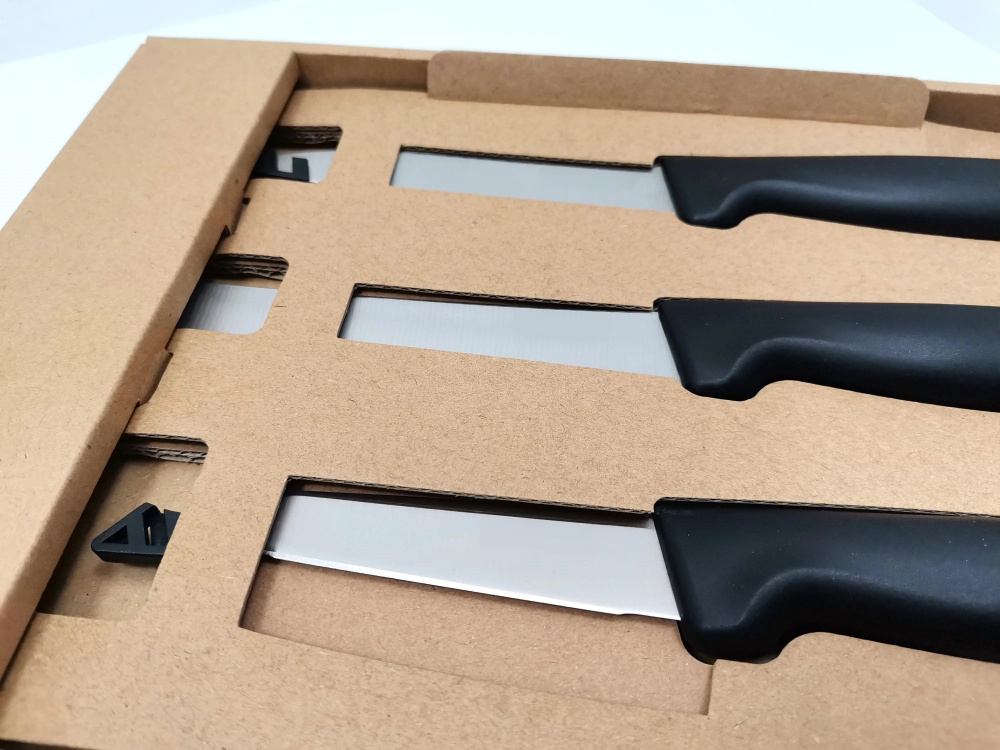
Retail packaging for kitchen knives can include a paperboard box, printed sleeve, plastic tray, blister pack, protective film, paper insert, barcode label, and outer shipping carton. Each component may have different material and reporting implications.
Recommended Packaging Information File
- Packaging bill of materials: list every component and identify its material type.
- Component weights: record the weight of each packaging material per product or packaging unit.
- Material supplier declarations: collect relevant specifications and chemical information for packaging materials.
- Applicable test reports: obtain reports where required by law, the material, or the buyer's written specification.
- Packaging artwork: retain approved artwork, product information, warnings, and recycling-related statements where applicable.
- Market-specific packaging data: prepare information requested by the importer for EPR reporting or other obligations.
Packaging compliance should be considered separately from the knife's food-contact compliance. A food-contact test report for a blade does not automatically establish compliance of a plastic tray, printed carton, or adhesive.
8. Product Safety and Shipping Documents Are a Separate Category
Food-contact and chemical documents do not replace ordinary product-safety, customs, or transport documentation. Depending on the market and transaction, importers may also need:
- Product drawings, dimensions, material specifications, and model identification.
- Risk assessment and product-safety records where required by the applicable product-safety framework.
- Batch or lot traceability and quality inspection records.
- Commercial invoice, packing list, transport documents, and origin information as applicable.
- Packaging artwork and required consumer information or warnings.
Kitchen knives should not automatically be assumed to require a CE mark. CE marking applies to product categories covered by specific EU harmonisation legislation; it is not a universal mark for ordinary kitchen knives.
Likewise, an ISO certificate, a laboratory accreditation certificate, or a generic “FDA certificate” does not automatically prove that a particular finished knife complies with all destination-market requirements.
9. A Practical Compliance Checklist for Kitchen Knife Importers
Before confirming a bulk order, importers and private-label brands can use the following checklist to identify missing evidence and reduce avoidable delays.
Product and Materials
- Confirm the exact product model and intended use.
- Identify blade steel, handle material, coatings, adhesives, and other relevant components.
- Record the material supplier and specification revision for each component.
Food-Contact Evidence
- Identify the applicable food-contact requirements for the destination.
- Request a relevant compliance statement or Declaration of Compliance where applicable.
- Confirm whether migration or other laboratory testing is required for the specific materials.
- Check that test reports identify the tested material or model and relevant conditions.
Chemical Compliance
- Define the relevant restricted-substance requirements instead of requesting an unspecified “chemical test.”
- Request a scoped REACH/SVHC declaration for EU or applicable UK supply chains.
- Assess other applicable market-specific restrictions, including relevant US state requirements.
- Determine whether additional notification, communication, or reporting obligations apply.
Packaging and Records
- List every packaging component and its material weight.
- Collect relevant packaging specifications and supporting declarations.
- Confirm who is responsible for packaging reporting and producer-responsibility obligations.
- Retain final artwork, inspection records, and batch traceability information.
Before Shipment
- Confirm the destination country and, for the UK, whether the goods are intended for Great Britain or Northern Ireland.
- Ensure documents correspond to the actual production model and materials being shipped.
- Check that the importer has reviewed the document set against its legal obligations and customer requirements.
- Agree on the process for approving material changes or replacing a component during production.
10. Frequently Asked Questions
Do kitchen knives need an FDA certificate to be imported into the United States?
There is no single FDA certificate that automatically certifies every kitchen knife. Food-contact components must have an appropriate legal basis for their intended use. Buyers may request material specifications, a supplier letter of guarantee, compliance statements, or supporting test reports, depending on the product.
Do all kitchen knives need a food-contact migration test?
No universal migration test requirement applies to every kitchen knife in every market. Testing depends on the materials, applicable regulations, intended use, risk assessment, and customer specifications. The correct test should be selected for the actual material and regulatory question.
Is an EU Declaration of Compliance mandatory for every kitchen knife?
No. A Declaration of Compliance is required for certain food-contact materials under specific rules, such as applicable EU plastics legislation. The documentation needed for a finished knife depends on its components and the rules that apply to those materials.
Is a REACH certificate required for kitchen knives exported to Europe?
REACH does not operate as one universal product certificate for every knife. Depending on the product and supply chain, relevant obligations may include SVHC communication, notification in qualifying circumstances, and SCIP information requirements. Buyers commonly request a scoped REACH/SVHC declaration and supporting material information.
What is the difference between a REACH declaration and a test report?
A REACH declaration is a supplier's statement about specified regulatory requirements and its stated scope. A test report records the results of defined tests on a sample. A declaration may rely on supplier data, material information, or testing, but it should not be presented as a laboratory result unless testing was actually performed.
Does a kitchen knife need CE marking for the EU market?
Ordinary kitchen knives do not automatically require CE marking. CE marking is used for product categories covered by specific EU harmonisation legislation. Importers should assess the product's actual classification and applicable product-safety requirements rather than assume a CE mark is needed.
What packaging documents should a kitchen knife exporter provide?
Commonly useful records include a packaging bill of materials, component weights, material specifications, relevant supplier declarations, and any required test evidence. Importers may use this information to assess applicable packaging rules and producer-responsibility reporting. The exact obligations depend on the destination and the role of each business.
Are the UK and EU compliance requirements the same?
Not always. Great Britain and Northern Ireland can follow different rules in certain areas. EU food-contact requirements continue to apply in Northern Ireland in relevant areas under the Windsor Framework, while Great Britain operates under its applicable domestic and assimilated legislation. Check the destination before finalising the document list.
Can one set of compliance documents cover the US, EU, and UK?
Some supporting records, such as material specifications, supplier declarations, and quality records, can be reused across markets. However, legal requirements, test methods, declaration formats, chemical restrictions, and packaging obligations may differ. A shared technical file can be useful, but it should include a market-specific compliance assessment.
Conclusion: Build a Product-Specific Compliance File Before Export
Kitchen knife export compliance is not a matter of collecting the largest possible number of certificates. It is about identifying the materials in the product, understanding the rules that apply to the destination, and keeping reliable evidence that supports the compliance assessment.
For the United States, focus on the applicable food-contact regulatory basis, relevant chemical restrictions, and market-specific packaging obligations. For the European Union, assess the food-contact framework, material-specific requirements, REACH/SVHC obligations, and the PPWR. For the United Kingdom, confirm whether the destination is Great Britain or Northern Ireland and assess the applicable food-contact, chemical, and packaging rules.
For importers and private-label brands, the best starting point is a product-specific document request that identifies the exact knife model, materials, intended use, packaging, and target market.
Looking for a Kitchen Knife Manufacturing Partner?
FASAKA is a brand under DKS Enterprises Co., Ltd., a manufacturer and supplier of hardware knives and scissors, BBQ tools, and kitchenware based in Yangjiang, Guangdong, China.
When sourcing kitchen knives for wholesale or private-label projects, confirm material specifications, packaging requirements, product documentation, and quality-control expectations before production.


