



5Cr15MoV vs 3Cr13 vs 420J2: Which Steel Is Better for Kitchen Knives?
Choosing the right stainless steel is an important decision in kitchen knife manufacturing. Steel grade can influence corrosion resistance, hardness, edge retention, sharpening requirements, production cost, and the overall positioning of a knife in the market.
Among the stainless steels used in economical and mid-range cutting tools, 5Cr15MoV, 3Cr13, and 420J2 are three grades buyers may encounter when sourcing kitchen knives and scissors. However, they are not interchangeable, and no single grade is automatically the best choice for every product.
For importers, wholesalers, distributors, and private-label brands, understanding these differences helps align knife specifications with target retail prices, customer expectations, and intended applications.
- 5Cr15MoV: A practical option for kitchen knives when buyers want a balance of corrosion resistance, edge performance, ease of maintenance, and cost.
- 3Cr13: A cost-conscious option for entry-level knives and general-purpose cutting tools.
- 420J2: A corrosion-resistant stainless steel commonly considered for economical knives and scissors where ease of maintenance is important.
Actual performance depends on the steel specification, heat treatment, hardness, blade geometry, finishing, and quality control. Always compare the finished product rather than selecting a knife by steel grade alone.
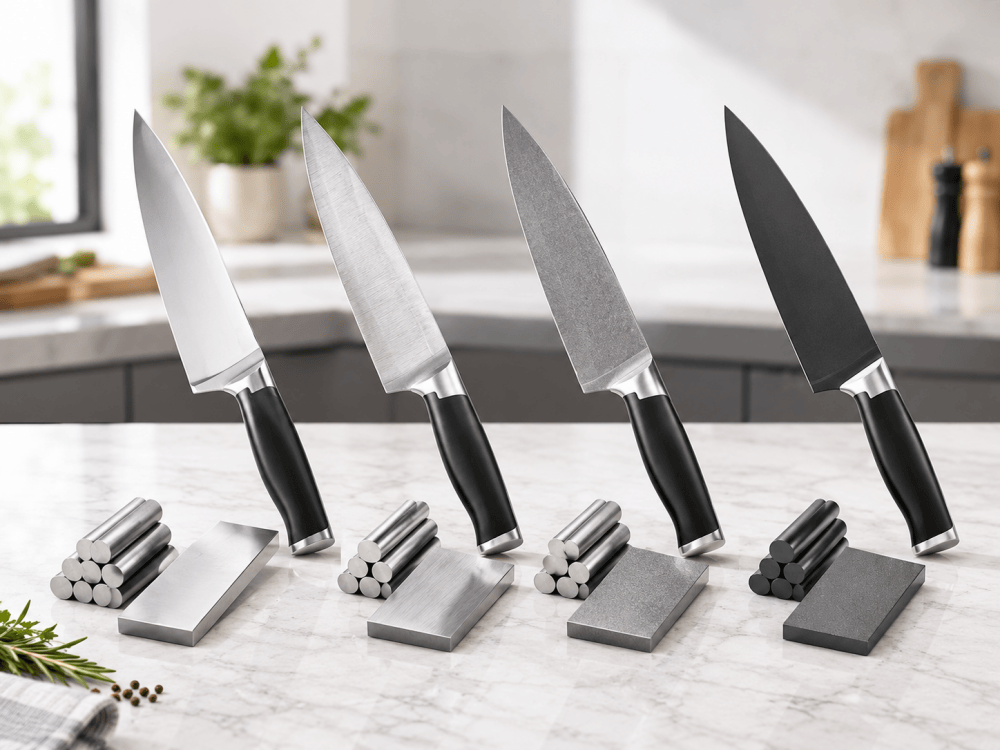
1. What Is 5Cr15MoV Steel?
5Cr15MoV stainless steel is used in a range of economical and mid-range knives. Its alloy composition includes chromium, molybdenum, and vanadium, although the exact composition depends on the applicable material specification.
When properly heat-treated and finished, 5Cr15MoV can offer a useful combination of corrosion resistance, sharpening convenience, and everyday cutting performance. It is often considered for kitchen knives intended for regular household use and for product ranges where buyers want a balance between performance and manufacturing cost.
Key characteristics of 5Cr15MoV
- Balanced performance: Can provide a practical combination of edge performance and corrosion resistance when properly processed.
- Convenient maintenance: Generally practical for everyday users who need to maintain and resharpen their knives.
- Versatile applications: Can be considered for chef knives, utility knives, paring knives, and kitchen knife sets, depending on the final product specification.
- Mid-range positioning: May suit product lines positioned above basic entry-level offerings without moving into higher-cost steel categories.
What should buyers consider?
The designation 5Cr15MoV does not guarantee a specific hardness or cutting performance. Heat treatment, blade thickness, edge angle, grinding quality, and finishing all affect the final result.
When evaluating a supplier, ask for the declared steel specification and the relevant product details. If edge retention is important to your market, assess performance on the finished knife rather than relying on the grade name alone.
Explore FASAKA's kitchen knife products to review options for different product ranges.
2. What Is 3Cr13 Steel?
3Cr13 is a cost-conscious martensitic stainless steel used in various cutting tools, including economical kitchen knives. It is often considered for products where affordability, straightforward maintenance, and general-purpose functionality are important.
For mass-market knife sets, 3Cr13 may be an option when the target retail price is a major purchasing consideration. However, the performance of a finished 3Cr13 knife still depends on its processing and design.
Key characteristics of 3Cr13
- Cost-conscious selection: Can suit entry-level and value-oriented product lines.
- Practical sharpening: Many knives made from this grade can be resharpened with ordinary knife-sharpening tools.
- Stainless steel characteristics: Offers corrosion resistance, but is not immune to rust or staining.
- General-purpose applications: May be considered for basic kitchen knives and other everyday cutting tools.
What are its limitations?
Buyers should not assume that every 3Cr13 knife has the same hardness, toughness, or edge retention. Different heat-treatment conditions and blade designs can produce different results.
For demanding professional applications, compare the finished knife's cutting performance, edge stability, and durability with the alternatives under realistic working conditions. A lower purchase price may be attractive, but the product must still meet the expectations of its intended users.
3. What Is 420J2 Stainless Steel?
420J2 stainless steel is a low-carbon martensitic stainless steel commonly associated with applications where corrosion resistance and ease of processing are important considerations. It is used in a range of economical cutting products, including certain knives and scissors.
For kitchenware buyers, 420J2 may be worth evaluating when the product needs to balance stainless steel characteristics, ease of maintenance, appearance, and cost. Its suitability depends on the knife's intended use and the performance requirements of the target market.
Key characteristics of 420J2
- Corrosion resistance: Can offer useful resistance to rust and staining under appropriate conditions.
- Processing and finishing: Can be suitable for products requiring stainless steel finishing and polishing.
- Maintenance: Practical for users who want a stainless steel cutting tool that can be cleaned and maintained routinely.
- Cost-conscious applications: May be considered for selected economical knives and scissors.
Does 420J2 always offer better rust resistance?
Corrosion performance is influenced by more than the steel grade. Surface finish, heat treatment, exposure to salt or acidic foods, cleaning practices, and moisture during storage can all affect the result.
Although 420J2 is known for its corrosion-resistant characteristics, buyers should avoid assuming that every 420J2 product will outperform every 3Cr13 or 5Cr15MoV product in all environments. Product-level testing and appropriate care instructions remain important.
4. 5Cr15MoV vs 3Cr13 vs 420J2: Steel Comparison
The following table provides a general purchasing overview. It is intended as an initial screening tool, not a substitute for verified material specifications or finished-product testing.
| Comparison Factor | 5Cr15MoV | 3Cr13 | 420J2 |
|---|---|---|---|
| General positioning | Economical to mid-range kitchen knives | Entry-level and value-oriented cutting tools | Economical stainless cutting tools |
| Corrosion resistance | Generally good when properly processed and maintained | Offers corrosion resistance; maintenance is still necessary | Known for corrosion-resistant characteristics |
| Edge retention | Depends on heat treatment, hardness, and edge geometry | Depends on heat treatment, hardness, and edge geometry | Depends on heat treatment, hardness, and edge geometry |
| Sharpening | Generally practical for routine resharpening | Generally practical for routine resharpening | Generally practical for routine resharpening |
| Typical buyer consideration | Balance of performance and cost | Affordable price positioning | Corrosion resistance and processing requirements |
| Potential applications | Chef knives, utility knives, and kitchen knife sets | Entry-level knives and general-purpose cutting tools | Selected kitchen knives, scissors, and economical cutting tools |
| What to verify | Steel specification, heat treatment, hardness, and cutting tests | Steel specification, edge performance, durability, and finish | Steel specification, corrosion performance, hardness, and intended use |
Important: The three grades should not be assigned a universal ranking for hardness, toughness, or edge retention without comparable test data. Results can vary with the precise material standard, manufacturing process, and finished blade design.
Which steel offers the best balance?
For buyers seeking a general-purpose kitchen knife, 5Cr15MoV is a reasonable grade to evaluate for balanced everyday performance. For price-sensitive ranges, 3Cr13 may be worth considering. Where corrosion resistance and ease of processing are priorities, 420J2 may be another candidate.
The best choice is the one that meets the target product's requirements at an acceptable total cost. It should be selected after reviewing the full specification, not solely from a short steel-grade comparison.
5. How Hardness and Heat Treatment Affect Knife Performance
Steel grade is only one part of knife performance. Two knives made from the same nominal steel can behave differently if their heat treatment, hardness, blade geometry, or manufacturing quality differs.
Hardness
Hardness is commonly measured using the Rockwell C scale (HRC) for suitable knife blades. It can influence wear resistance and the way an edge behaves in use, but higher hardness is not automatically better in every application.
A suitable hardness target depends on the steel, blade geometry, intended cutting tasks, and required balance between edge retention and resistance to damage. Buyers should request the manufacturer's specified hardness range rather than assume one universal HRC value for each steel grade.
Heat treatment
Heat treatment affects the microstructure and properties of a blade. Inadequate or inconsistent processing may reduce the performance expected from a given steel, while appropriate processing helps the material meet its intended application.
For B2B sourcing, consistency across production batches is particularly important. A sample may perform well, but buyers should also understand how the supplier maintains specifications during mass production.
Blade geometry and sharpening
Blade thickness, edge angle, grind, and finishing all influence cutting feel and edge durability. A well-designed blade made from a cost-effective steel may be more suitable for a particular task than a poorly designed blade made from a more expensive steel.
For a meaningful comparison, evaluate the actual knives using consistent cutting tests and clearly defined acceptance criteria.
6. Which Knife Steel Is Better for Your Target Market?
For importers, distributors, retailers, and private-label brands, steel selection should match the product's intended use, price point, and customer expectations. The following matrix can help narrow the options for further evaluation.
| Target Market or Product Goal | Steel to Evaluate First | Key Checks Before Ordering |
|---|---|---|
| Entry-level retail knife sets | 3Cr13 or other suitable cost-conscious options | Cutting performance, finish, consistency, and target price |
| General-purpose household knives | 5Cr15MoV as one candidate | Edge performance, corrosion resistance, sharpening, and handle design |
| Products emphasizing corrosion resistance | 420J2 or other appropriate stainless grades | Actual corrosion performance, intended exposure, and care instructions |
| Professional or high-frequency use | Compare suitable grades and finished products | Edge stability, durability, maintenance, user feedback, and service requirements |
| Private-label product development | Choose based on the complete product specification | Material documentation, sample evaluation, production consistency, and packaging |
These are starting points rather than fixed rules. For example, a knife intended for a humid market does not automatically require 420J2. Cleaning habits, food exposure, storage conditions, blade finish, and the target price should all be considered together.
Questions to ask before selecting a steel grade
- What foods and cutting tasks will the knife be used for?
- What price range and performance expectations define the target market?
- What steel specification and hardness range does the manufacturer offer?
- How are corrosion resistance and cutting performance evaluated?
- Are replacement, sharpening, and maintenance expectations appropriate for the target customer?
- Can the supplier maintain consistent specifications across repeat orders?
7. How to Compare Kitchen Knife Suppliers
Choosing the right steel is only one step in developing a reliable kitchen knife product. Buyers should also evaluate the manufacturer's ability to provide consistent specifications, clear product information, and appropriate quality checks.
Verify material specifications
Ask the supplier to identify the steel grade and applicable specification for the proposed knife. Where relevant, request supporting material documentation and confirm that the information corresponds to the finished product being quoted.
Evaluate samples before bulk production
Inspect the blade finish, edge consistency, handle assembly, overall balance, and ease of cleaning. Conduct appropriate cutting and corrosion evaluations based on the intended use and agreed acceptance criteria.
Review production consistency
For repeat orders, make sure the approved sample, product drawings, material specifications, and inspection requirements are documented. This helps reduce the risk of differences between the sample and mass-produced goods.
Consider the complete knife design
Steel grade should be evaluated alongside handle material, handle construction, blade shape, packaging, and storage options. To learn how handle selection can affect product design and maintenance, read our guide to Best Kitchen Knife Handle Materials.
8. OEM & ODM Kitchen Knife Manufacturing Solutions
For global importers, wholesalers, distributors, and private-label brands, selecting a kitchen knife involves more than choosing a steel grade. Product positioning, handle design, blade specifications, packaging, and quality requirements all contribute to the final product.
When developing a kitchen knife project, buyers should discuss the following details with their manufacturing partner:
- Product selection: Identify suitable knife styles and set configurations for the intended market.
- Material specifications: Confirm the proposed steel grade and other relevant product details.
- Branding: Discuss available logo and private-label options.
- Packaging: Evaluate packaging formats appropriate for retail, wholesale, or distribution.
- Quality requirements: Agree on sample approval, inspection criteria, and documentation before mass production.
- Compliance documentation: Confirm the requirements for the destination market and the specific product. Any FDA, LFGB, or other compliance support should be verified for the relevant materials and product configuration rather than assumed to apply to every item.
FASAKA is a brand under DKS Enterprises Co., Ltd., a manufacturer and supplier based in Yangjiang, Guangdong, China, specializing in hardware knives and scissors, BBQ tools, and kitchenware.
Explore our kitchen knife collection and OEM & ODM kitchenware manufacturing solutions to discuss product options for your business.
9. Frequently Asked Questions
Is 5Cr15MoV better than 3Cr13 for kitchen knives?
5Cr15MoV is a useful candidate when buyers want a balance of everyday cutting performance, corrosion resistance, and cost. However, it is not automatically superior in every finished product. Heat treatment, hardness, blade geometry, and manufacturing quality must also be considered.
Is 420J2 good for kitchen knives?
420J2 can be suitable for selected economical kitchen knives and other cutting tools. Its corrosion-resistant characteristics and processing properties may be useful, but the final knife should still be evaluated for its intended cutting tasks, edge performance, and maintenance requirements.
Which steel is the most rust-resistant: 5Cr15MoV, 3Cr13, or 420J2?
420J2 is commonly associated with good corrosion resistance, but a universal ranking cannot be established from the grade names alone. Exact composition, surface finish, heat treatment, food exposure, cleaning, and storage all affect corrosion performance. Comparable testing is the best way to assess a specific product.
Which steel keeps its edge the longest?
Edge retention depends on steel composition, heat treatment, hardness, edge geometry, and the cutting conditions. Buyers should compare finished knives under consistent test conditions instead of assuming that one of these grades will always hold an edge longer.
Is a higher HRC rating always better for a kitchen knife?
No. Hardness is one factor in knife performance. The appropriate hardness depends on the steel and the intended use, and must be balanced with edge stability, toughness, blade geometry, and maintenance requirements.
Can these steel grades be used for OEM kitchen knife projects?
They may be considered for suitable product designs, subject to the manufacturer's material options and the project's requirements. Buyers should confirm the exact steel specification, finished-product performance, production consistency, and any destination-market requirements before placing a bulk order.
What should I request from a kitchen knife manufacturer before ordering?
Request the product specification, steel grade, relevant hardness information, sample evaluation details, available branding and packaging options, quality-control requirements, and applicable compliance documentation. Make sure all agreed specifications are confirmed before mass production.
Looking for a Kitchen Knife Manufacturing Partner?
Choosing the right steel is an important step in developing a kitchen knife range. The best solution also depends on blade design, handle materials, target pricing, quality requirements, and the needs of your customers.
FASAKA supports B2B buyers exploring kitchen knife products and OEM/ODM kitchenware options. Share your target market and product requirements to discuss suitable solutions.
Explore Kitchen Knives | OEM & ODM Services
Contact Us