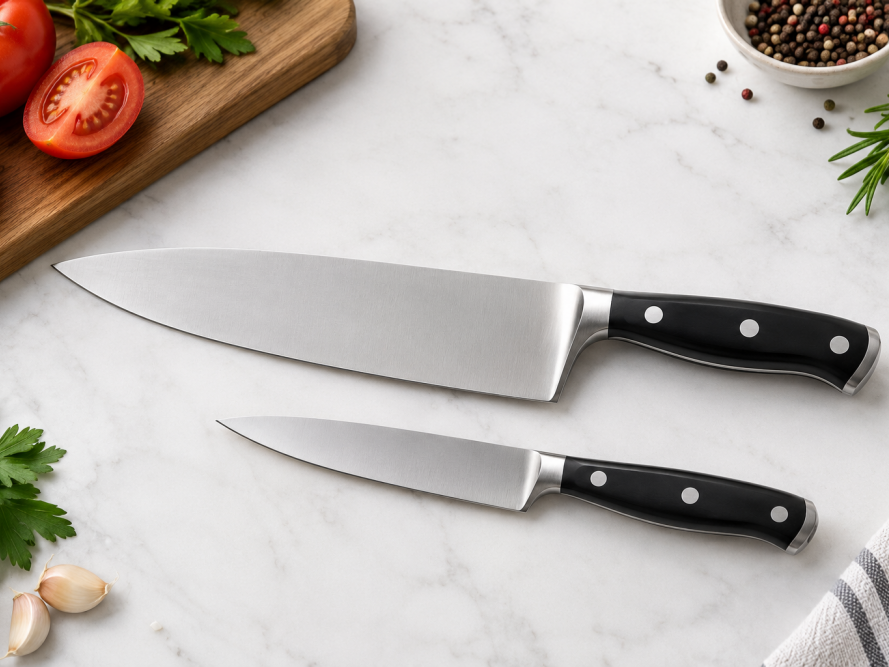



Full Tang vs Partial Tang vs Hidden Tang: Which Kitchen Knife Construction Is Best?
Full Tang vs Partial Tang vs Hidden Tang: Which Kitchen Knife Construction Is Best?
Which handle construction is best for home kitchens, restaurants, and high-volume commercial kitchens: full tang, partial tang, or hidden tang? The answer depends on how the knife will be used, how the handle is secured, and what matters most for the application, including durability, weight, balance, maintenance, and cost.
Full tang construction is often a practical choice for knives exposed to frequent use and demanding handling. Partial tang designs can work well when the construction is properly engineered for the intended workload. Hidden tang designs can offer a lighter, more streamlined handle and may be suitable for professional kitchens when the tang, handle fit, and fastening method are designed and manufactured correctly.
However, tang type alone does not determine service life. Blade steel, tang dimensions, handle material, fasteners, adhesive quality, moisture exposure, and manufacturing consistency all affect long-term performance.
- Home kitchens: Choose the construction that offers comfortable balance, reliable handle attachment, easy cleaning, and suitable value for everyday cooking.
- Restaurants: Consider full tang or a well-engineered hidden tang with secure handle construction. Prioritize repeated-use durability, hygiene, and maintenance.
- High-volume commercial kitchens: Give priority to verified handle retention, robust construction, cleanable handle joints, and consistent quality-control results. A well-made full tang is a strong starting point, but it is not automatically superior to every alternative.
- Wholesale and private-label buyers: Specify the tang design, attachment method, materials, inspection criteria, and intended use before approving samples or placing bulk orders.
1. What Is a Knife Tang?
The tang is the portion of the blade steel that extends into the handle. It connects the cutting blade to the part of the knife held by the user. Tang construction affects how loads are transferred from the blade to the handle, how the knife can be balanced, and how the handle is assembled.
In a full tang design, the steel generally extends along the full length and much of the width of the handle. In a partial tang design, the steel stops short of the handle's full length or width. In a hidden tang design, the tang is enclosed within the handle and is not normally visible from the outside.
These terms describe different aspects of construction and are not always mutually exclusive. A hidden tang can extend through much of the handle, while a partial tang can also be hidden. For an accurate comparison, buyers should ask for a construction drawing or product specification rather than rely on the name alone.
2. Full Tang, Partial Tang, and Hidden Tang: Structural Differences
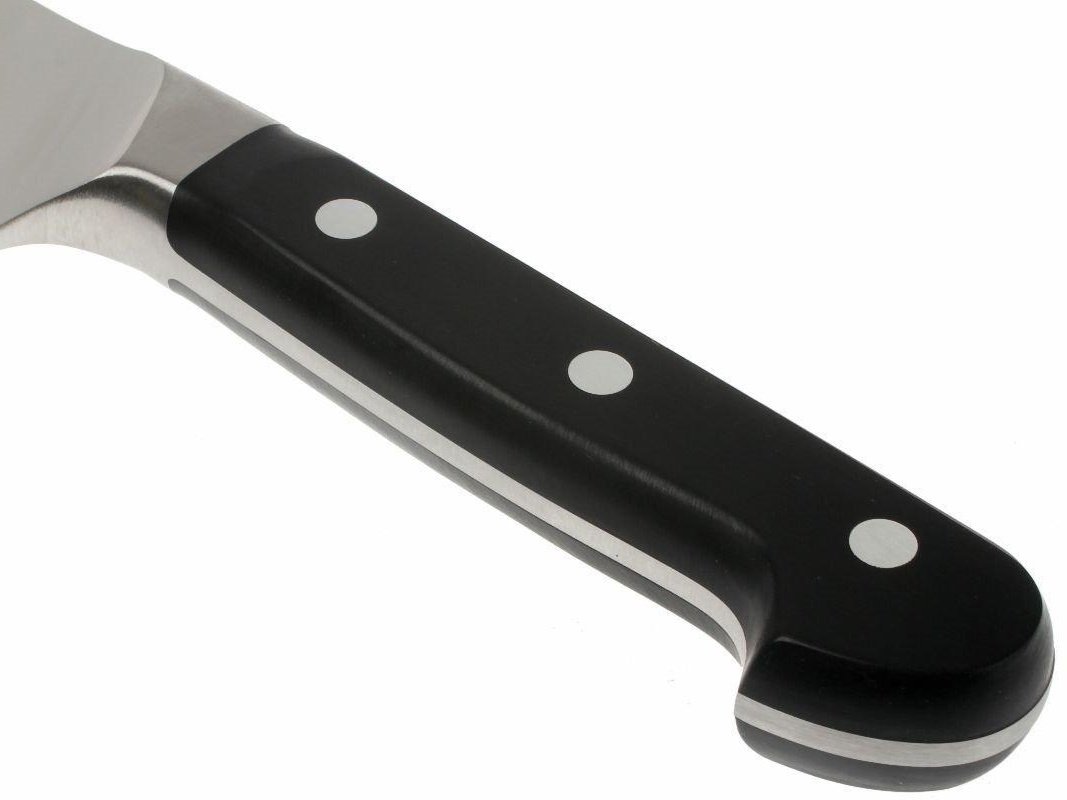
Full tang: Steel extends through the handle
Typical construction: The blade and tang form a continuous piece of steel that extends through the handle. In a common scale-handle design, handle materials are attached to both sides using rivets, pins, screws, adhesive, or a combination of methods.
Key characteristics: The steel runs through most or all of the handle length and width, depending on the exact design. The handle scales may be easier to inspect, and individual scales may be replaceable on some models.
Main consideration: The additional steel can increase weight and material cost. Durability still depends on tang dimensions, handle attachment, and overall workmanship.
Partial tang: Steel extends only partway into the handle
Typical construction: The tang stops before reaching the full length or width of the handle. The exact design can range from a substantial shortened tang to a narrow extension embedded inside the handle.
Key characteristics: It may reduce material use and weight. Performance depends heavily on the remaining tang cross-section, how far it extends into the handle, and how the handle is secured.
Main consideration: A short or narrow tang can concentrate stress near the blade-to-handle transition. Buyers should not treat every partial tang design as equivalent.
Hidden tang: The tang is enclosed inside the handle
Typical construction: A narrower tang enters a handle made from wood, resin, plastic, or another suitable material. Depending on the design, it may be secured with adhesive, friction fit, a pin, a threaded fastener, or other mechanical retention features.
Key characteristics: The exterior can have a smooth, rounded, or traditional handle shape without exposed tang edges. Some designs are relatively lightweight and may offer a forward balance.
Main consideration: Because the tang is concealed, buyers need reliable construction specifications and quality-control checks to verify its dimensions and retention method.
Important distinction: Hidden tang does not automatically mean short tang, and partial tang does not always mean hidden tang. These labels can overlap. For sourcing decisions, specify the actual tang length, cross-section, handle material, and attachment method.
3. Tang Construction Durability Comparison
When comparing tang construction, durability means more than whether the steel can break. In everyday kitchen work, common concerns include handle loosening, cracking, gaps around the handle, corrosion near joints, and deterioration after repeated cleaning and moisture exposure.
| Evaluation factor | Full Tang | Partial Tang | Hidden Tang |
|---|---|---|---|
| Structural support | Generally provides a continuous, broad steel support through the handle. | Depends on tang length, width, thickness, and transition design. | Depends on tang cross-section, depth, fit, and retention method. |
| Resistance to handle movement | Can be very good when scales and fasteners are properly fitted. | Depends on the handle attachment and the amount of support inside the handle. | Can be reliable when the fit and mechanical or adhesive retention are properly engineered. |
| Weight and balance | Often heavier, with more mass in the handle. | May reduce handle weight; balance varies by design. | Often allows a lighter handle, but balance depends on the entire knife. |
| Handle maintenance | Some scale-handle designs allow repair or replacement, although riveted scales may require specialist work. | Repairability varies and may be limited by the construction. | Some designs allow handle replacement; others are difficult to disassemble. |
| Moisture and hygiene | Exposed joints and scale seams still need appropriate cleaning and inspection. | Any gap around the handle joint can become a maintenance concern. | A well-sealed handle can be easy to clean, but gaps or failed seals can be difficult to inspect. |
| Manufacturing considerations | Requires appropriate tang material, handle scales, and secure fastening. | Can reduce material use, but the tang-to-handle interface needs careful design. | Requires accurate fitting and a dependable fastening or retention process. |
| Best evaluation method | Inspect scale fit, fasteners, tang dimensions, and handle stability. | Verify tang dimensions, handle retention, and performance under intended use. | Review construction drawings, retention specifications, and handle-stability test results. |
There is no universal service-life ranking that applies to every knife made with these three designs. A well-made hidden tang can outperform a poorly assembled full tang knife. Likewise, a partial tang designed for light food preparation should not be judged against a full tang knife intended for a different workload without considering their intended uses.
4. Which Tang Construction Is Best for Different Kitchen Environments?
Kitchen conditions change how a knife is used and maintained. A home cook may use one chef knife for a few meals each day, while a restaurant may have several workers using the same type of knife throughout a shift. A high-volume operation may also have standardized cleaning, storage, and inspection procedures.
| Kitchen environment | Suggested starting point | What matters most | What to verify |
|---|---|---|---|
| Home kitchen | Any of the three, when appropriately designed | Comfort, balance, everyday durability, price, and ease of care | Secure handle, comfortable grip, clear care instructions |
| Enthusiast or frequent home cooking | Full tang or a well-made hidden tang | Long-term handle stability, preferred balance, maintenance needs | Handle fit, construction details, corrosion care, repair options |
| Restaurant kitchen | Full tang or a validated hidden tang design | Frequent use, grip comfort, cleaning, consistency, and downtime | Handle retention, seam quality, cleaning compatibility, inspection process |
| High-volume food preparation | Robust full tang or another construction proven for the specified workload | Repeatability, secure assembly, maintenance procedures, and replacement planning | Representative-use testing, batch consistency, handle stability, sanitation suitability |
| Premium or traditional knife line | Full tang or hidden tang, based on the product design | Balance, handle ergonomics, appearance, and intended cutting style | Accurate specifications, assembly quality, and service support |
| Cost-sensitive retail range | Partial tang may be considered if validated for its intended use | Target price, expected workload, acceptable service life, and warranty risk | Tang dimensions, attachment strength, sample inspection, and production consistency |
Home kitchens: Comfort and everyday practicality
For most home cooks, cutting tasks such as slicing vegetables, dicing onions, and portioning boneless ingredients do not require a knife to withstand extreme leverage. A properly manufactured knife with a secure handle can perform well regardless of whether it uses a full, partial, or hidden tang.
Comfort and balance can matter more than simply choosing the design with the most steel. Buyers should consider handle shape, knife weight, ease of cleaning, and whether the knife feels stable during normal use.
Restaurant kitchens: Repeated use and maintenance
Restaurant knives are used frequently, so handle movement, worn fasteners, cracks, and gaps can become operational concerns. Full tang construction can make the handle assembly easier to inspect in some designs, but exposed scale joints still require care.
A hidden tang can also be suitable for restaurant use if its handle attachment is secure, its surfaces are appropriate for the cleaning routine, and the product has been evaluated for the intended workload. The important question is not simply whether the tang is visible, but whether the complete knife remains stable and cleanable over time.
High-volume commercial kitchens: Standardization and quality control
In high-volume kitchens, the cost of a knife includes more than its purchase price. Replacement frequency, downtime, maintenance effort, and consistency across a large group of knives can all affect the total cost of ownership.
A robust full tang is a sensible option to evaluate first for demanding, repeated use. However, a well-designed molded handle or hidden tang construction may also perform reliably when its design and assembly have been validated. Choose based on representative-use testing and documented quality criteria, not the tang label alone.
5. How to Read a Tang Construction Cross-Section
A cross-section or exploded drawing helps buyers understand what is hidden inside the handle. Product photos alone may not reveal the tang's length, thickness, or attachment method.
Full tang cross-section
- Blade steel: Continues into the handle as a broad tang.
- Handle scales: Commonly sit on both sides of the tang.
- Fasteners: Rivets, pins, screws, adhesive, or a combination may hold the assembly together.
- Inspection points: Check for gaps, loose fasteners, uneven scales, sharp edges, and signs of corrosion.
Partial tang cross-section
- Blade steel: Stops before extending through the full handle length or width.
- Handle body: Surrounds the shortened tang.
- Attachment: May rely on adhesive, pins, molded material, or other design features.
- Inspection points: Confirm tang dimensions, depth, transition geometry, and the handle's resistance to movement.
Hidden tang cross-section
- Blade steel: Extends into the handle but is concealed by the handle material.
- Handle body: May be a single piece or a multi-part assembly.
- Retention: Can use adhesive, friction fit, pins, threaded fasteners, or a combination.
- Inspection points: Verify the tang's actual dimensions, the attachment process, sealing, and handle stability.
For OEM and private-label projects, ask the manufacturer to identify the exact construction in the technical drawing. If handle durability is a critical requirement, agree on measurable acceptance criteria before production rather than relying on a marketing description.
6. What Actually Determines Knife Handle Durability?
Tang construction matters, but it is only one part of the assembly. These additional factors should be evaluated alongside the tang design.
1. Tang dimensions and transition geometry
The length, width, thickness, and shape of the tang affect how loads are transferred into the handle. Abrupt changes in cross-section can concentrate stress. A longer tang is not automatically better if the tang is too thin or the transition is poorly designed.
2. Handle material
Wood, composite materials, resin, and molded polymers have different properties. Some materials may be more sensitive to moisture, heat, impact, or chemical exposure than others. The material must be suitable for the knife's intended environment and care routine.
3. Fastening and assembly quality
Rivets, pins, screws, adhesives, friction fits, and molded attachments each require appropriate design and process control. Loose fasteners, incomplete bonding, poor fit, and inconsistent assembly can undermine an otherwise sound tang design.
4. Cleaning and moisture exposure
Water entering a handle joint can contribute to corrosion, swelling, or deterioration depending on the materials and construction. Knives should be cleaned and dried according to the manufacturer's instructions. Do not assume that a knife is dishwasher-safe simply because it has a full tang or a synthetic handle.
5. Intended cutting tasks
A kitchen knife is designed primarily for cutting food. Twisting, prying, striking hard objects, or using the blade as a lever can impose loads beyond normal cutting. Tang construction should be evaluated for the intended application, and the knife should not be used as a substitute for a tool designed for those actions.
7. How Wholesale Buyers Should Specify Tang Construction
For distributors, importers, restaurant-supply companies, and private-label brands, a clear product specification reduces ambiguity between the sample and mass production.
Before requesting quotations or approving a production sample, document the following:
- Tang type and dimensions: Define the intended full, partial, or hidden tang construction and specify relevant length, width, and thickness measurements.
- Handle material: Identify the material grade or specification, surface finish, color, and design.
- Attachment method: Specify rivets, pins, adhesive, molding, threaded fasteners, or other relevant features.
- Performance expectations: Describe the intended use, frequency of use, and applicable durability requirements.
- Cleaning requirements: Confirm compatibility with the expected washing, drying, and sanitation procedures.
- Inspection criteria: Define acceptable handle movement, gaps, cracks, loose fasteners, and other defects.
- Sample approval: Confirm that the approved sample reflects the intended production materials and construction.
- Production consistency: Agree on the inspection process and how changes to materials or assembly will be controlled.
Test the complete knife, not just the tang type
For demanding applications, buyers should evaluate representative samples under conditions that reflect the intended use. Depending on the product, checks may include handle stability, attachment integrity, repeated cleaning exposure, visual inspection, and other agreed durability tests.
Acceptance criteria should be appropriate to the knife category and its intended workload. Avoid using an improvised force test that could damage the product or create a safety hazard. Where formal test methods are required, agree on the method and acceptance limits with the manufacturer before testing.
For businesses developing a customized knife range, FASAKA's OEM/ODM kitchenware service page provides a starting point for discussing product requirements and customization. Confirm the availability of each construction type, material, and process directly with the team.
8. Frequently Asked Questions
Is a full tang kitchen knife always more durable?
No. Full tang construction generally provides a broad, continuous steel support through the handle, but durability also depends on tang dimensions, handle material, fastening quality, and manufacturing consistency. A well-made hidden tang can be reliable for normal kitchen use, while a poorly assembled full tang knife can still develop handle problems.
Is a hidden tang the same as a partial tang?
Not exactly. Hidden tang describes a tang concealed inside the handle, while partial tang describes a tang that does not extend through the full handle length or width. The terms can overlap, so buyers should verify the actual construction and dimensions.
Which tang construction is best for restaurant kitchens?
A full tang is a practical starting point for many frequently used kitchen knives, but it is not the only suitable design. A properly engineered hidden tang can also work well. Prioritize secure handle attachment, cleaning compatibility, grip comfort, and evidence of performance under the intended workload.
Which knife construction is best for high-volume commercial kitchens?
Look for a construction validated for repeated use, with consistent assembly, a stable handle, and clear maintenance requirements. Full tang designs are worth evaluating first for demanding applications, but a well-made alternative may be suitable when it meets the same agreed performance and quality criteria.
Does full tang make a knife heavier?
It can. Full tang construction generally uses more steel in the handle area than a narrow hidden tang design, but overall weight and balance depend on blade dimensions, steel thickness, handle material, and the complete knife geometry.
Can hidden tang knives be used in professional kitchens?
Yes, when the knife is designed and manufactured for the intended workload. Buyers should evaluate the tang dimensions, handle retention, material compatibility, cleaning requirements, and quality-control results rather than rejecting a knife solely because its tang is hidden.
What should importers check before ordering kitchen knives in bulk?
Importers should confirm the tang construction, handle material, fastening method, dimensions, sample approval criteria, cleaning requirements, durability expectations, and production inspection process. These details should be recorded in the product specification and confirmed before mass production.
Conclusion: Choose Tang Construction by Application, Not by Label
Full tang, partial tang, and hidden tang construction each serve different design and cost objectives. Full tang often provides a broad steel support through the handle and is a practical option for demanding kitchen work. Partial tang designs may be suitable for products engineered for lighter workloads. Hidden tang designs can offer a lighter, streamlined handle while still providing dependable performance when the tang and handle are properly designed and secured.
For home cooks, comfort and everyday practicality are key. For restaurants and high-volume kitchens, handle stability, cleaning compatibility, durability, and consistent quality control deserve greater attention. For wholesale buyers, the most reliable decision comes from clear specifications, representative samples, and agreed performance criteria.
Developing a Kitchen Knife Range for Your Brand?
FASAKA is a brand under DKS Enterprises Co., Ltd., a manufacturer and supplier based in Yangjiang, Guangdong, China, specializing in hardware knives and scissors, BBQ tools, and kitchenware. If you are sourcing kitchen knives for retail, distribution, or private-label projects, discuss your product specifications, handle construction, and customization requirements with the team.
Contact FASAKA