




Tailor Scissors vs Sewing Scissors vs Dressmaker Shears: What’s the Difference?
Tailor Scissors vs Sewing Scissors vs Dressmaker Shears: What’s the Difference?
Tailor scissors, sewing scissors, and dressmaker shears are terms commonly used for fabric-cutting tools, but their meanings overlap in the market. The practical differences are usually easier to understand by comparing blade length, handle design, cutting control, and intended application rather than relying on the product name alone.
For example, a manufacturer may describe a long bent-handle fabric-cutting tool as "tailor scissors," while another may call a very similar product "dressmaker shears." Sewing scissors can refer to a broader category that includes both larger fabric shears and smaller scissors used for sewing tasks.
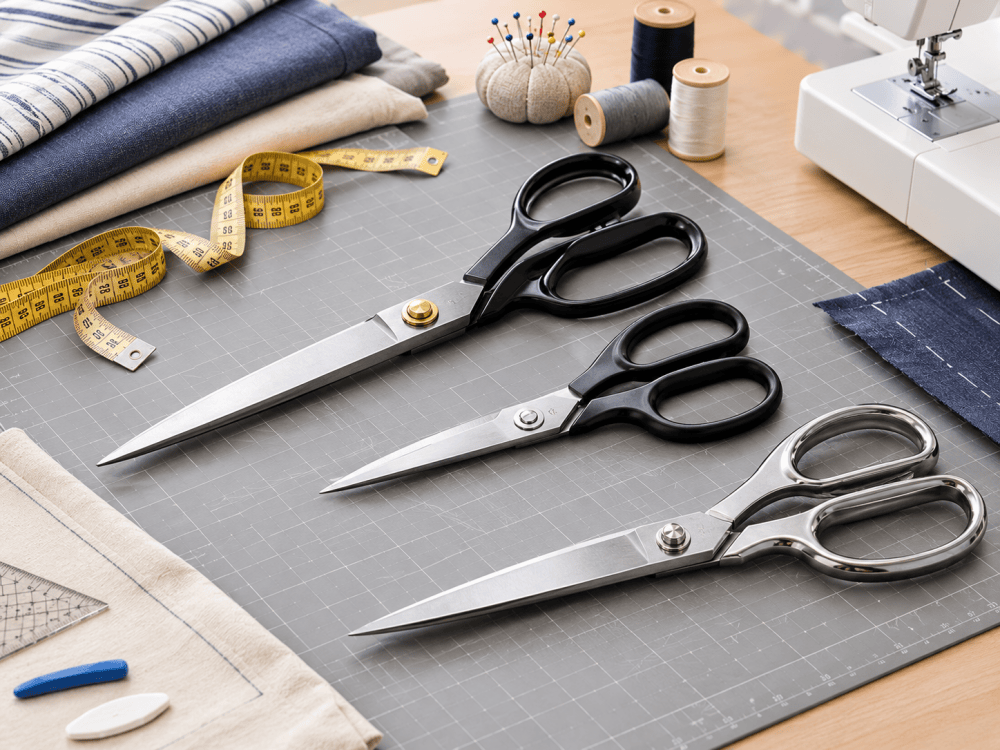
Are Tailor Scissors, Sewing Scissors, and Dressmaker Shears the Same?
Not exactly, but the terminology is not standardized enough to create three completely separate product categories.
In textile and sewing terminology, fabric shears can include tailor's shears and dressmaker's shears. The terms "fabric scissors" and "fabric shears" are also frequently used interchangeably in commercial product listings.
This means that a buyer should not assume that every product called "tailor scissors" has the same design, or that every product called "dressmaker shears" has the same blade length.
For sourcing or selecting a product, the more useful questions are:
- How long are the blades?
- Is the handle straight, offset, or bent?
- What fabrics is the tool designed to cut?
- Is it intended for long cuts or detail work?
- How is the blade constructed and ground?
- Is the tool designed for occasional sewing or repeated professional use?
Tailor Scissors vs Sewing Scissors vs Dressmaker Shears: Quick Comparison
| Feature | Tailor Scissors | Sewing Scissors | Dressmaker Shears |
|---|---|---|---|
| Meaning | Usually fabric-cutting scissors associated with tailoring | Broad term for scissors used in sewing | Fabric shears associated with dressmaking and garment cutting |
| Blade length | Often medium to long | Can vary widely | Often longer blades |
| Handle design | May be offset or bent | Depends on the specific type | Often offset or bent |
| Main use | Tailoring and fabric cutting | General sewing tasks | Garment and fabric cutting |
| Long straight cuts | Well suited to suitable models | Model-dependent | Well suited to suitable models |
| Detail work | Depends on size | Often suitable for smaller scissors | Less suitable when the shears are large |
| Multiple fabric layers | Suitable models can handle them | Depends on construction and size | Suitable models can handle them |
What Are Tailor Scissors?
Tailor scissors are fabric-cutting scissors commonly associated with tailoring, garment production, pattern cutting, and other textile work.
Many professional tailor scissors use relatively long blades and a handle design intended to provide stability during fabric cutting. Some models use a bent or offset handle so that the lower blade can remain closer to the cutting surface while the user's hand stays above the fabric.
This configuration can be useful when cutting large pieces of fabric on a table because it helps the operator maintain a consistent cutting position.
Common Uses for Tailor Scissors
- Tailoring
- Garment cutting
- Pattern cutting
- Dressmaking
- Denim cutting
- Canvas and upholstery fabric
- Quilting and textile crafts
- Cutting multiple layers of suitable fabric
The exact application depends on the model. A pair designed for lightweight garment fabric should not automatically be assumed to be suitable for heavy canvas, leather, or multiple thick layers.
For a broader introduction to tailor scissors, see our What Are Tailor Scissors? Types, Uses & Buying Guide .
What Are Sewing Scissors?
"Sewing scissors" is a broader term that can describe scissors used for different stages of sewing and textile work.
Unlike a specific product design, the term does not necessarily tell you the blade length or handle configuration. A sewing scissors product may be relatively compact for trimming and precision work, or it may be a larger fabric-cutting tool.
For example, sewing resources commonly distinguish larger fabric shears from smaller sewing scissors used for trimming and detail work. Some sewing scissors have tapered blades with one pointed and one rounded tip, which can be useful for trimming seams and notches.
Typical Sewing Scissors Applications
- Cutting fabric
- Trimming seams
- Cutting thread and loose ends
- Pattern preparation
- Small sewing projects
- Appliqué and craft work
- General sewing-room tasks
Therefore, when a buyer searches for "sewing scissors," it is important to identify the actual task before choosing a product.
What Are Dressmaker Shears?
Dressmaker shears are fabric-cutting shears commonly associated with dressmaking, garment construction, and cutting fabric patterns.
A typical dressmaker shear may feature long blades and an offset or bent handle. This design can help keep the cutting edge closer to the table while cutting fabric, particularly during long pattern cuts. :contentReference[oaicite:3]{index=3}
Dressmaker shears are often selected for cutting garment panels, pattern pieces, long fabric edges, and suitable multiple layers.
Why Are Dressmaker Shears Often Long?
A longer blade allows more fabric to be cut during each closing movement. This can be useful for long, relatively straight cuts because the user can make fewer cutting strokes.
However, longer does not automatically mean better. A long, heavy shear may be less convenient for detailed curves or users who prefer a lighter tool. The appropriate length depends on the cutting task, fabric, and user.
Why Does Handle Design Matter?
Handle geometry is one of the most useful ways to understand differences between fabric-cutting tools.
Offset or Bent Handles
An offset or bent handle positions the hand above the blades and can allow the lower blade to remain close to the table surface during cutting.
This can be particularly useful when cutting large fabric pieces or following paper patterns on a flat work surface.
Straight or More Symmetrical Handles
A straighter handle can be useful for compact sewing tasks where the tool is frequently lifted from the work surface or used at different angles.
This does not mean one handle design is universally better. The choice depends on how the scissors will actually be used.
Blade Length: Tailor Scissors vs Sewing Scissors vs Dressmaker Shears
Blade length is another practical difference, although there is no universal size boundary that every manufacturer follows.
Some traditional sewing terminology distinguishes smaller scissors from longer shears based partly on size and handle design. One sewing education source describes scissors as generally smaller and shears as longer, while noting that home sewists often use around 10-inch bent-handle shears and professional dressmakers may use heavier 12-inch versions.
For modern commercial products, however, the naming overlap is significant. Current catalogs may use "scissors" for products with long blades and "shears" for products across a range of sizes.
| Cutting Task | Blade Direction | Why |
|---|---|---|
| Long straight fabric cuts | Longer blade | More fabric can be cut with each stroke |
| Large garment panels | Medium to long blade | Provides cutting reach and control |
| Small pattern pieces | Shorter blade | Easier maneuverability |
| Seam trimming | Shorter or specialized blade | Better control around detailed areas |
| Thread trimming | Small scissors or snips | Designed for quick, precise cuts |
Which Is Better for Long Fabric Cuts?
For long fabric cuts, a suitable pair of dressmaker shears or longer tailor scissors will generally provide more cutting reach than a small sewing scissors.
Long blades can reduce the number of cutting strokes required and are particularly useful when cutting garment panels, pattern pieces, curtains, or other large textile sections.
The cutting surface also matters. An offset or bent handle can help keep the lower blade close to the table while the fabric remains relatively flat during cutting.
Which Is Better for Detail Work?
For small pattern pieces, trimming, notching, seam work, and other detailed operations, a shorter sewing scissors may be easier to control than a large pair of tailor scissors.
Large shears are optimized for reach and cutting leverage. Small scissors are generally easier to position in tight spaces.
This is why professional sewing environments often use more than one type of cutting tool rather than relying on one pair for every task.
Which Is Better for Thick Fabric?
The answer depends more on the actual construction of the scissors than on whether the product is called "tailor scissors," "sewing scissors," or "dressmaker shears."
For denim, canvas, upholstery fabrics, or multiple layers, look for:
- Strong and stable blade construction
- Appropriate blade thickness
- Suitable blade hardness
- Accurate blade alignment
- A reliable pivot
- Comfortable leverage
- A blade length appropriate to the cutting task
A product should always be tested against the actual fabric before being specified for demanding applications.
Tailor Scissors vs Sewing Scissors vs Dressmaker Shears for Different Tasks
| Task | Tailor Scissors | Sewing Scissors | Dressmaker Shears |
|---|---|---|---|
| Cutting garment panels | Excellent for suitable models | Depends on size | Excellent for suitable models |
| Long straight cuts | Very suitable with longer blades | Model-dependent | Very suitable with longer blades |
| Pattern cutting | Suitable | Suitable depending on size | Highly suitable |
| Small fabric pieces | Suitable, but large models may be less maneuverable | Often suitable | Large models may be less convenient |
| Seam trimming | Possible | Often suitable | Possible, depending on size |
| Thread trimming | Not the primary use | Suitable for appropriate models | Not the primary use |
| Denim | Suitable heavy-duty models | Depends on construction | Suitable heavy-duty models |
| Multiple layers | Suitable models | Depends on size and construction | Suitable models |
Does "Shears" Mean Better Than "Scissors"?
No. The word "shears" should not be treated as a quality ranking.
Traditionally, the terms have often been differentiated by size and handle configuration, with shears generally referring to larger tools. However, current sewing-tool catalogs use "scissors" and "shears" in overlapping ways.
For B2B buyers, the product specification is much more useful than the terminology. A well-made 9-inch fabric scissors can be more appropriate for one application than a poorly matched 12-inch shear.
How Should You Choose Between Tailor Scissors, Sewing Scissors and Dressmaker Shears?
- Start with the fabric. Identify whether you will cut cotton, linen, wool, denim, canvas, upholstery fabric, or multiple layers.
- Define the cutting task. Long pattern cuts require different characteristics from small trimming or detailed work.
- Choose the blade length. Longer blades can improve cutting reach, while shorter blades can provide more maneuverability.
- Check the handle geometry. An offset or bent handle may be useful for table-based fabric cutting.
- Check the blade construction. Material, grinding, thickness, hardness, and alignment all affect cutting performance.
- Consider the working frequency. Professional users who cut fabric repeatedly may require more durable construction and consistent manufacturing.
- Test the actual material. Do not select a tool based only on the product name. Test representative fabric whenever possible.
What Should B2B Buyers Look for When Sourcing Fabric Scissors?
For wholesalers, retailers, sewing brands, garment manufacturers, and private-label buyers, the comparison should go beyond "tailor scissors vs sewing scissors."
The important question is whether the manufacturer can consistently produce the required product specification.
| Specification | What to Confirm |
|---|---|
| Product type | Tailor scissors, sewing scissors, dressmaker shears, or a defined custom design |
| Blade length | Exact finished blade and overall product dimensions |
| Blade material | Exact steel grade or material specification |
| Blade hardness | Target hardness and applicable production standard |
| Blade grinding | Edge geometry, finish and cutting requirements |
| Handle | Material, shape, color and surface finish |
| Pivot | Rivet or screw construction and adjustment requirements |
| Logo | Engraving, printing or other branding method |
| Packaging | Retail box, sleeve, blister, card or bulk packaging |
| MOQ | Minimum order quantity by size and SKU |
| Sample | Pre-production or approval sample requirements |
| Quality control | Cutting performance, alignment, appearance and assembly checks |
Can Tailor Scissors and Dressmaker Shears Be OEM Products?
Yes. The exact customization options depend on the manufacturer, but B2B buyers can often specify dimensions, blade materials, handle design, surface finish, branding and packaging.
For private-label projects, it is better to define the product by measurable specifications rather than simply requesting "tailor scissors."
- Product: Professional fabric-cutting scissors
- Product positioning: Tailoring and dressmaking
- Size: 8 / 9 / 10 / 11 / 12 inch
- Blade material: Specified stainless steel grade
- Handle: Forged metal or customized construction
- Finish: Black titanium or polished finish
- Logo: Custom brand logo
- Packaging: Custom retail box
- Target fabrics: Garment fabric, denim, canvas and upholstery
- Sample: Required before mass production
- MOQ: Quoted by SKU
FASAKA Tailor Scissors and Professional Scissors
FASAKA offers professional scissors for B2B customers across tailoring, fabric cutting, sewing and other cutting applications.
Its Black Titanium Forged Handle Professional Tailor Scissors series includes 8, 9, 10, 11 and 12-inch sizes. The product uses black titanium-coated stainless steel blades, a forged steel handle and reinforced brass rivets.
FASAKA also offers Full Stainless Steel Tailor Scissors in different sizes for fabric, denim, leather, canvas, upholstery and multi-layer textile applications.
For buyers developing their own sewing or tailoring product line, FASAKA can support OEM/ODM requirements such as product specifications, logo customization and packaging development. See the FASAKA OEM/ODM service for more information.
Frequently Asked Questions
Tailor scissors are generally associated with fabric cutting for tailoring and garment work, while sewing scissors is a broader term covering different scissors used in sewing. The actual difference depends on the product's size, blade design, handle geometry and intended application.
They can be very similar and the terms are often used interchangeably. Both generally refer to fabric-cutting tools used in tailoring or garment making, but exact specifications vary by manufacturer.
Neither is automatically better. The appropriate tool depends on blade length, handle design, fabric, cutting task and user requirements. Product specifications are more useful than the name alone.
Yes, when the specific sewing scissors are designed for fabric. However, smaller sewing scissors may be more suitable for trimming and detail work, while longer fabric shears are often better suited to large or long fabric cuts.
Not necessarily. Longer blades can be useful for long straight cuts, while shorter scissors can provide better maneuverability for smaller or more detailed pieces.
The appropriate size depends on the user and cutting task. Around 10 inches is commonly used for general dressmaking, while larger sizes can provide greater cutting reach for professional or large-scale fabric work. The actual blade construction and balance should also be considered.
Suitable heavy-duty tailor scissors can be designed for denim and other heavier fabrics. Buyers should check the manufacturer's intended applications and test the actual scissors with representative denim before bulk purchasing.
Some dressmaker shears are designed for multiple layers, but performance depends on the blade geometry, hardness, construction, fabric thickness and number of layers. It is best to test the product under the intended working conditions.
Yes, depending on the manufacturer. Common OEM options can include product size, blade specification, handle design, finish, logo application and packaging.
Tailor Scissors vs Sewing Scissors vs Dressmaker Shears: Final Takeaway
The biggest mistake is to treat tailor scissors, sewing scissors, and dressmaker shears as three completely separate products with universally fixed definitions.
In practice, the terms overlap. A better way to compare them is to look at the actual product:
- For long fabric cuts: consider longer blades and a suitable offset or bent handle.
- For garment and pattern cutting: look for stable, sharp fabric-cutting blades.
- For detail work: shorter sewing scissors may provide better maneuverability.
- For thick fabrics: prioritize blade construction, hardness, alignment and leverage.
- For professional use: consider durability, balance and consistent manufacturing quality.
- For B2B sourcing: specify the actual dimensions, materials, construction, branding and packaging rather than relying only on the product name.
In other words, the right question is not simply "Which is better: tailor scissors or dressmaker shears?" It is "Which scissor design matches the fabric and cutting task I need to perform?"
Looking for Custom Tailor Scissors?
FASAKA provides professional scissors and OEM/ODM solutions for global B2B customers. Share your required size, blade material, handle design, logo, packaging and target application with our team.
Request a Scissors Quote

