





Why Do Steak Knives Have Serrated Blades?
Many steak knives feature serrated blades instead of completely smooth cutting edges. If you have ever used a steak knife at a restaurant, you may have noticed its small teeth along the blade. These teeth are not simply a decorative feature. They are designed to help the knife cut through cooked meat, including tougher surfaces and browned crusts.
Why do steak knives have serrated blades? Serrations create multiple small cutting points that help the blade engage with food surfaces. They can reduce the need for a perfectly smooth initial cutting contact and make it easier to start cutting through certain meats. However, serrated blades are not automatically better than straight-edge blades. Their performance depends on tooth geometry, blade sharpness, steel quality, and the type of food being cut.
In this guide, we explain how serrated steak knife blades work, why their tooth design matters, their advantages and limitations, and what restaurants and wholesale buyers should consider when selecting steak knives.
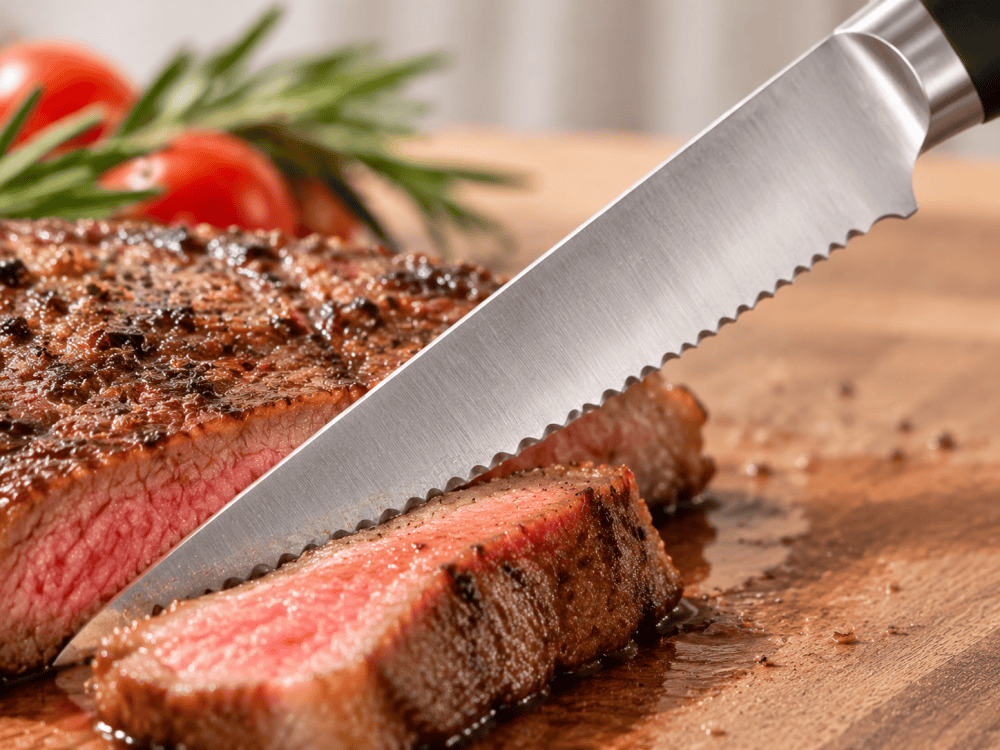
Quick Answer: Why Are Steak Knives Serrated?
Serrated steak knives have small teeth along the cutting edge. These teeth help the blade grip and penetrate food surfaces, making it easier to begin cutting through browned meat crusts and other relatively firm exterior layers. They can also remain functionally effective for a long time between sharpening sessions, although they still require proper maintenance.
1. How Do Serrated Steak Knife Blades Work?
A serrated blade has a series of small teeth and curved sections, often called gullets, along its cutting edge. Unlike a straight-edge blade, which has a continuous smooth edge, a serrated blade uses a repeating pattern of points and recessed areas.
When the knife moves across a piece of meat, the pointed sections help initiate contact with the surface. The recessed sections provide space between the teeth, allowing the blade to continue cutting as pressure and movement are applied.
This design can be particularly useful when cutting meat with a browned or firm exterior and a softer interior. The teeth help the blade engage with the surface instead of relying entirely on a smooth edge to make the initial cut.
The Main Parts of a Serrated Edge
- Teeth: The raised points that first contact and engage with the food surface.
- Gullets: The recessed areas between teeth that form the characteristic serrated pattern.
- Cutting edges: The sharpened surfaces that help slice through the material as the knife moves.
- Serration spacing: The distance between individual teeth, which influences the blade's cutting behavior.
The exact shape, depth, spacing, and sharpness of these features vary between steak knife designs. Even small changes in tooth geometry can influence how a knife performs.
2. Five Reasons Steak Knives Often Have Serrated Blades
1. They Help Start a Cut Through Firm Surfaces
Cooked steak often develops a browned outer crust during grilling, pan-searing, or roasting. This exterior can be firmer than the meat underneath.
The pointed teeth of a serrated blade help the knife engage with this surface. Rather than requiring the entire smooth edge to make contact at once, the teeth create localized contact points that can help initiate a cut.
This is one reason serrated steak knives are commonly used for serving cooked meat.
2. They Can Reduce the Need for Heavy Initial Pressure
A serrated edge can concentrate contact at individual teeth. This may help users begin cutting through certain food surfaces without applying as much initial downward pressure as they might with a dull or poorly maintained straight-edge blade.
Actual cutting effort still depends on blade sharpness, tooth geometry, meat texture, and the way the knife is used. A blunt serrated knife may still require considerable force.
3. They Work Well With a Slicing Motion
Serrated steak knives are generally designed to work with a back-and-forth slicing motion. As the knife moves, the teeth repeatedly engage with the food surface and help extend the cut.
This makes the design suitable for cutting many types of cooked meat, especially when the exterior is firmer than the interior.
4. They Can Maintain Useful Cutting Performance Between Sharpening Sessions
Serrated blades can retain useful cutting performance for a relatively long time because their recessed sections are less exposed to direct contact with cutting surfaces than the raised teeth.
However, this does not mean serrated knives never become dull. The teeth can wear down, lose sharpness, or become damaged through repeated use. Regular inspection and appropriate maintenance are still important.
5. They Are Practical for Many Foodservice Environments
Restaurants, hotels, steakhouses, and catering businesses need knives that can handle repeated serving tasks. Serrated steak knives are a common choice because their blade design is suitable for cutting a variety of cooked meats.
For commercial buyers, the decision should also consider cleaning requirements, handle comfort, blade durability, replacement costs, and the availability of consistent bulk supply.
3. Does Serration Design Affect Cutting Performance?
Yes. Not all serrated steak knives perform in the same way. The arrangement and shape of the teeth influence how the blade contacts food, how smoothly it moves through a cut, and how easy it is to maintain.
Tooth Size and Spacing
Fine serrations have smaller teeth positioned relatively close together. They can provide frequent contact points along the cutting edge and are often used in steak knife designs intended for controlled slicing.
Larger serrations have more pronounced teeth and wider recessed sections. Their performance depends on the specific tooth shape and the food being cut. A more aggressive serration pattern is not necessarily better for every steak or serving application.
Tooth Shape and Depth
The profile of each tooth influences how the edge engages with food. Shallow serrations and deeper serrations can produce different cutting sensations and maintenance requirements.
Manufacturers need to consider the relationship between tooth depth, edge angle, blade thickness, and the overall shape of the knife. These details should be evaluated through practical cutting tests rather than appearance alone.


