


What Makes Good Sewing Scissors? 8 Features to Check Before Buying
What Makes Good Sewing Scissors? 8 Features to Check Before Buying
Good sewing scissors should do more than simply look sharp. For fabric cutting, the quality of the blades, steel, pivot, handle, balance, and overall construction all affect how smoothly and accurately the scissors perform.
Whether you are buying sewing scissors for home sewing, dressmaking, tailoring, garment production, or wholesale distribution, it is important to evaluate the product based on its actual construction and cutting performance rather than appearance or price alone.
What Makes a Pair of Sewing Scissors Good Quality?
A high-quality pair of sewing scissors should provide consistent cutting performance while remaining comfortable and reliable during repeated use.
The most important characteristics are:
| Feature | Why It Matters | What to Check |
|---|---|---|
| Blade sharpness | Provides clean and efficient cuts | Does the blade cut fabric smoothly from heel to tip? |
| Blade alignment | Helps maintain consistent cutting contact | Do the blades meet correctly without excessive gaps? |
| Steel quality | Affects durability, corrosion resistance, and edge performance | What steel and heat treatment are used? |
| Pivot construction | Controls blade movement and tension | Is the pivot secure and smooth? |
| Handle design | Affects comfort and control | Does the handle fit the user's hand? |
| Balance | Influences cutting control and fatigue | Do the scissors feel stable during use? |
| Cutting consistency | Determines real-world performance | Does performance remain consistent across different fabrics? |
| Overall durability | Important for long-term and professional use | Can the construction withstand repeated operation? |
8 Features to Check Before Buying Sewing Scissors
01. Sharp and Consistent Blades
Blade sharpness is one of the first things to evaluate when buying sewing scissors.
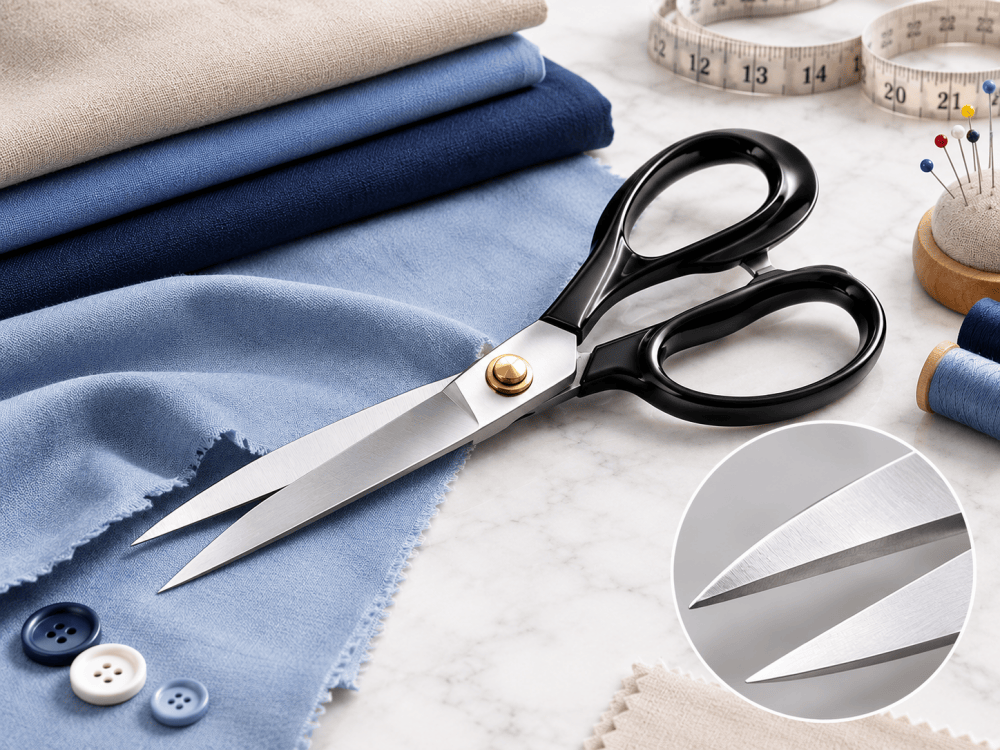
Good fabric scissors should cut the material cleanly rather than pulling, folding, or repeatedly catching the fabric. A properly finished cutting edge should provide smooth cutting throughout the blade rather than working well only near the tip.
However, sharpness alone does not determine quality. A blade can be extremely sharp when new but still perform poorly if its geometry, alignment, hardness, or surface finish is inconsistent.
- Clean cutting without excessive pulling
- Consistent cutting from the rear of the blade toward the tip
- No obvious damage or irregularities along the edge
- Suitable edge geometry for the intended fabric
02. Proper Blade Alignment
Blade alignment is easy to overlook, but it has a major effect on cutting performance.
The two blades need to interact correctly throughout the opening and closing motion. If they are poorly aligned, the scissors may struggle to cut fabric cleanly, particularly toward the tip.
Good alignment also helps provide a more predictable cutting action and reduces unnecessary force during use.
When inspecting a pair of scissors, open and close the blades slowly and observe whether they move smoothly and meet consistently along the cutting path.
03. Suitable Steel and Heat Treatment
The steel used for the blades influences several important characteristics, including edge performance, durability, corrosion resistance, and maintenance requirements.
Stainless steel is widely used for sewing scissors because it can provide useful corrosion resistance and durability. However, the steel grade itself does not tell the entire story.
Heat treatment is equally important. Two scissors made from similar steel can perform differently if their hardness, heat treatment, grinding, or finishing processes are different.
04. A Strong and Smooth Pivot
The pivot connects the two blades and controls how they move against each other. It is one of the most important mechanical points of a pair of scissors.
A good pivot should provide stable blade movement without excessive looseness. It should also allow the scissors to open and close smoothly without unnecessary friction or wobbling.
For professional or repeated use, pivot durability becomes particularly important because the scissors may be opened and closed thousands of times during their working life.
When checking the pivot, look for:
- Stable blade movement
- No obvious lateral wobbling
- Smooth opening and closing
- Secure fastening
- Appropriate blade tension
05. Comfortable and Functional Handle Design
A sharp blade does not make a good sewing scissor if the handle is uncomfortable to use.
Sewing and tailoring often involve repeated cutting movements, so handle design directly affects comfort, control, and user fatigue.
The handle should provide a stable grip and allow the user to open and close the blades without excessive pressure.
For fabric scissors designed to cut on a table, an offset or bent handle can also help keep the blades closer to the cutting surface.
For B2B products, handle design can also influence the product's market positioning. Different customers may prefer forged metal handles, coated handles, ergonomic plastic handles, or other customized configurations.
06. Good Balance and Weight Distribution
Balance is often overlooked when comparing sewing scissors, but it can make a noticeable difference during repeated cutting.
The scissors should feel stable in the hand rather than excessively heavy toward either the blade or handle.
A heavier pair is not automatically better. Additional weight may provide strength in some applications, but excessive weight can increase hand fatigue during long cutting sessions.
For professional users, the best balance depends on the cutting task, blade length, handle design, and personal preference.
07. Consistent Cutting Performance
One of the best ways to judge sewing scissors is to test how they actually cut fabric.
A good pair should provide a reasonably smooth cutting action rather than requiring repeated force or causing the fabric to bunch up.
Testing more than one fabric is useful because scissors that work well on lightweight cotton may not perform the same way on denim, canvas, felt, or synthetic fabrics.
For professional and B2B buyers, testing should ideally include the materials that the target customers will actually use.
- Lightweight fabric
- Medium-weight fabric
- Thick fabric such as denim
- Multiple fabric layers
- Long straight cuts
- Curved or detailed cuts where relevant
08. Durable Overall Construction
Good sewing scissors should maintain their cutting performance through repeated use.
Durability depends on the complete construction rather than a single component. Blade material, heat treatment, grinding, pivot construction, handle assembly, fastening, and surface finishing can all contribute to product life.
For a professional pair of scissors, buyers should also consider whether the product is designed for occasional home use or continuous commercial use.
For wholesale and private-label projects, production consistency is just as important as the specifications of the initial sample.
How Can You Tell if Sewing Scissors Are Good Quality?
If you are buying a pair in person, several simple checks can help you evaluate the basic quality.
1. Check the Blades
Look at the blades from different angles. They should appear properly formed, with a consistent cutting edge and no obvious damage or manufacturing defects.
2. Open and Close the Scissors
The movement should feel controlled and reasonably smooth. Excessive looseness, grinding, or inconsistent resistance can indicate a problem with the pivot or blade relationship.
3. Test Them on Fabric
Whenever possible, use a representative piece of fabric. Check whether the scissors cut cleanly without excessive pulling or crushing.
4. Check the Handle
Hold the scissors in the position you would normally use. The handle should provide a secure grip without creating uncomfortable pressure points.
5. Test More Than One Area of the Blade
Do not test only the tip. Try cutting with different sections of the blade to see whether the cutting performance is consistent.
What Makes Sewing Scissors Sharp?
Sharpness is influenced by several manufacturing factors rather than simply the final sharpening operation.
These can include:
- Steel selection
- Heat treatment
- Blade geometry
- Grinding accuracy
- Edge angle
- Blade alignment
- Final sharpening and finishing
For this reason, a manufacturer's production process is important when evaluating sewing scissors for professional or wholesale use.
Does Stainless Steel Make Good Sewing Scissors?
Stainless steel can be an excellent choice for sewing scissors because it can provide a useful combination of corrosion resistance, durability, and practical maintenance.
However, “stainless steel” covers many different grades and performance levels. Buyers should not assume that every stainless steel scissor will have the same cutting performance.
For B2B sourcing, the specific steel grade and manufacturing process should be confirmed with the supplier.
Are More Expensive Sewing Scissors Always Better?
No. Price alone does not determine whether sewing scissors are good.
A higher price may reflect better steel, more precise manufacturing, more expensive finishing, ergonomic design, stronger construction, or brand positioning. But the most expensive product is not necessarily the best choice for every application.
The better approach is to compare performance against the intended use.
| Requirement | What to Prioritize |
|---|---|
| Home sewing | Comfort, sharpness, control, reasonable price |
| Dressmaking | Blade precision, comfortable handle, suitable size |
| Tailoring | Durability, balance, blade length, repeated-use comfort |
| Heavy fabric | Strong construction, suitable blade geometry, cutting power |
| Professional production | Consistency, durability, ergonomics, quality control |
| Wholesale | Stable quality, specifications, packaging, MOQ, cost |
| Private label | Customization, production capability, QC, packaging |
Good Sewing Scissors vs Cheap Sewing Scissors
The difference between good and low-quality sewing scissors is not always visible from the outside.
Lower-cost scissors may still look attractive but can have inconsistent blade alignment, weaker pivots, less durable cutting edges, uncomfortable handles, or inconsistent production quality.
For occasional use, a budget product may be sufficient. For professional sewing, tailoring, or wholesale distribution, buyers should pay more attention to long-term cutting performance and manufacturing consistency.
What Should B2B Buyers Check Before Buying Sewing Scissors?
For wholesalers, distributors, garment manufacturers, retailers, and private-label brands, product evaluation should go beyond a single sample.
- Exact scissor size
- Blade length
- Blade thickness
- Steel grade
- Hardness specification
- Heat-treatment process
- Blade edge type
- Blade alignment
- Pivot construction
- Handle material
- Handle design and color
- Surface finish
- Cutting performance
- Packaging
- Logo and private-label options
- MOQ
- Sample approval process
- Production lead time
- Quality-control procedure
How Should You Test Sewing Scissors Before a Wholesale Order?
A sample approval should ideally reproduce the conditions in which the product will be used.
Instead of testing only whether the scissors are sharp, buyers should evaluate the complete product.
- Check the physical construction. Inspect the blades, pivot, handle, fastening, and finish.
- Test different parts of the blade. Cut using the rear, middle, and tip sections where appropriate.
- Use representative fabrics. Include the main materials expected in the target market.
- Test repeated cutting. Check whether the cutting feel remains consistent.
- Evaluate ergonomics. Consider comfort during repeated opening and closing.
- Record specifications. Confirm that the approved sample matches the production specification.
What Should You Ask a Sewing Scissors Manufacturer?
If you are sourcing sewing scissors directly from a manufacturer, asking specific technical questions can help you compare suppliers more effectively.
Questions for a Sewing Scissors Manufacturer
1. What steel grade is used for the blades?

2. What is the blade hardness range?

3. What heat-treatment process is used?

4. What blade lengths and sizes are available?

5. What handle materials can be customized?

6. Can you provide samples before mass production?

7. What fabrics are the scissors designed to cut?

8. Can the scissors be customized with our logo?

9. What packaging options are available?

10. What is the MOQ for OEM production?

11. What is the production lead time?

12. How is product quality inspected before shipment?
Can Good Sewing Scissors Be Customized for Private Label?
Yes. For brands and distributors, the characteristics that make a good sewing scissor can be incorporated into an OEM or private-label specification.
Depending on the manufacturer's capabilities, buyers may be able to customize:
- Scissor size
- Blade length
- Blade material
- Blade finish
- Handle design
- Handle color
- Logo
- Packaging
- Retail box
- Product sets
The key is to define the performance requirements before discussing cosmetic customization. A customized logo or color does not compensate for poor blade alignment, unsuitable hardness, or inconsistent production.
Good Sewing Scissors: A Practical Buying Checklist
- Are the blades sharp? Can they cut the intended fabric cleanly?
- Are the blades properly aligned? Do they meet consistently throughout the cutting motion?
- Is the steel suitable? Is the steel grade appropriate for the expected use?
- Is the pivot secure? Does it open and close smoothly without excessive looseness?
- Is the handle comfortable? Can the scissors be used repeatedly without unnecessary discomfort?
- Are they well balanced? Do the weight and blade length feel appropriate?
- Is the cutting performance consistent? Do they work across the fabrics you actually need to cut?
- Is the construction durable? Can the scissors withstand the expected frequency of use?
Why Choose FASAKA for Sewing and Tailor Scissors?
FASAKA is a brand under DKS Enterprises Co., Ltd., a manufacturer and supplier based in Yangjiang, Guangdong, China, specializing in hardware knives and scissors, BBQ tools, and kitchenware.
For B2B buyers, FASAKA can support professional scissors sourcing and customization based on requirements such as size, blade specifications, handle design, surface finish, logo, and packaging.
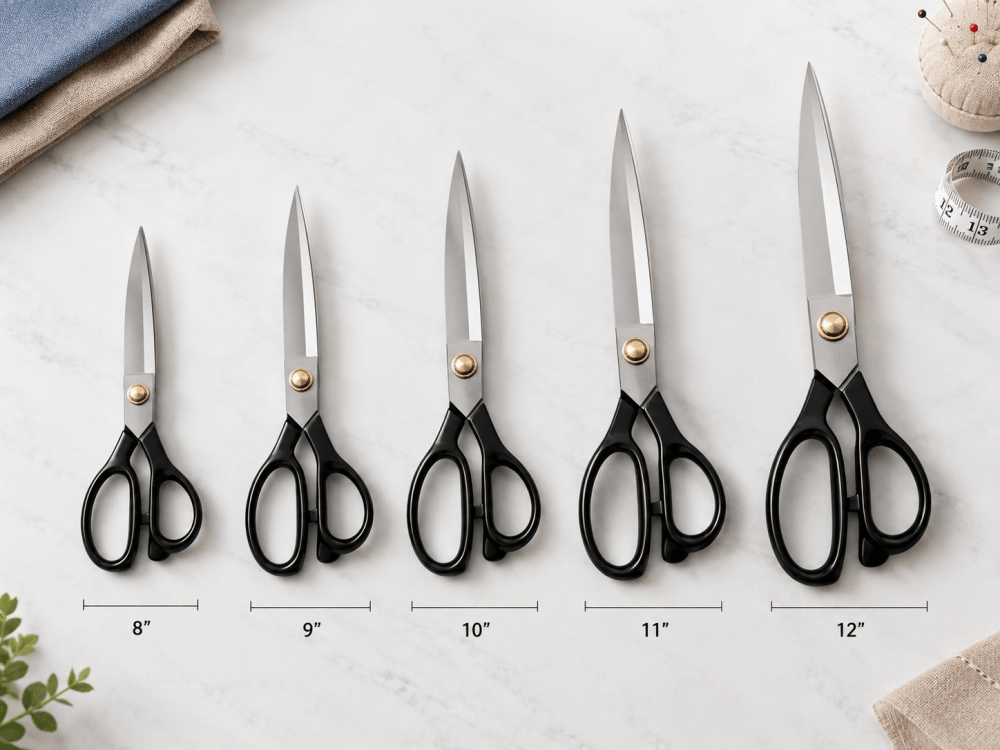
FASAKA's professional tailor scissors range includes multiple sizes for fabric-related applications. The Black Titanium Forged Handle Professional Tailor Scissors, for example, is available in 8, 9, 10, 11, and 12 inch sizes.
For brands, wholesalers, and distributors looking for customized products, you can learn more about FASAKA OEM/ODM Services.
Frequently Asked Questions About Good Sewing Scissors
What makes good sewing scissors?
Good sewing scissors typically have sharp and properly aligned blades, suitable steel and heat treatment, a secure pivot, comfortable handles, good balance, smooth operation, consistent cutting performance, and durable construction.
How can you tell if sewing scissors are good quality?
Check the blade sharpness and alignment, open and close the scissors to evaluate the pivot, test them on representative fabrics, inspect the handle, and assess overall balance and construction.
What should I look for when buying sewing scissors?
Look at blade sharpness, blade alignment, steel quality, heat treatment, blade length, pivot construction, handle comfort, balance, and the intended fabric application.
Are stainless steel sewing scissors good?
Stainless steel can be a good material for sewing scissors because of its combination of durability and corrosion resistance. However, the specific steel grade, heat treatment, blade geometry, and manufacturing quality also affect performance.
Does a sharper sewing scissor mean it is better?
Not necessarily. Sharpness is important, but overall quality also depends on blade alignment, steel, hardness, pivot construction, handle design, balance, and durability.
Are heavier sewing scissors better?
Not automatically. Heavier scissors may provide a substantial feel and can be suitable for some heavy-duty applications, but excessive weight can increase hand fatigue. The best weight depends on the cutting task and user.
What makes sewing scissors durable?
Durability depends on the complete construction, including blade material, heat treatment, grinding, pivot construction, handle assembly, fastening, and manufacturing consistency.
What should wholesalers check when buying sewing scissors?
Wholesalers should evaluate product specifications, cutting performance, steel and hardness, blade alignment, pivot construction, handle design, packaging, MOQ, sample approval, production lead time, and quality-control procedures.
Can good sewing scissors be customized for private label?
Yes. Depending on the manufacturer, sewing scissors can be customized in areas such as size, blade specifications, handle design, color, surface finish, logo, packaging, and product sets.
Final Takeaway
Good sewing scissors are defined by their overall performance and construction, not by one feature alone.
Before buying, focus on the eight fundamentals: blade sharpness, blade alignment, steel and heat treatment, pivot construction, handle design, balance, cutting consistency, and overall durability.
For home sewing, comfort and control may be the highest priorities. For professional tailoring and garment production, durability and consistent performance become more important. For B2B buyers, the evaluation should also include specifications, quality control, customization capability, MOQ, packaging, and production reliability.
Looking for Quality Sewing Scissors for Your Brand?
FASAKA supports B2B buyers with professional scissors, OEM/ODM customization, private-label development, and product specifications tailored to different fabric-cutting applications.
Contact FASAKA