




What Size Tailor Scissors Should You Choose? 8, 9, 10, 11 or 12 Inch
What Size Tailor Scissors Should You Choose? 8, 9, 10, 11 or 12 Inch
Choosing the right tailor scissors size can make a noticeable difference in fabric cutting. An 8-inch pair is easier to control, while longer 10-, 11-, or 12-inch tailor scissors can cover more fabric with each cutting movement. But longer does not automatically mean better.
The right size depends on your fabric type, cutting distance, hand comfort, workspace, cutting volume, and application. For home sewing, smaller sizes may be easier to manage. For professional tailoring, garment production, upholstery, or long straight cuts, longer shears can provide greater reach and efficiency.
Quick answer:
8-inch tailor scissors are compact and easy to control for general sewing, smaller pattern pieces, and lighter cutting. 9-inch is a practical middle ground for dressmaking and everyday fabric cutting. 10-inch offers a useful balance between control and cutting reach. 11-inch provides more blade reach for larger fabric pieces and heavier work. 12-inch tailor scissors are better suited to long, straight cuts, large fabric layouts, and professional or industrial applications.
The best size is therefore not simply the longest one you can buy. Choose the longest size that you can comfortably control throughout your normal cutting work.
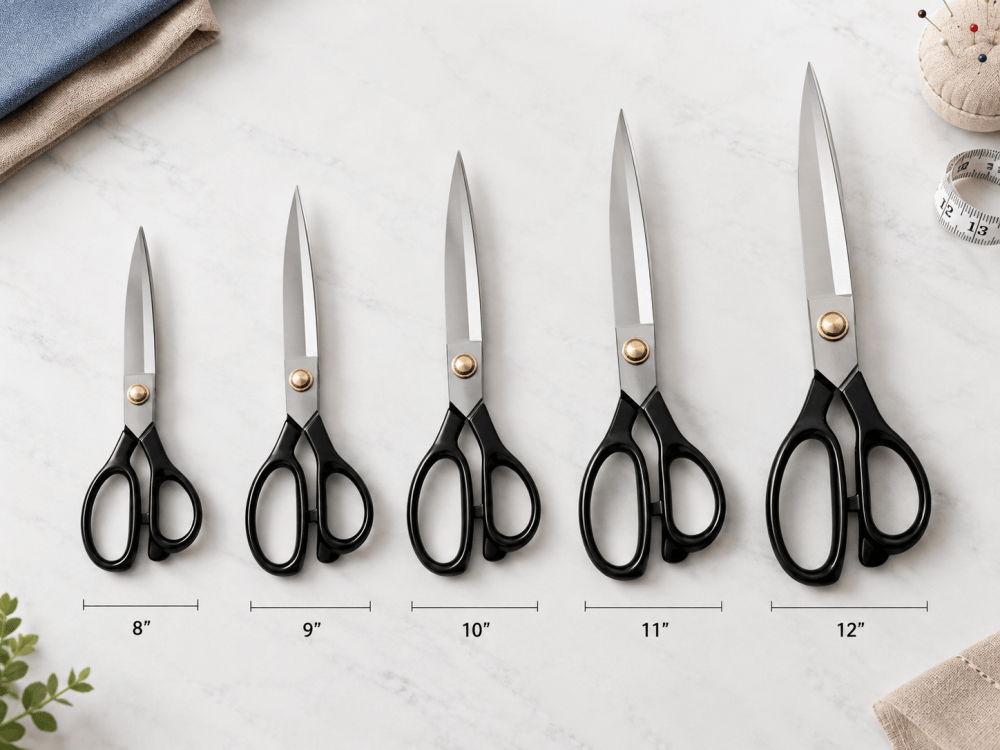
8, 9, 10, 11 or 12 Inch Tailor Scissors: Quick Comparison
The table below provides a practical starting point when comparing different tailor scissors sizes. The exact performance of a pair of scissors also depends on blade geometry, steel, handle design, balance, pivot adjustment, and manufacturing quality.
| Size | Typical Strength | Suitable Cutting | Common Applications | Control Level |
|---|---|---|---|---|
| 8" | Compact and maneuverable | Shorter cuts, smaller pieces, general fabric | Home sewing, alterations, crafts | High control |
| 9" | Balanced size | General fabric and dressmaking | Dressmaking, sewing studios, light professional work | High control with added reach |
| 10" | Balance of reach and control | Garment pieces and longer cuts | Tailoring, professional sewing, sample rooms | Balanced |
| 11" | Longer cutting stroke | Large fabric pieces and heavier materials | Professional workrooms, curtains, larger garments | More reach |
| 12" | Maximum reach in this range | Long straight cuts and large layouts | Industrial tailoring, upholstery, large fabric work | Requires good hand control |
Why Does Tailor Scissor Size Matter?
The advertised size of tailor scissors generally refers to the overall length of the scissors rather than the exact length of the cutting edge. As the overall size increases, the tool generally becomes larger and can provide greater cutting reach.
A longer pair can reduce the number of opening-and-closing movements required for a long straight cut. This can be useful when working on large garment panels, curtains, upholstery fabric, or production cutting tables.
A shorter pair, however, can feel easier to maneuver around corners, curves, smaller pattern pieces, and detailed areas. For this reason, professional cutting does not automatically mean choosing the largest available scissors.
Shorter Size
Easier to maneuver and control, especially around smaller pieces, curves, and detailed fabric work.
Medium Size
Provides a practical balance between cutting reach, control, comfort, and general tailoring use.
Longer Size
Covers more fabric per cutting movement and can be useful for long straight cuts and larger workpieces.
8-Inch Tailor Scissors: Who Should Choose Them?
8-inch tailor scissors are a good option when maneuverability and control are more important than maximum cutting reach. They can be useful for general sewing, dressmaking, quilting, alterations, crafts, and smaller garment pieces.
8-inch tailor scissors are suitable for:
- General fabric cutting
- Small and medium garment pieces
- Home sewing
- Alterations
- Quilting and fabric crafts
- Pattern work where close control is important
An 8-inch pair can also be a practical choice for users who find longer shears uncomfortable or difficult to control. The shorter format does not automatically mean lower quality; construction, blade geometry, balance, and sharpening still matter.
9-Inch Tailor Scissors: A Flexible Middle Ground
9-inch tailor scissors provide more reach than 8-inch models while remaining relatively easy to maneuver. This makes 9 inches a useful size for dressmaking and general fabric cutting where users want a little more cutting length without moving to a larger professional shear.
9-inch scissors can work well for:
- Dressmaking
- Cotton and linen fabrics
- Medium-sized garment pieces
- Everyday fabric cutting
- Small sewing studios
- Light professional tailoring
If you are deciding between 8 and 9 inches, consider whether you frequently make longer cuts. If you value compact handling and detailed control, 8 inches may feel easier. If you want additional reach for garment cutting, 9 inches can be a useful compromise.
10-Inch Tailor Scissors: The Balance Between Control and Reach
10-inch tailor scissors are widely used for professional fabric cutting because they provide more blade reach without becoming as large as 11- or 12-inch shears. They can be suitable for garment pieces, tailoring, pattern cutting, and longer fabric edges.
A 10-inch size can be particularly practical for users who want one pair of scissors for a broad range of professional cutting tasks. Some professional tailor scissor ranges are specifically offered in 10-inch and 12-inch versions, reflecting different preferences for reach and cutting style. :contentReference[oaicite:2]{index=2}
10-inch tailor scissors are suitable for:
- Professional tailoring
- Dressmaking
- Garment pattern cutting
- Longer fabric edges
- Medium-to-large garment pieces
- Regular workshop use
Why choose 10 inches? If 8 or 9 inches feels too short for your regular cutting work but 11 or 12 inches feels unnecessarily large, 10 inches can provide a practical balance between reach and control.
11-Inch Tailor Scissors: More Reach for Larger Work
11-inch tailor scissors move further toward professional and heavy-duty fabric cutting. The longer format can be useful when cutting larger fabric pieces or making repeated long cuts on a full-size cutting table.
11-inch scissors may be suitable for:
- Large garment pieces
- Professional tailoring
- Large fabric panels
- Heavier fabrics
- Curtain production
- Frequent workroom cutting
However, the larger size also means that the scissors require sufficient hand opening and workspace. If the user has smaller hands or frequently cuts tight curves, an 11-inch shear may not provide the same level of maneuverability as a shorter model.
12-Inch Tailor Scissors: When Do You Need Them?
12-inch tailor scissors are designed for users who value long cutting reach and efficient straight-line cutting. They are commonly associated with professional workrooms and larger cutting applications.
12-inch tailor scissors are particularly useful for:
- Long straight fabric cuts
- Large fabric layouts
- Heavy-duty tailoring
- Upholstery fabrics
- Curtain fabrics
- Large garment production
- Professional or industrial cutting environments
The advantage is cutting reach: a longer blade can cover more material in each closing movement. The trade-off is that a 12-inch pair can require more hand strength, workspace, and familiarity with long shears. Professional cutting guides commonly associate 11- and 12-inch shears with workroom cutting, long straight sections, upholstery, curtains, and larger fabric layouts. :contentReference[oaicite:3]{index=3}
8 vs 9 vs 10 vs 11 vs 12 Inch Tailor Scissors
Instead of asking which size is universally “best,” it is more useful to ask which size matches your cutting task.
| Cutting Requirement | Recommended Starting Size | Why |
|---|---|---|
| Small fabric pieces | 8" | Easy to control and maneuver |
| General sewing | 8–9" | Good balance of control and reach |
| Dressmaking | 9–10" | Additional reach for garment pieces |
| Professional tailoring | 10–11" | Efficient for longer fabric cuts |
| Large fabric panels | 11–12" | Longer cutting stroke |
| Upholstery and curtains | 11–12" | Useful for large, long cutting lines |
| Industrial fabric cutting | 10–12" | Choice depends on fabric, table size, and operator |
What Size Tailor Scissors Is Best for Different Fabrics?
Fabric thickness is important, but it should not be the only factor used to select scissor size. Blade quality, geometry, handle design, sharpness, and the number of layers being cut also influence performance.
| Fabric | Typical Size Range | Why |
|---|---|---|
| Cotton | 8–10" | Good control for general garment and sewing work |
| Linen | 8–10" | Suitable for general dressmaking and longer fabric edges |
| Silk | 8–9" | Shorter sizes can provide closer control |
| Denim | 9–11" | Additional leverage and reach can be useful for heavier fabric |
| Canvas | 10–12" | Longer, robust shears can be useful for larger or heavier cuts |
| Leather | 9–12" | Depends strongly on thickness, construction, and cutting method |
| Upholstery fabric | 10–12" | Large pieces often benefit from longer cutting reach |
These are practical starting ranges rather than strict rules. A high-quality 8-inch shear can outperform a poorly made 12-inch pair, especially when control and blade geometry are more important than cutting reach.
Does a Longer Tailor Scissor Cut Faster?
It can, particularly when making long, relatively straight cuts. A longer cutting edge can cover more fabric during each closing movement, which may reduce the number of strokes needed along a long pattern edge.
However, “faster” does not mean “better” for every task. Longer shears can be less agile around tight curves and small pattern pieces. They may also feel heavier or more demanding during extended use if the handle size, balance, and weight do not suit the user.
This is why the right question is not: “What is the longest tailor scissors I can buy?”
A better question is: “What is the longest size I can comfortably control for my normal cutting work?”
How Does Hand Size Affect Tailor Scissor Selection?
Hand size is an important but often overlooked factor. A larger scissor requires a larger opening and closing movement, so a user who cannot comfortably operate the handles may experience fatigue even if the blades are excellent.
When comparing sizes, consider:
- Can your fingers fit comfortably inside the handle?
- Can you fully open and close the blades without excessive effort?
- Can you maintain control near the blade tip?
- Does the handle create pressure points?
- Can you use the scissors repeatedly without excessive hand fatigue?
For professional users, comfort becomes particularly important because scissors may be opened and closed repeatedly throughout the working day. Handle geometry and balance should therefore be evaluated alongside overall length.
Blade Length vs Overall Scissor Length: Are They the Same?
No. When a product is described as an 8-inch, 10-inch, or 12-inch tailor scissor, the advertised size generally refers to the overall length of the tool. The actual cutting blade is shorter than the total scissor length.
This distinction matters when comparing products from different manufacturers. Two scissors with the same advertised length may have different blade lengths, handle dimensions, blade profiles, or overall weight.
For B2B purchasing, it is therefore better to specify the actual product dimensions rather than relying only on “10-inch” or “12-inch.”
What Else Should You Check Besides Size?
Size is only one part of tailor scissor performance. Before choosing a professional pair, evaluate the complete construction.
- Blade material: Check the specified steel and its intended application.
- Blade geometry: Blade thickness, profile, edge geometry, and alignment can affect cutting performance.
- Handle design: Offset, ergonomic, forged, or soft-grip handles can change comfort and control.
- Balance: A larger scissor should still feel controllable rather than excessively front-heavy.
- Pivot construction: Proper tension and stable blade movement are important for consistent cutting.
- Sharpness and finishing: A sharp blade alone is not enough; the two blades need to work together correctly.
- Intended fabric: Consider whether the scissors are designed for light fabric, denim, canvas, leather, upholstery, or multiple layers.
What Size Tailor Scissors Should Professionals Choose?
For professional users, the decision often comes down to the balance between cutting efficiency and operator control.
| Professional Application | Potential Size | Main Consideration |
|---|---|---|
| Alteration shop | 8–10" | Control and versatility |
| Dressmaking studio | 9–10" | Balance between control and reach |
| Garment sample room | 9–11" | Different fabric and pattern sizes |
| Garment production | 10–12" | Cutting efficiency and long fabric runs |
| Curtain production | 11–12" | Large fabric panels and long straight cuts |
| Upholstery | 10–12" | Heavy materials and large workpieces |
What Size Tailor Scissors Should B2B Buyers Order?
For wholesalers, distributors, sewing brands, and private-label buyers, size selection is slightly different from choosing one pair for personal use. Instead of asking which size is “best,” buyers should consider whether their target customers need one standard size or a multi-size product range.
For example, a sewing tools brand may offer:
- 8-inch scissors for general sewing and compact applications
- 9-inch scissors for dressmaking and everyday fabric cutting
- 10-inch scissors for professional tailoring
- 11-inch scissors for larger fabric and heavier applications
- 12-inch scissors for long straight cuts and industrial applications
Offering multiple sizes can allow distributors and retailers to target different customer groups without changing the core product category.
How to Specify Tailor Scissors Size in an OEM RFQ
If you are sourcing tailor scissors from a manufacturer, avoid sending only: “Please quote 10-inch tailor scissors.”
A more complete RFQ should specify the size together with the intended application and product construction.
Example OEM RFQ:
Professional tailor scissors for garment cutting
Size: 8", 9", 10", 11", and 12"
Blade: stainless steel
Handle: forged steel handle
Finish: black titanium coating
Application: denim, canvas, leather, upholstery
Logo: custom laser logo
Packaging: customized retail box
Target market: US and European sewing tool distributors
Quantity: 3,000 pcs per size
Please provide sample cost, MOQ, production lead time, packaging options, and bulk quotation.
FASAKA 8–12 Inch Professional Tailor Scissors
FASAKA offers professional tailor scissors in 8", 9", 10", 11", and 12" sizes, allowing B2B buyers to develop a multi-size tailor scissor range for different cutting applications.
The FASAKA SS23008 series features black titanium-coated stainless steel blades, forged one-piece steel handles, and reinforced brass rivets. The product is positioned for fabric, denim, leather, canvas, upholstery, curtain cutting, garment production, tailoring workshops, and sewing studios. :contentReference[oaicite:4]{index=4}
FASAKA also supports OEM and ODM tailor scissors, including custom logo engraving, private-label production, customized retail packaging, surface finishes, and multi-size packaging solutions. :contentReference[oaicite:5]{index=5}
For B2B buyers, this means the scissor size can be selected together with the blade material, handle construction, finish, logo, packaging, and target application rather than treating size as an isolated specification.
8 vs 9 vs 10 vs 11 vs 12 Inch: Which One Should You Choose?
Use the following decision guide as a quick reference:
| If Your Priority Is... | Consider |
|---|---|
| Maximum maneuverability | 8" |
| Everyday fabric cutting | 8–9" |
| Dressmaking and general tailoring | 9–10" |
| Balanced professional performance | 10" |
| Larger garment pieces | 10–11" |
| Long straight cuts | 11–12" |
| Large fabric layouts | 11–12" |
| Industrial or heavy-duty cutting | 10–12" |
Tailor Scissors Size Buying Checklist
Before choosing 8, 9, 10, 11, or 12 inch tailor scissors, check:
- What type of fabric will you cut?
- How thick is the fabric?
- Are you cutting one layer or multiple layers?
- Are most cuts short, curved, or long and straight?
- How large is your cutting table?
- Does the handle fit your hand comfortably?
- Is the scissor balanced?
- What steel is used for the blades?
- How is the blade finished and sharpened?
- Is the pivot adjustable?
- Will the scissors be used occasionally or every day?
- For B2B sourcing, do you need one size or multiple sizes?
FAQ About Tailor Scissors Sizes
There is no single best size for every user. 8–9 inch scissors generally emphasize maneuverability and control, while 10–12 inch scissors provide greater cutting reach for larger pieces and longer cuts. The right choice depends on your fabric, hand comfort, workspace, and application.
Yes. 8-inch tailor scissors can be useful for general fabric cutting, home sewing, alterations, quilting, and smaller garment pieces where control is important.
Yes. 10-inch tailor scissors can provide a useful balance between cutting reach and maneuverability and are suitable for many professional tailoring and dressmaking applications.
Not automatically. 12-inch scissors provide more reach and can be useful for long straight cuts and large fabric pieces, while 10-inch scissors can offer easier maneuverability. The better choice depends on the cutting task and user.
9–11 inch scissors can be a practical starting range for denim, depending on fabric thickness, number of layers, cutting distance, and the construction of the scissors.
For leather, 9–12 inch heavy-duty scissors may be considered depending on leather thickness and the cutting application. Blade construction and geometry are particularly important for heavier materials.
They can be. A longer cutting edge can cover more fabric with each cutting movement, which may reduce the number of strokes needed for long straight cuts. However, longer scissors can be less maneuverable around curves and smaller pieces.
Usually, the advertised size refers to the overall length of the scissors rather than the exact blade length. When comparing products from different manufacturers, B2B buyers should request complete product dimensions and specifications.
Yes. OEM tailor scissors can be developed in different sizes, handle designs, finishes, colors, logos, and packaging formats depending on the manufacturer's capabilities and project requirements.
Final Takeaway
Choosing between 8, 9, 10, 11, and 12 inch tailor scissors is mainly a question of balance. Smaller scissors provide greater maneuverability, while longer scissors can provide greater reach and efficiency for long fabric cuts.
For general sewing and smaller projects, 8–9 inches can be practical. For dressmaking and professional tailoring, 9–10 inches can offer a useful balance. For larger fabric pieces, long straight cuts, upholstery, curtains, and industrial applications, 10–12 inches may be more appropriate.
Most importantly, do not evaluate size alone. Blade material, blade geometry, handle design, balance, pivot construction, sharpness, fabric type, and user comfort all contribute to the final cutting performance.
Looking for Custom Tailor Scissors?
FASAKA provides professional tailor scissors in 8–12 inch sizes with OEM and ODM options for wholesalers, distributors, sewing brands, and private-label customers.
Get a Tailor Scissors Quote

