




What Are Sewing Scissors? Types, Uses & How to Choose
What Are Sewing Scissors? Types, Uses & How to Choose
Sewing scissors are cutting tools designed primarily for sewing, fabric cutting, tailoring, quilting, embroidery, and other textile work. Unlike general-purpose scissors, sewing scissors are selected around the characteristics of fabric and the type of cutting required.
Because fabric can move, stretch, fold, or shift during cutting, the right scissors need to provide controlled, consistent cutting rather than simply cutting through the material. Blade sharpness, blade alignment, handle design, overall size, balance, and the intended fabric all affect the cutting experience.
The term sewing scissors can also overlap with terms such as fabric scissors, fabric shears, dressmaking scissors, and tailor scissors. In practical use, the most important question is not only what the tool is called, but how it is designed and what type of cutting it is intended to perform.
Quick answer: What are sewing scissors?
Sewing scissors are scissors designed for cutting fabric and performing other sewing-related cutting tasks. They include general fabric-cutting scissors as well as more specialized tools for trimming, embroidery, applique, pinking, and other applications.
For general fabric cutting, look for sharp and consistently aligned blades, comfortable handles, appropriate blade length, good balance, and a design suited to your fabric. Keep your main fabric scissors dedicated to fabric rather than using them for paper, cardboard, packaging, or other abrasive materials.
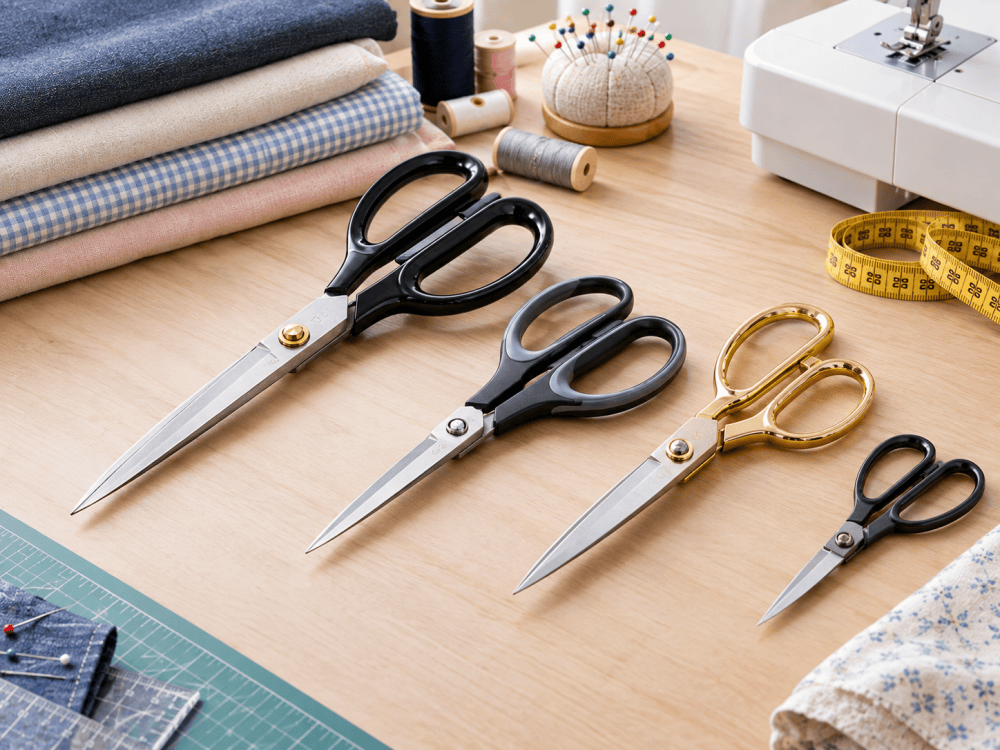
What Are Sewing Scissors Used For?
The main purpose of sewing scissors is to cut fabric and textile materials with control and consistency. Depending on the design, different sewing scissors can be used for everything from cutting large garment panels to trimming loose threads or making small detailed cuts.
Fabric Cutting
Cut cotton, linen, denim, polyester, felt, canvas, and other fabrics according to the intended application and scissor design.
Garment Making
Cut pattern pieces, garment panels, seam allowances, hems, and other components during dressmaking and tailoring.
Detailed Work
Use smaller sewing scissors or specialized scissors for thread trimming, embroidery, applique, and other precision tasks.
What Are the Different Types of Sewing Scissors?
There is no single type of sewing scissors for every sewing task. The appropriate tool depends on the material, cutting pattern, required precision, and amount of fabric being cut.
1. Fabric Scissors or Dressmaking Scissors
These are general fabric-cutting scissors designed for everyday sewing and garment work. They are typically used for cutting pattern pieces, fabric panels, seams, hems, and other relatively general-purpose fabric tasks.
For many sewing users, this is the main pair of scissors to choose first because it can cover a broad range of fabric-cutting applications.
2. Tailor Scissors
Tailor scissors are designed for controlled fabric cutting and are often larger and more robust than small sewing scissors. They can be suitable for professional tailoring, heavier fabrics, large fabric pieces, and long cutting lines.
Tailor scissors may also be called tailor shears, depending on the manufacturer or market. The terminology overlaps with other fabric-cutting scissors, so buyers should compare the actual blade length, handle geometry, construction, and intended application.
3. Embroidery Scissors
Embroidery scissors are smaller scissors designed for precision cutting. Their compact size and pointed blades can make them useful for trimming threads, working around embroidery details, and reaching small areas where large fabric shears would be difficult to control.
4. Pinking Shears
Pinking shears have blades designed to create a zigzag or sawtooth edge rather than a straight cut. They are used when the desired result is a decorative or functional patterned edge.
Pinking shears should therefore not be treated as a replacement for ordinary fabric-cutting scissors. They perform a different cutting function.
5. Thread Snips
Thread snips are compact cutting tools intended primarily for trimming threads and performing quick, small cutting tasks during sewing. They are useful at the sewing machine or worktable but are not normally a replacement for full-size fabric scissors.
6. Serrated or Micro-Serrated Fabric Scissors
Some fabric scissors use serrated or micro-serrated edges to help maintain contact with certain fabrics during cutting. The exact benefit depends on the blade design and material being cut, so buyers should evaluate the tool according to its intended application rather than assuming a serrated edge is always better.
Sewing Scissors vs Fabric Scissors: Are They the Same?
In many markets, sewing scissors and fabric scissors refer to overlapping categories. There is no universally consistent naming rule across manufacturers and retailers.
The Canadian government's TERMIUM Plus terminology database, for example, describes fabric shears as a subset of sewing scissors and notes that terms such as fabric scissors and fabric shears are often used interchangeably. In actual product catalogs, the same overlap can be seen between sewing scissors, fabric scissors, dressmaker shears, and tailor scissors.
Therefore, when comparing products, focus on:
- Blade length
- Blade shape and edge design
- Handle geometry
- Overall weight and balance
- Intended fabric
- Cutting application
- Handedness and user comfort
For B2B purchasing, the physical specifications are more useful than relying on the product name alone.
Sewing Scissors vs Regular Scissors: What's the Difference?
Regular household scissors can cut many materials, but they are not necessarily designed for controlled fabric cutting. Fabric is flexible and can shift during cutting, so fabric-specific scissors are designed around a different cutting requirement.
| Feature | Sewing Scissors | General-Purpose Scissors |
|---|---|---|
| Primary use | Fabric and sewing-related cutting | General household or craft tasks |
| Blade design | Optimized for controlled fabric cutting | Designed for broader material use |
| Fabric performance | Designed to provide clean and consistent fabric cuts | Depends heavily on the individual scissors |
| Handle design | Often designed around repeated cutting and user comfort | General-purpose ergonomic requirements |
| Typical use | Sewing, quilting, tailoring, garment making | Paper, packaging, household and craft tasks |
A dedicated pair of sewing scissors should generally be reserved for fabric. Cutting paper, cardboard, packaging, or other non-fabric materials can reduce the useful sharpness of the cutting edge over time.
Why Are Sewing Scissors Different for Fabric?
Fabric is not a rigid sheet. It can move, stretch, fold, and shift as the blades pass through it. A good fabric-cutting tool therefore needs to maintain control while producing a consistent cut.
For this reason, quality fabric scissors are commonly evaluated by their blade quality, edge consistency, handle comfort, balance, and smoothness of cutting. The Sewing & Craft Alliance recommends checking factors such as blade material, uniform cutting-edge width and angle, smooth cutting from the rear of the blades to the tips, and how the scissors feel in the hand.
This also explains why a pair of scissors that works well for paper may not be the best tool for sewing. The material and cutting requirements are different.
What Size Sewing Scissors Should You Choose?
The right size depends on the cutting task rather than simply choosing the largest available pair.
| Approximate Size | Typical Strength | Potential Applications |
|---|---|---|
| Small | High maneuverability | Thread trimming, embroidery, detailed work |
| Medium | Balance of control and reach | General sewing and fabric cutting |
| Large | Greater cutting reach | Dressmaking, tailoring, larger fabric pieces |
| Extra Large | Long cutting stroke | Large fabric panels, heavy fabrics, professional cutting |
For general sewing, a medium-size fabric shear can provide a useful balance between maneuverability and cutting reach. Longer shears can be more efficient for large, straight cuts, while shorter scissors can be easier to control for curves and detailed work.
If you want a detailed size comparison specifically for professional tailoring, see our guide: What Size Tailor Scissors Should You Choose? 8, 9, 10, 11 or 12 Inch .
What Sewing Scissors Are Best for Different Fabrics?
There is no single sewing scissor that is automatically best for every fabric. The ideal choice depends on fabric thickness, structure, number of layers, cutting length, and the type of edge you need.
| Fabric or Material | What to Look For | Potential Scissor Choice |
|---|---|---|
| Cotton | Sharp, smooth fabric-cutting edge | General fabric scissors or dressmaking shears |
| Linen | Clean cutting and good blade control | General sewing scissors |
| Silk | Precise control and clean edge | Sharp, well-aligned fabric scissors |
| Denim | Strong construction and sufficient cutting leverage | Sturdy fabric shears or tailor scissors |
| Canvas | Robust blade and handle construction | Heavy-duty fabric shears |
| Leather | Blade geometry suited to thickness | Heavy-duty scissors designed for the material |
| Multiple layers | Blade length, sharpness, leverage, and construction | Sturdy professional fabric shears |
For heavy or multi-layer materials, do not evaluate scissors only by their advertised size. Blade construction, edge geometry, handle design, balance, and the actual thickness of the material can have a significant effect on cutting performance.
Can Sewing Scissors Cut Multiple Layers of Fabric?
Yes, some sewing scissors can cut multiple layers of fabric, but the number of layers depends on the fabric and the scissors. There is no universal layer count that applies to every pair.
When cutting multiple layers, consider:
- Fabric thickness
- Fabric structure
- Number of layers
- Blade sharpness
- Blade length
- Handle leverage
- Scissor balance
- Cutting direction
For example, several layers of lightweight cotton are very different from several layers of denim or canvas. A manufacturer or buyer should therefore define the actual cutting application when specifying a product.
What Makes a Good Pair of Sewing Scissors?
A high-quality pair of sewing scissors is not defined by sharpness alone. Several components work together to determine cutting performance.
- Blade quality: The blade material should be appropriate for the intended application and manufacturing process.
- Edge consistency: The cutting edges should work smoothly together rather than creating uneven resistance.
- Blade alignment: Proper alignment helps maintain consistent contact during the cutting stroke.
- Handle comfort: The handle should allow repeated operation without unnecessary pressure points.
- Balance: The weight distribution should feel controlled in the user's hand.
- Pivot construction: The pivot affects blade movement, tension, and overall cutting feel.
- Blade length: Longer blades can improve efficiency on long cuts, while shorter blades can provide greater maneuverability.
- Intended application: The scissors should match the fabric, cutting method, and workload.
Should Sewing Scissors Have Stainless Steel Blades?
Stainless steel is one common choice for sewing scissors because corrosion resistance and durability can be useful for a tool that is frequently handled and stored in sewing environments. Other steel types may also be used depending on the desired hardness, edge characteristics, manufacturing process, cost, and product positioning.
When comparing stainless steel sewing scissors, do not look at the word “stainless” alone. For B2B sourcing, ask the manufacturer for the specific steel grade, blade thickness, heat-treatment specification where applicable, surface finish, and quality-control requirements.
The final cutting performance comes from the complete blade system and manufacturing process rather than the steel name alone.
Why Should You Not Use Sewing Scissors for Paper?
Sewing scissors are designed for fabric, so it is better to keep them dedicated to textile cutting. Paper and other non-fabric materials can be more abrasive to a fine cutting edge than fabric and may reduce the sharpness needed for clean fabric cutting.
A practical sewing setup should therefore separate:
- Fabric scissors: fabric and textiles
- Paper scissors: paper patterns and packaging materials
- Thread snips: thread trimming
- Embroidery scissors: small precision work
- Pinking shears: zigzag edge cutting
Keeping each tool for its intended application can help maintain predictable cutting performance.
Sewing Scissors vs Tailor Scissors vs Dressmaker Shears
These terms can be confusing because the sewing industry does not use them as perfectly separated categories. A tailor scissor may also be described as a tailor shear, while a fabric-cutting shear may be marketed as sewing scissors or dressmaker shears.
Instead of assuming that the name determines performance, compare:
| Factor | Why It Matters |
|---|---|
| Overall size | Influences reach, control, and hand comfort |
| Blade length | Affects how much fabric can be cut per stroke |
| Handle geometry | Changes hand position and cutting comfort |
| Blade geometry | Affects cutting behavior and precision |
| Weight | Influences control and fatigue during repeated cutting |
| Application | Determines whether the tool suits light, general, or heavy fabric work |
For a detailed terminology comparison, see: Tailor Scissors vs Sewing Scissors vs Dressmaker Shears: What's the Difference? .
How to Choose Sewing Scissors: A Practical Buying Guide
If you are choosing sewing scissors for yourself, a sewing studio, or a professional workshop, use the following process.
- Define the main fabric. Start with cotton, silk, denim, canvas, leather, or another specific material.
- Define the main cutting task. Decide whether you need long straight cuts, curves, trimming, detailed work, or thread cutting.
- Choose the appropriate size. Longer scissors provide greater reach, while shorter scissors can provide easier control.
- Check the handle. Make sure the handle fits the user's hand and supports repeated cutting.
- Check blade alignment. The blades should operate smoothly and consistently through the cutting stroke.
- Consider material and construction. Check the steel grade, blade construction, pivot, finish, and overall build quality.
- Test the actual cutting performance. Where possible, test the scissors on the fabrics they are intended to cut.
What Should B2B Buyers Check When Sourcing Sewing Scissors?
For wholesalers, distributors, retailers, sewing brands, and private-label buyers, selecting sewing scissors involves more than choosing a sharp pair. The product specification needs to match the target market and intended application.
A B2B sewing scissors specification should cover:
- Product type
- Overall length
- Blade length
- Blade material
- Blade thickness
- Blade finish
- Handle material
- Handle shape and color
- Left-handed or right-handed requirements
- Logo and branding
- Retail packaging
- Set configuration
- MOQ
- Sample requirements
- Production lead time
- Target market
- Intended fabric and application
- Quality-control requirements
How to Write an OEM Sewing Scissors RFQ
If you are requesting a quotation from a sewing scissors manufacturer, provide enough technical information for the supplier to understand the intended product.
Example Sewing Scissors OEM RFQ:
Product: Professional sewing scissors
Size: 8 inch
Application: General fabric cutting and dressmaking
Blade: Stainless steel
Blade finish: Polished
Handle: Forged steel handle with custom finish
Logo: Custom laser logo
Packaging: Custom retail box
Target market: US sewing and craft retailers
Quantity: 3,000 pcs
Please quote MOQ, sample cost, production lead time, packaging options, and bulk price.
The more specific the application is, the easier it is for a manufacturer to recommend an appropriate blade construction, size, handle design, and production configuration.
Can Sewing Scissors Be Customized for OEM?
Yes. Depending on the manufacturer's capabilities, sewing scissors can be customized for private-label and OEM projects. Customization may include the product size, blade finish, handle design, color, logo, packaging, and product configuration.
For larger B2B projects, buyers can also develop a multi-size range, such as general sewing scissors for everyday fabric cutting combined with larger tailor scissors for professional applications.
This approach allows a sewing brand or distributor to build a more complete cutting-tool range instead of relying on a single product specification.
FASAKA Sewing & Fabric Cutting Scissors
FASAKA is a brand under DKS Enterprises Co., Ltd., a manufacturer and supplier based in Yangjiang, Guangdong, China, specializing in hardware knives and scissors, BBQ tools, and kitchenware.
For sewing and textile applications, FASAKA can support B2B buyers with professional scissors and tailor scissors designed for different fabric-cutting requirements. Product specifications can be developed around factors such as size, blade material, handle construction, finish, logo, packaging, and target application.
FASAKA's professional tailor scissor range includes multiple sizes from 8 to 12 inches, giving distributors and private-label customers flexibility when developing different sewing and tailoring products.
FAQ About Sewing Scissors
Sewing scissors are primarily used for cutting fabric and textiles. Depending on the type, they can also be used for trimming threads, embroidery, applique, pinking edges, and other sewing-related cutting tasks.
The terms often overlap. Fabric scissors are commonly used as a general term for scissors designed to cut fabric, while sewing scissors can refer to a broader category of scissors used for sewing-related cutting tasks.
For general fabric cutting, choose scissors with sharp and consistently aligned blades, a comfortable handle, suitable size, good balance, and construction appropriate for the fabric. The best choice depends on the specific material and cutting application.
Regular scissors may cut fabric, but fabric-specific sewing scissors are generally designed to provide more controlled and consistent textile cutting. For better long-term fabric-cutting performance, keep a dedicated pair of scissors for fabric.
Choose the size according to your main cutting task. Smaller scissors provide more maneuverability for detail work, while larger fabric shears provide more reach for long cuts and large fabric pieces.
Yes, suitable sewing or tailor scissors can be used for denim. For heavier denim or multiple layers, choose a robust pair with appropriate blade geometry, sharpness, handle leverage, and construction.
Some heavy-duty fabric or tailor scissors can cut leather, but the appropriate tool depends on leather thickness and construction. Buyers should confirm the manufacturer's intended application before selecting scissors for leather.
Sewing scissors are designed around fabric cutting. Paper and other non-fabric materials can wear a fine cutting edge more quickly, so it is better to keep a separate pair for paper and packaging.
Yes. Depending on the manufacturer's capabilities, OEM sewing scissors can be customized in areas such as size, blade finish, handle design, logo, color, packaging, and product configuration.
Final Takeaway
Sewing scissors are not simply ordinary scissors with a different label. They are tools selected and designed around the requirements of fabric and sewing-related cutting.
For general fabric cutting, choose a pair with suitable blade length, sharp and consistent cutting edges, comfortable handles, good balance, and construction appropriate for your fabric. For specialized tasks, use the corresponding tool rather than expecting one pair of scissors to perform every job.
Most importantly, do not choose sewing scissors by name alone. Blade geometry, size, handle design, balance, material, cutting application, and user comfort are more useful specifications when comparing products.
Looking for Custom Sewing Scissors?
FASAKA supports B2B buyers with professional scissors, tailor scissors, OEM/ODM development, private-label branding, and customized packaging for different market requirements.
Get a Sewing Scissors Quote
