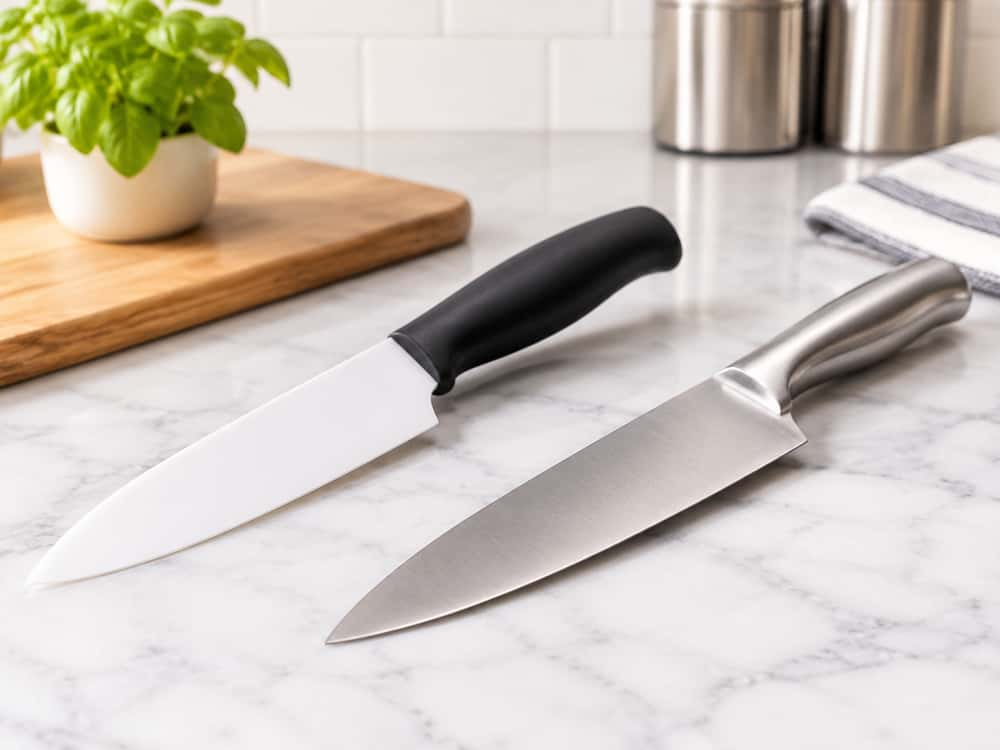




What Are Ceramic Knives Made Of? Understanding Zirconia Ceramic Blades
What are ceramic knives made of? Most modern ceramic kitchen knives are made from zirconia ceramic, a high-performance material based on zirconium dioxide (ZrO₂). Unlike traditional metal kitchen knives, ceramic knives use a non-metallic blade material known for its high hardness, wear resistance, lightweight feel, and excellent resistance to blade corrosion.
But zirconia is more than simply a hard material. Its performance depends on powder quality, manufacturing processes, sintering conditions, blade design, and finishing. Understanding what goes into a ceramic knife helps consumers, retailers, and kitchenware buyers evaluate its advantages, limitations, and applications.
In this guide, we explain what ceramic knife blades are made of, how zirconia ceramic blades are manufactured, and what makes them different from stainless steel kitchen knives.
Quick Answer: What Material Is Used in Ceramic Knives?
Most ceramic kitchen knife blades are made from zirconium dioxide (ZrO₂), commonly known as zirconia. Zirconia powder is processed and sintered at high temperatures to form a dense, hard ceramic blade.
Zirconia ceramic offers excellent hardness and wear resistance, but it is more brittle than stainless steel. This makes ceramic knives suitable for controlled slicing tasks rather than heavy-duty cutting or prying.
1. What Are Ceramic Knives Made Of?
Most modern ceramic kitchen knives are made from zirconia, or zirconium dioxide (ZrO₂). Zirconia is an advanced ceramic material widely used in applications that require high hardness, wear resistance, and chemical stability.
Unlike stainless steel, which is an iron-based metal alloy, zirconia is a ceramic compound. It does not contain iron as its main component and does not rust like a conventional steel blade.
The material used in a ceramic knife is not simply natural zirconium or ordinary pottery clay. It is a specially prepared ceramic material that undergoes controlled processing to achieve the density and mechanical properties needed for a cutting blade.
What Is Zirconium Dioxide?
Zirconium dioxide, with the chemical formula ZrO₂, is an inorganic compound made from zirconium and oxygen. It is valued for its hardness, wear resistance, and ability to maintain useful mechanical properties in demanding applications.
In ceramic knife production, zirconia is processed into a dense ceramic body. The finished blade is then shaped and sharpened to create a cutting edge.
Is Every Ceramic Knife Made from Zirconia?
No. The term "ceramic" refers to a broad category of non-metallic inorganic materials. However, zirconia is the material most commonly associated with modern ceramic kitchen knife blades.
When comparing ceramic knives, buyers should look beyond the general term "ceramic" and ask about the actual blade material, material grade, manufacturing quality, and product specifications.
2. Why Is Zirconia Used for Ceramic Knife Blades?
Zirconia is selected for ceramic knife production because it combines several properties that are useful for precision cutting applications.
High Hardness
Zirconia ceramic is very hard compared with most common knife steels. This helps the blade resist surface wear and maintain its cutting edge during normal use.
High hardness is one reason ceramic knives can remain sharp for a relatively long time when used correctly. However, hardness alone does not determine cutting performance. Blade geometry, edge finishing, and manufacturing quality also matter.
Excellent Wear Resistance
Zirconia ceramic has good resistance to abrasive wear. This property helps reduce the rate at which the cutting edge wears during suitable slicing tasks.
For users who mainly prepare fruits and vegetables, a well-made ceramic knife can offer consistent cutting performance without frequent conventional sharpening.
Resistance to Blade Corrosion
Because zirconia is a ceramic rather than an iron-based metal, its blade does not rust like stainless or carbon steel. It also has good chemical stability in ordinary food preparation environments.
This makes ceramic blades attractive to users who want a knife with low blade-corrosion concerns. However, the handle, fittings, and other components may still require appropriate care.
Lightweight Feel
Ceramic blades are generally lightweight compared with many metal blades. This can make ceramic knives comfortable to handle during repetitive slicing tasks.
The overall weight of a knife still depends on its blade dimensions, handle material, and construction.
3. How Are Zirconia Ceramic Knives Made?
Manufacturing a ceramic knife involves more than shaping a piece of ceramic material. Zirconia powder must be processed under controlled conditions to create a dense blade with suitable mechanical properties.
Although specific production methods vary by manufacturer, the general process includes several key stages.
Step 1: Zirconia Powder Preparation
The process begins with specially prepared zirconia ceramic powder. Material composition, particle characteristics, and powder quality can influence the consistency and performance of the final ceramic body.
Step 2: Forming the Blade Shape
The prepared powder is placed into a mold and formed into a blade-shaped component. Forming methods and production parameters depend on the manufacturer's equipment and product requirements.
At this stage, the blade has its basic shape, but it has not yet reached its final density and mechanical properties.
Step 3: High-Temperature Sintering
The formed ceramic body is heated at a carefully controlled high temperature in a process known as sintering.
During sintering, ceramic particles bond together and the material becomes denser. This stage is essential for developing the strength, hardness, and structural integrity of the finished zirconia component.
Step 4: Grinding and Edge Sharpening
After sintering, the blade is ground and finished to achieve its required dimensions and cutting geometry. Because zirconia is extremely hard, specialized abrasive tools are generally needed for shaping and sharpening.
The cutting edge must be carefully finished to achieve the desired sharpness and consistency.
Step 5: Handle Assembly and Quality Inspection
The finished blade is assembled with a suitable handle. Depending on the product design, manufacturers may use different handle materials, shapes, colors, and joining methods.
Quality inspection may include checks of blade appearance, dimensions, edge condition, handle assembly, and overall product consistency.
The final quality of a ceramic knife depends on the entire production process, not just the zirconia material itself.
4. What Are the Main Properties of Zirconia Ceramic Blades?
Zirconia ceramic has a distinctive combination of physical and mechanical properties. The following table summarizes the characteristics most relevant to kitchen knife applications.