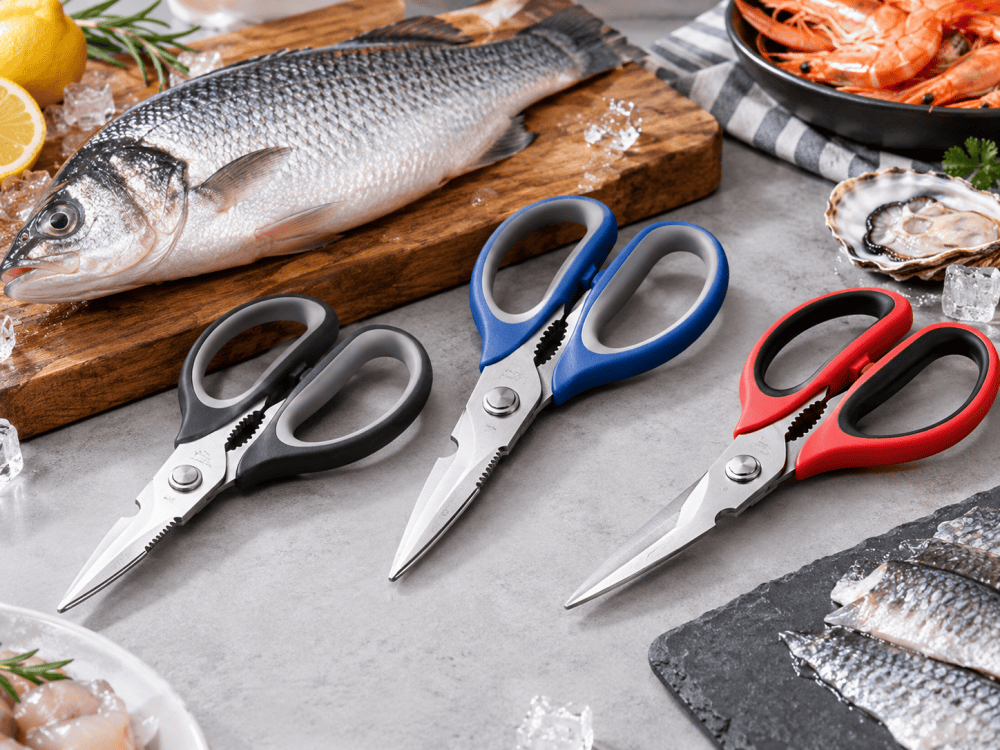

Straight Blade vs Serrated Blade Kitchen Scissors: Which Blade Type Is Right for You?
Kitchen scissors are one of the most versatile tools in any kitchen, making food preparation faster, safer, and more efficient. Whether you're trimming chicken, cutting herbs, opening food packaging, or preparing seafood, a quality pair of kitchen scissors can often replace a knife for many everyday tasks.
However, many buyers focus only on handle comfort, stainless steel quality, or whether the scissors are detachable. One of the most important features is frequently overlooked—the blade edge.
Kitchen scissors generally use one of two blade designs:
- Straight Blade
- Serrated Blade (Micro-Serrated Blade)
Although they may appear similar, these blade types perform very differently. Straight blades deliver smooth, precise cuts, while serrated blades grip slippery food and tough materials more effectively.
In this guide, we'll compare straight blade and serrated blade kitchen scissors in terms of cutting performance, durability, sharpening, maintenance, food applications, and buying recommendations to help you choose the right tool for your kitchen.
Quick Answer
Straight blade kitchen scissors provide clean, smooth, and highly precise cuts, making them ideal for vegetables, herbs, fruit, and everyday food preparation.
Serrated blade kitchen scissors feature tiny teeth that grip slippery surfaces, making them the preferred choice for cutting meat, poultry, seafood, tough packaging, and foods with smooth skins.
For maximum versatility, many professional kitchens use both blade types for different cutting tasks.
What Are Straight Blade Kitchen Scissors?
Straight blade kitchen scissors have smooth cutting edges without teeth or grooves. The two blades slide cleanly past each other, creating precise and effortless cuts through soft and medium-density foods.
This traditional blade design has been used for decades because it produces clean cutting lines with minimal tearing, making it popular for delicate food preparation.
Advantages of Straight Blade Kitchen Scissors
- ✔ Smooth and accurate cutting
- ✔ Excellent precision for detailed food preparation
- ✔ Easy to sharpen using standard sharpening tools
- ✔ Produces clean cutting edges
- ✔ Ideal for herbs, vegetables, and fruit
- ✔ Lower manufacturing complexity
Disadvantages
- May slip on smooth meat surfaces
- Less grip when cutting raw chicken skin
- Requires sharper edges to maintain performance
- Can struggle with slippery seafood
Straight blades prioritize precision rather than gripping power.
What Are Serrated Blade Kitchen Scissors?
Serrated blade kitchen scissors feature small teeth along one or both cutting edges. These teeth grip food before cutting, preventing slippery ingredients from sliding away during use.
Some scissors use large serrations, while many premium kitchen scissors feature micro-serrated blades, which provide better control without sacrificing cutting smoothness.
Micro-serrated blades are especially common in professional poultry shears, seafood scissors, and BBQ kitchen scissors because they improve grip when cutting greasy or moist ingredients.
Advantages of Serrated Blade Kitchen Scissors
- ✔ Excellent grip on slippery food
- ✔ Better control when cutting raw meat
- ✔ Reduces blade slipping
- ✔ Stays effective even after slight wear
- ✔ Excellent for poultry and seafood preparation
- ✔ Cuts tough packaging more easily
Disadvantages
- More difficult to sharpen
- Can leave rougher cutting edges
- Cleaning requires extra attention around the teeth
- Usually costs slightly more to manufacture
Serrated blades sacrifice a little precision in exchange for much better grip and cutting control.
Blade Geometry Comparison
Although both blade types use stainless steel and similar handle designs, their cutting geometry creates very different user experiences.
| Feature | Straight Blade | Serrated Blade |
|---|---|---|
| Blade Edge | Smooth | Micro-serrated or toothed |
| Grip | ★★★☆☆ | ★★★★★ |
| Cut Precision | ★★★★★ | ★★★★☆ |
| Ease of Sharpening | ★★★★★ | ★★★☆☆ |
| Cutting Slippery Food | ★★★☆☆ | ★★★★★ |
| Cleaning | ★★★★★ | ★★★★☆ |
| Typical Users | Home cooks, bakers, vegetable preparation | Chefs, BBQ enthusiasts, seafood preparation |
Why Blade Design Matters
The blade edge determines how the scissors interact with food. A straight blade relies on a razor-sharp edge to slice cleanly through ingredients, while a serrated blade uses tiny teeth to grip the surface before cutting. This difference significantly affects performance when working with slippery meat, seafood, vegetables, or packaging materials.
Understanding these blade characteristics helps buyers choose kitchen scissors that match their cooking style instead of simply selecting the most expensive model.
Coming Up in Part 2
In Part 2, we'll compare straight and serrated blade kitchen scissors in real-world use, including cutting performance, grip, sharpness retention, ease of sharpening, durability, cleaning, and which blade works best for chicken, seafood, vegetables, herbs, pizza, frozen food, and professional kitchens.
Straight Blade vs Serrated Blade: Performance Comparison
While both blade types are capable of handling everyday kitchen tasks, their performance varies considerably depending on the ingredient being cut. Understanding these differences helps you select the right kitchen scissors for maximum efficiency and safety.
Below is a side-by-side comparison of the most important performance factors.
| Performance | Straight Blade | Serrated Blade |
|---|---|---|
| Cutting Precision | ★★★★★ | ★★★★☆ |
| Grip on Slippery Foods | ★★★☆☆ | ★★★★★ |
| Sharpness Retention | ★★★★☆ | ★★★★★ |
| Ease of Sharpening | ★★★★★ | ★★★☆☆ |
| Cleaning | ★★★★★ | ★★★★☆ |
| Heavy-Duty Cutting | ★★★★☆ | ★★★★★ |
Cutting Performance
Straight blade kitchen scissors excel at making smooth, clean cuts. Because the cutting edge is continuous, they slice through herbs, vegetables, fruit, dough, and soft foods with minimal tearing.
Serrated blade kitchen scissors work differently. Instead of relying solely on sharpness, the tiny teeth grip the food first, then cut through it. This prevents ingredients from sliding away, making them especially effective for meat, poultry, seafood, and foods with smooth or slippery surfaces.
Straight Blade = Precision Cutting
Serrated Blade = Maximum Grip
Grip Comparison
Grip is where serrated blades truly shine.
When cutting raw chicken skin, fish fillets, steak, or seafood, smooth blades can occasionally slide across the surface before biting into the food. Serrated edges eliminate this problem by creating multiple contact points that hold the ingredient firmly during cutting.
This added grip improves both efficiency and safety, reducing the force needed to complete each cut.
Which Blade Stays Sharp Longer?
Straight blades generally deliver sharper cuts initially, but because the entire edge contacts the material during every cut, they may lose their razor edge slightly faster with heavy use.
Micro-serrated blades distribute cutting pressure across many small teeth. Even as some teeth wear down, the remaining serrations continue gripping the material effectively, helping the scissors maintain usable cutting performance for a longer period.
Winner for Edge Retention: Serrated Blade
Ease of Sharpening
Straight blade kitchen scissors are much easier to sharpen. Most users can restore the cutting edge using a sharpening stone, ceramic rod, or dedicated scissor sharpener.
Serrated blades require more specialized sharpening tools because each tooth must be sharpened individually. Improper sharpening may damage the serration profile and reduce cutting performance.
For users who regularly maintain their own kitchen tools, straight blades offer a significant advantage.
Cleaning and Maintenance
Straight blade scissors are generally easier to clean because the smooth cutting edge has no grooves where food particles can become trapped.
Serrated blades require a little more attention, especially after cutting fatty meat or seafood. Small food particles may remain between the teeth and should be removed with a soft brush during washing.
If the scissors also feature a detachable design, cleaning both blade types becomes much easier.
Which Blade Works Best for Different Foods?
| Food | Straight Blade | Serrated Blade |
|---|---|---|
| Raw Chicken | ★★★★☆ | ★★★★★ |
| Steak & Meat | ★★★★☆ | ★★★★★ |
| Fish & Seafood | ★★★★☆ | ★★★★★ |
| Fresh Herbs | ★★★★★ | ★★★★☆ |
| Vegetables | ★★★★★ | ★★★★☆ |
| Pizza | ★★★★★ | ★★★★★ |
| Frozen Food Packaging | ★★★★☆ | ★★★★★ |
| Plastic Packaging | ★★★★☆ | ★★★★★ |
Which Blade Do Professional Chefs Prefer?
Professional chefs rarely rely on a single blade style. Instead, they choose the blade that best matches the task.
- Straight blades are commonly used for herbs, garnishes, vegetables, pastry, and precise food preparation.
- Serrated blades are preferred for trimming poultry, portioning meat, cleaning seafood, opening vacuum packaging, and cutting through slippery ingredients.
In commercial kitchens, many premium kitchen scissors combine both blade styles by using one straight blade and one micro-serrated blade. This hybrid design delivers the precision of a straight edge while adding the gripping power of serrations, making it one of the most versatile options available.
Coming Up in Part 3
In Part 3, we'll explain how to choose the right blade type based on your cooking style, compare stainless steel materials, provide a professional buying checklist, discuss OEM customization options, and answer the most frequently asked questions about straight and serrated blade kitchen scissors.
How to Choose the Right Kitchen Scissors Blade Type
Choosing between straight blade and serrated blade kitchen scissors depends on how you cook, what ingredients you prepare most often, and how much maintenance you're willing to perform. Neither blade design is universally better—they simply excel in different situations.
The following recommendations can help you identify which blade type best matches your cooking habits.
| User Type | Recommended Blade | Reason |
|---|---|---|
| Home Cook | Straight Blade | Clean cuts for everyday vegetables, herbs, and food preparation. |
| Family Cooking Raw Chicken | Serrated Blade | Improved grip on slippery poultry skin. |
| BBQ Enthusiast | Serrated Blade | Better control when trimming ribs, brisket, and steaks. |
| Restaurant Kitchen | Hybrid Blade (Straight + Serrated) | Maximum versatility for different ingredients. |
| Seafood Preparation | Serrated Blade | Excellent grip on fish and shellfish. |
| Bakery & Pastry | Straight Blade | Produces neat, accurate cuts. |
Why Many Premium Kitchen Scissors Use Both Blade Types
Many premium kitchen scissors combine one straight blade with one micro-serrated blade instead of using two identical cutting edges.
This hybrid configuration offers several advantages:
- ✔ The straight blade delivers clean, smooth cuts.
- ✔ The serrated blade grips slippery ingredients before cutting.
- ✔ Improved cutting control with less hand pressure.
- ✔ Greater versatility across different kitchen tasks.
- ✔ Popular among professional chefs and commercial kitchens.
Hybrid Blade Design = Precision + Grip
Choosing the Right Stainless Steel
Blade geometry is only part of the equation. The steel used for the blades also affects sharpness, corrosion resistance, durability, and overall performance.
| Steel Grade | Characteristics | Best For |
|---|---|---|
| 420J2 | Highly corrosion-resistant and economical. | Household kitchen scissors. |
| 3Cr13 | Excellent balance of hardness, toughness, and price. | Most retail kitchen scissors. |
| 5Cr15MoV | Superior edge retention and wear resistance. | Professional-grade kitchen scissors. |
For most households and retailers, 3Cr13 stainless steel offers the best balance of cutting performance, corrosion resistance, durability, and cost.
How Straight and Serrated Kitchen Scissors Are Manufactured
Although straight blade and serrated blade kitchen scissors may look similar, their manufacturing processes are quite different. The blade edge geometry is created during production and directly affects cutting performance, durability, sharpening characteristics, and overall product quality.
Professional manufacturers invest heavily in precision machining and quality control to ensure every pair of kitchen scissors delivers smooth operation and long service life.
1. Stainless Steel Selection
Manufacturing begins with selecting the appropriate stainless steel grade. Common materials include 420J2, 3Cr13, and 5Cr15MoV. Each steel offers a different balance of hardness, corrosion resistance, toughness, and edge retention.
| Steel | Hardness | Typical Use |
|---|---|---|
| 420J2 | 50–53 HRC | Entry-level scissors |
| 3Cr13 | 52–55 HRC | General kitchen scissors |
| 5Cr15MoV | 56–58 HRC | Professional scissors |
2. Blade Stamping
High-tonnage stamping machines cut each blade from stainless steel sheets with exceptional dimensional accuracy. Precision stamping ensures both blades align perfectly after assembly.
3. Heat Treatment
The blades undergo controlled heat treatment to improve hardness and wear resistance while maintaining sufficient toughness to resist chipping and cracking.
4. Precision Grinding
This stage creates the final cutting edge.
- Straight blades are ground into a continuous razor edge.
- Serrated blades require precision machining to create evenly spaced teeth.
Manufacturing serrated blades is significantly more complex because each tooth must have identical spacing, depth, and cutting angle.
5. CNC Serration Machining
Premium micro-serrated blades are often produced using CNC grinding equipment that machines hundreds of tiny teeth with extremely tight tolerances. Uniform serrations ensure consistent grip and cutting performance.
6. Surface Finishing
After grinding, the blades are polished or satin-finished to improve corrosion resistance and enhance product appearance.
7. Handle Injection Molding
Handles are molded from materials such as PP, TPR, or ABS, providing comfort, durability, and slip resistance.
8. Assembly and Adjustment
The blades are assembled using precision rivets or detachable pivot mechanisms. Blade tension is carefully adjusted to achieve smooth opening, controlled resistance, and optimal cutting force.
9. Quality Inspection
Professional manufacturers test each batch for:
- Blade alignment
- Opening and closing smoothness
- Sharpness
- Cutting force
- Corrosion resistance
- Handle strength
- Durability
A premium pair of kitchen scissors goes through dozens of manufacturing and inspection processes before reaching consumers.
Common Blade Problems and How to Fix Them
Even the highest-quality kitchen scissors require proper care. Understanding common problems helps extend blade life and maintain optimal cutting performance.
Why Do Straight Blade Kitchen Scissors Become Dull Faster?
Straight blades rely entirely on a razor-sharp edge. Repeated cutting of hard materials, bones, frozen food, or plastic packaging gradually wears the edge down.
Solution: Sharpen regularly using a dedicated scissor sharpener or whetstone and avoid using kitchen scissors for non-food materials.
Why Do Serrated Blades Lose Their Grip?
Although serrated blades generally stay effective longer, heavy commercial use may eventually round off the teeth, reducing their gripping ability.
Solution: Professional sharpening or blade replacement may be required for heavily worn serrations.
Can Serrated Kitchen Scissors Be Sharpened at Home?
Yes, but sharpening serrated blades is much more difficult than sharpening straight blades. Each serration must be sharpened individually using specialized cone-shaped sharpening tools.
Many users choose professional sharpening services for premium kitchen scissors.
Why Do My Kitchen Scissors Feel Loose?
After years of use, the pivot rivet or screw may loosen slightly, reducing cutting efficiency.
Solution: Tighten adjustable pivots when possible or replace worn pivot hardware if necessary.
Why Are My Kitchen Scissors Rusting?
Even stainless steel can develop corrosion if food residue, salt, or moisture remains on the blades for extended periods.
Solution:
- Wash immediately after use.
- Dry thoroughly.
- Store in a dry location.
- Apply a small amount of food-safe mineral oil periodically.
Should Kitchen Scissors Be Oiled?
Yes. A drop of food-grade mineral oil applied to the pivot every few months keeps the blades opening smoothly while reducing wear.
How Often Should Kitchen Scissors Be Sharpened?
| Usage | Suggested Sharpening |
|---|---|
| Occasional Home Use | Every 12–18 months |
| Frequent Home Cooking | Every 6–12 months |
| Restaurant Kitchen | Every 2–4 months |
| Commercial Food Processing | Monthly inspection |
Expert Tip
If you're purchasing kitchen scissors for a retail brand or OEM project, don't choose a blade style based solely on appearance. Consider your target users, common food preparation tasks, expected maintenance, and long-term durability requirements. Straight blades are ideal for precision and easy sharpening, while serrated blades offer superior grip and edge retention. For maximum versatility, a hybrid blade design remains the preferred choice for many premium kitchen scissors on today's market.
Kitchen Scissors Buying Checklist
Before purchasing kitchen scissors, check the following features:
- ✔ Food-grade stainless steel blades
- ✔ Straight, serrated, or hybrid blade design suitable for your cooking style
- ✔ Comfortable ergonomic handles
- ✔ Non-slip soft-grip material
- ✔ Precision-ground cutting edges
- ✔ Strong pivot construction
- ✔ Rust-resistant finish
- ✔ Easy-to-clean design
- ✔ Optional detachable blades for improved hygiene
- ✔ Manufacturer with strict quality control standards
Why Choose FASAKA for OEM Kitchen Scissors?
FASAKA is an experienced kitchen scissors manufacturer providing OEM and ODM solutions for global brands, distributors, supermarkets, and wholesalers. We manufacture household kitchen scissors, poultry shears, seafood scissors, BBQ scissors, multifunction kitchen shears, and professional culinary scissors.
Our Manufacturing Advantages
- Custom straight blade, serrated blade, or hybrid blade designs
- Multiple stainless steel options including 420J2, 3Cr13, and 5Cr15MoV
- Laser logo engraving and private labeling
- Custom handle colors and materials (PP, TPR, ABS)
- Retail-ready packaging and gift box customization
- Strict quality inspection throughout production
- Stable production capacity for bulk orders
- Comprehensive OEM and ODM development support
Looking for High-Quality Kitchen Scissors?
Whether you need straight blade scissors for precision cutting or serrated blade kitchen scissors for heavy-duty food preparation, FASAKA provides professional manufacturing solutions tailored to your market.
Contact our team today to discuss OEM customization, private labeling, and wholesale kitchen scissors for your business.
Frequently Asked Questions
Are serrated kitchen scissors better than straight blade scissors?
Not necessarily. Serrated blades are better for gripping slippery foods like chicken and seafood, while straight blades provide cleaner and more precise cuts for vegetables, herbs, and general food preparation.
Can serrated kitchen scissors be sharpened?
Yes, but sharpening serrated blades is more difficult because each serration must be sharpened individually using specialized tools or professional sharpening services.
Why do professional kitchen scissors have serrated blades?
Micro-serrated blades help prevent slipping when cutting raw meat, poultry, seafood, and other smooth or greasy ingredients, improving both safety and efficiency.
Which blade lasts longer?
Serrated blades often maintain effective cutting performance longer because the individual teeth continue gripping materials even as the cutting edge experiences normal wear.
Which blade is better for herbs?
Straight blades are generally the better choice for herbs because they create cleaner cuts without crushing delicate leaves.
Which blade is best for cutting chicken?
Serrated blades are usually preferred because they grip slippery chicken skin more securely and reduce blade slippage during cutting.
Should I choose straight, serrated, or hybrid blades?
If you prepare a wide variety of foods, hybrid kitchen scissors that combine one straight blade and one micro-serrated blade offer the best overall versatility for both home and professional kitchens.
Final Thoughts
Straight blade and serrated blade kitchen scissors each offer distinct advantages. Straight blades excel in precision, clean cuts, and easy maintenance, making them ideal for vegetables, herbs, and everyday cooking. Serrated blades provide superior grip, longer-lasting cutting performance, and greater control when handling meat, poultry, seafood, and tough packaging.
For many users, the best solution isn't choosing one over the other—it's selecting a hybrid design that combines the smooth cutting performance of a straight blade with the gripping power of a micro-serrated edge. This versatile configuration has become the preferred choice for many professional chefs and premium kitchen scissors manufacturers.
By understanding the strengths of each blade type, you can confidently select kitchen scissors that improve efficiency, enhance food safety, and deliver reliable performance for years to come.
The best kitchen scissors aren't defined by one blade style—they're defined by choosing the right blade for the right job.