



Santoku Knife vs Nakiri: What's the Difference?
Santoku and Nakiri are two popular Japanese kitchen knives, especially among people who prepare vegetables regularly. At first glance, they may look similar because both often have wide blades and relatively flat cutting edges. However, they are designed for different purposes.
A Santoku knife is an all-purpose kitchen knife used for vegetables, boneless meat, and fish. A Nakiri knife is a specialized Japanese vegetable knife with a rectangular blade and a straight cutting edge, designed mainly for chopping and slicing vegetables.
So, which one should you choose? In this guide, we compare Santoku and Nakiri knives by blade shape, cutting performance, common uses, advantages, and maintenance to help you find the right knife for your kitchen.
Quick Answer: Santoku Knife vs Nakiri
The main difference is their intended use. A Santoku knife is a versatile Japanese kitchen knife for cutting vegetables, boneless meat, and fish. A Nakiri knife is designed primarily for vegetable preparation, with a rectangular blade and a straight edge that supports efficient up-and-down chopping.
Choose a Santoku if you want one knife for a variety of ingredients. Choose a Nakiri if vegetables are your main focus and you prefer a dedicated vegetable knife.
1. What Is a Santoku Knife?
A Santoku knife is a Japanese all-purpose kitchen knife. Its name is commonly translated as "three virtues," referring to its versatility in preparing meat, fish, and vegetables.
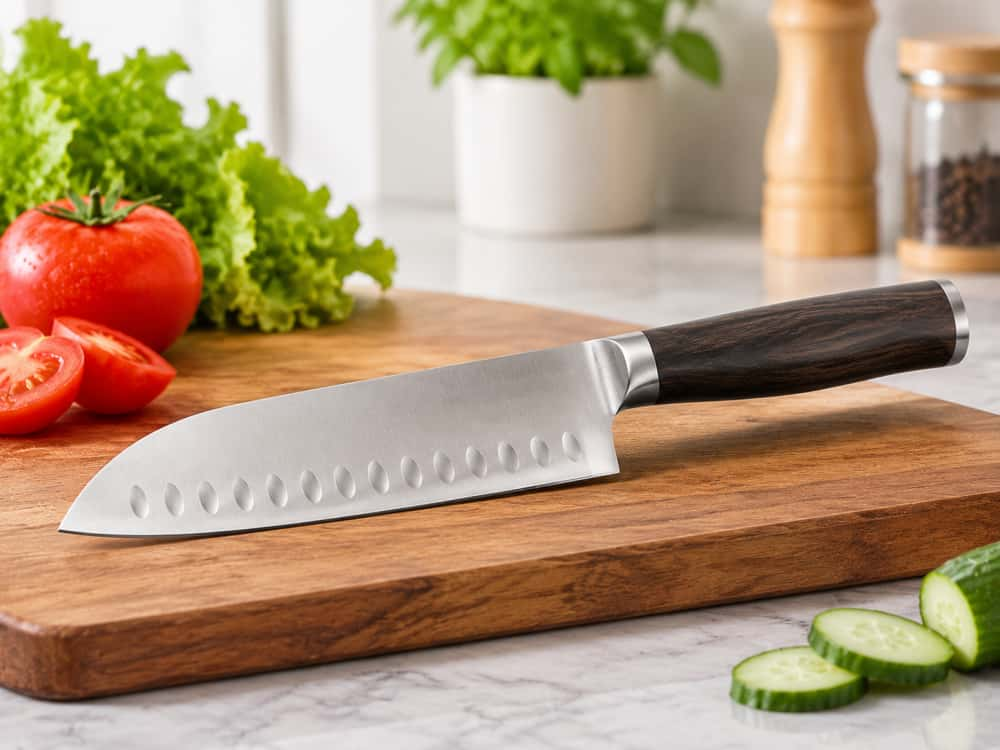
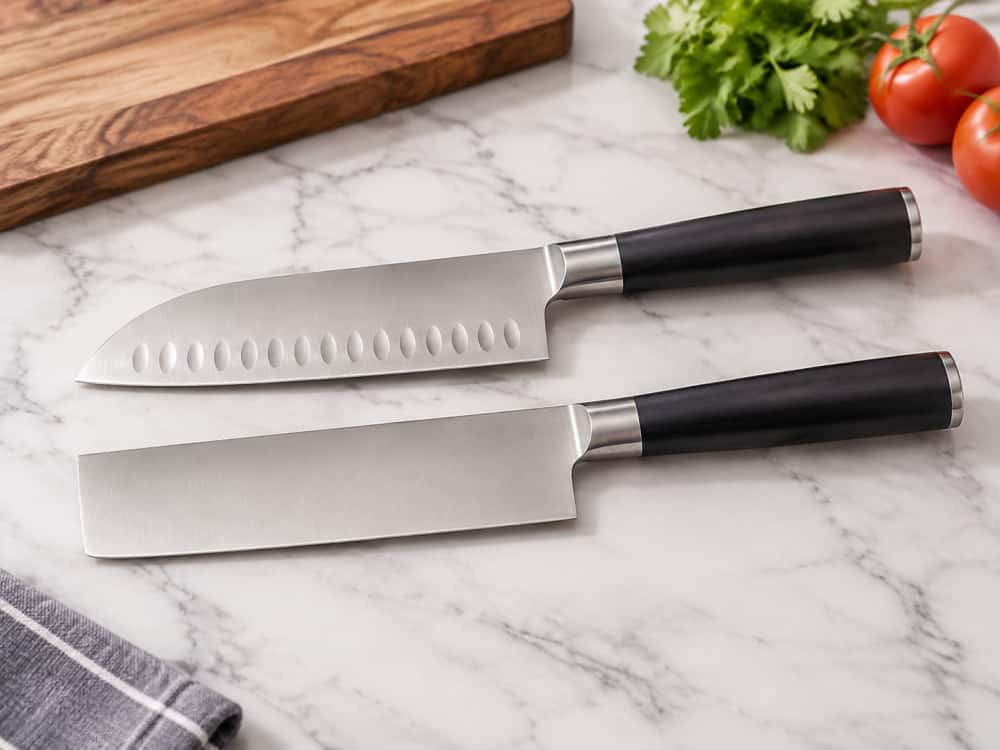
A typical Santoku has a relatively wide blade, a straight or gently curved cutting edge, and a tip that slopes down toward the edge. Many models have a double-bevel design, meaning both sides of the blade are sharpened.
Santoku knives are commonly used for:
- Slicing and chopping vegetables
- Dicing boneless meat and poultry
- Preparing fish fillets
- Slicing fruit and other everyday ingredients
- General food preparation at home or in professional kitchens
Many Santoku knives have blade lengths of approximately 5 to 7 inches, although sizes and designs vary. Their compact format makes them a practical option for everyday kitchen work.
2. What Is a Nakiri Knife?
A Nakiri knife is a traditional Japanese vegetable knife. Its name is associated with cutting greens and vegetables. Unlike a Santoku, which is designed for a wider range of ingredients, a Nakiri is specifically intended for vegetable preparation.
The most recognizable feature of a Nakiri is its rectangular blade. It usually has a straight cutting edge and a squared-off tip rather than the pointed or sloping tip found on many other kitchen knives.
Common Nakiri knife features include:
- Rectangular blade: Provides a broad cutting surface for vegetable preparation.
- Straight cutting edge: Supports vertical chopping and push-cutting techniques.
- Blunt or squared tip: Designed for controlled vegetable cutting rather than piercing.
- Double-bevel design: Common on many modern Nakiri knives, although individual edge designs can vary.
Nakiri knives are commonly used for cabbage, carrots, onions, cucumbers, potatoes, leafy greens, and other vegetables. Their straight edge can make it easier to cut through ingredients with a consistent up-and-down motion.
3. Santoku vs Nakiri: Key Differences
Although both knives are associated with Japanese kitchen design, their blade shapes and intended applications are different. The following table summarizes their main characteristics.
| Feature | Santoku Knife | Nakiri Knife |
|---|---|---|
| Main purpose | General-purpose food preparation | Vegetable preparation |
| Blade shape | Wide blade with a sloping tip | Rectangular blade with a squared-off tip |
| Cutting edge | Usually straight or gently curved | Generally straight and flat |
| Common ingredients | Vegetables, boneless meat, and fish | Vegetables, leafy greens, and fruit |
| Cutting techniques | Chopping, push cutting, and slicing | Up-and-down chopping and push cutting |
| Blade tip | Usually slopes down toward the cutting edge | Usually squared off with no pointed tip |
| Versatility | Suitable for a wider range of ingredients | Specialized for vegetables and similar soft ingredients |
| Typical blade length | Often around 5–7 inches | Often around 6–7 inches |
3.1 Blade Shape and Design
The most obvious difference between these knives is the blade shape. A Santoku has a sloping tip and a more versatile profile, allowing it to handle vegetables, boneless meat, and fish.
A Nakiri has a rectangular blade with a straight edge. Its squared-off shape provides a consistent cutting edge along much of the blade, making it especially suitable for chopping vegetables.
The broad blade of either knife can also help transfer chopped ingredients from the cutting board to a bowl or pan. However, neither knife should be used for prying or scraping ingredients with its sharp edge.
3.2 Cutting Techniques
Santoku knives are commonly used for chopping, push cutting, and slicing. Their blade profile supports a range of everyday cutting movements, although the exact technique depends on the individual knife and the user's preference.
Nakiri knives are particularly suitable for straight up-and-down chopping and push cutting. Their flat edge can make consistent contact with the cutting board across a larger portion of the blade.