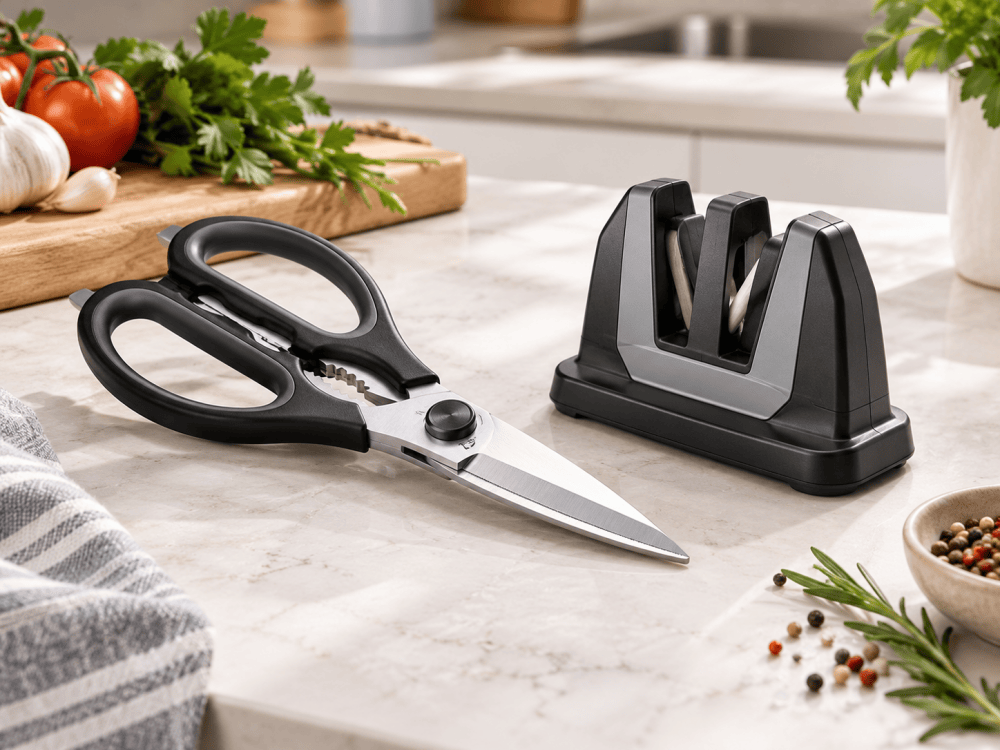




What Are Poultry Shears? Uses, Types, Features & Buying Guide
Poultry shears are specialized kitchen cutting tools used to trim poultry, separate suitable joints, and prepare chicken and other birds for cooking. Their blade design and construction differ from those of ordinary kitchen scissors. Understanding these differences helps home cooks choose the right tool and helps importers and retailers evaluate products for their markets.
The key point: Poultry shears are designed for demanding poultry preparation, but their cutting capacity depends on the individual model. A pair intended for trimming meat is not necessarily suitable for cutting through bones. Blade strength, pivot construction, grip, and cleaning requirements should all be considered before use or purchase.
Poultry shears are used in domestic kitchens, restaurants, catering operations, and other food-preparation environments. They can make certain cutting tasks more controlled than using a knife alone, particularly when trimming around joints or working with awkward sections of poultry.
For kitchenware buyers, poultry shears are also a product category with several design variables. Blade material, handle construction, opening mechanism, product dimensions, packaging, and intended use can all affect which model is suitable for a particular retail or foodservice market.

What Are Poultry Shears?
Poultry shears are heavy-duty kitchen scissors developed for cutting and trimming poultry. Depending on their design, they may be used to remove wings, trim skin and fat, separate certain joints, or prepare a chicken for cooking. Compared with light-duty scissors, poultry shears generally place greater emphasis on cutting force, blade stability, and control.
Their defining feature is not simply a thicker blade. The relationship between the blade edges, pivot, handle length, and cutting angle determines how effectively force is transferred to the material being cut. A well-designed tool should perform its intended tasks without requiring excessive force or causing the blades to twist out of alignment.
Poultry shears are not all built to the same specification. Some are intended mainly for trimming meat and connective tissue, while certain heavy-duty models may be designed to handle specified poultry joints or small bones. The product description and manufacturer's instructions should define the permitted applications.
What makes poultry shears different?
- Construction intended for demanding food-preparation tasks
- Blade geometry selected for trimming and cutting poultry
- A pivot designed to maintain blade alignment under normal intended loads
- Handle design intended to provide control when applying cutting force
What Are Poultry Shears Used For?
The main purpose of poultry shears is to make selected poultry-preparation tasks easier to control. Their usefulness depends on the blade design and the resistance of the material being cut.
01 / TRIMMING
Trimming Poultry
Use suitable shears to trim excess skin, fat, and unwanted tissue from chicken, turkey, duck, and other poultry.
02 / PORTIONING
Preparing Portions
Shears can help remove wings or separate suitable sections when the blade design and cutting capacity are appropriate.
03 / JOINTS
Cutting Suitable Joints
Certain models can cut through specified joints or small bones. Always follow the manufacturer's limits rather than assuming every model can do so.
04 / PREPARATION
Spatchcocking Chicken
Appropriate heavy-duty poultry shears may be used to remove the backbone of a chicken. The model must be suitable for this task.
Can Poultry Shears Cut Through Chicken Bones?
The answer depends on the specific product. Some poultry shears are designed to handle certain small bones or joints, while others are intended primarily for meat, skin, and connective tissue. Blade thickness alone does not establish bone-cutting capability.
Thick bones can damage the cutting edges, strain the pivot, or cause the tool to slip if the shears are not designed for the task. For demanding cutting applications, confirm the manufacturer's specifications and use an appropriate alternative tool whenever the material exceeds the shears' rated capacity.