




Nakiri Knife vs Chef Knife: Which One Is Better?
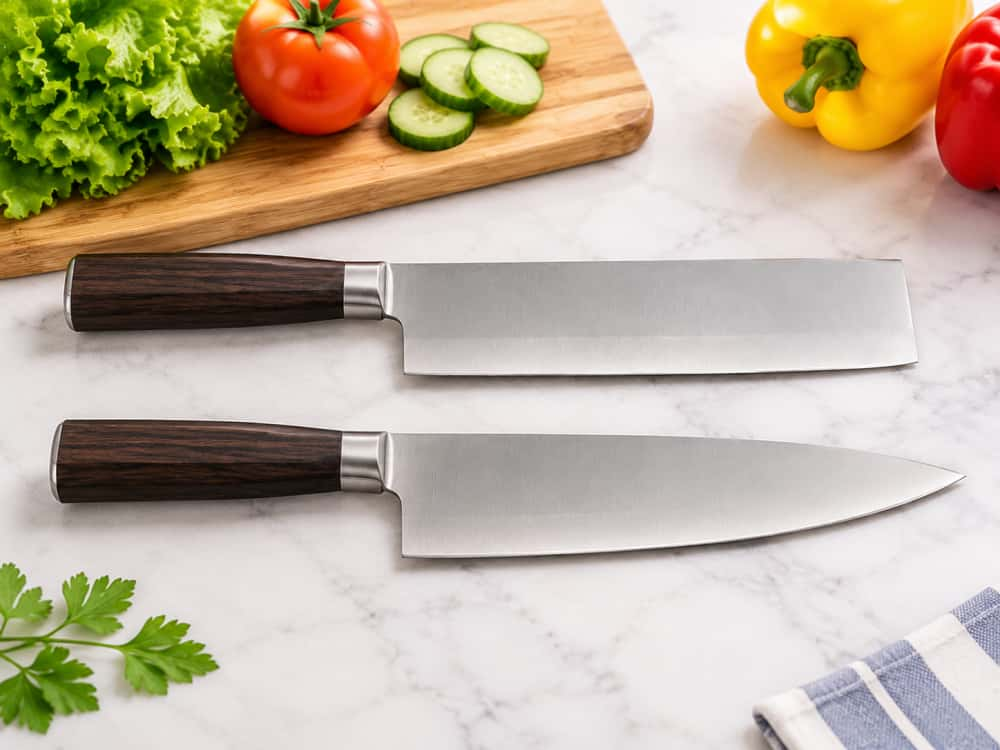
When comparing a Nakiri knife vs chef knife, the biggest difference is their intended purpose. A Nakiri knife is a Japanese-style vegetable knife with a wide rectangular blade and a relatively straight cutting edge. A chef knife is a versatile all-purpose kitchen knife with a curved blade profile, designed for a wider range of food preparation tasks.
So, which one is better? If you mainly prepare vegetables and prefer straight chopping motions, a Nakiri knife may be the better choice. If you need one knife for vegetables, boneless meat, herbs, and general kitchen preparation, a chef knife is usually more versatile.
Quick Answer: Choose a Nakiri knife for dedicated vegetable preparation, including slicing, chopping, and dicing. Choose a chef knife if you want a more versatile kitchen tool for different ingredients and cutting techniques. Neither knife is universally better; the right choice depends on how you cook.
1. What Is a Nakiri Knife?
A Nakiri knife is a Japanese-style kitchen knife designed primarily for cutting vegetables. It is easily recognized by its wide rectangular blade, squared-off tip, and straight or nearly straight cutting edge.
Unlike many traditional chef knives, which have a curved blade belly, a Nakiri knife has a flatter cutting profile. This design supports up-and-down chopping and push-cutting motions, allowing a large portion of the edge to contact the cutting board during a straight cut.
Common Nakiri knife uses include:
- Slicing cucumbers, carrots, zucchini, and radishes.
- Chopping cabbage, lettuce, and leafy greens.
- Dicing onions, bell peppers, and other vegetables.
- Preparing vegetable ingredients for salads, soups, and stir-fries.
- Chopping and gathering prepared vegetables with its wide blade.
Many Nakiri knives use a double-bevel edge, although specific blade geometry and construction vary between models. Their main advantage is specialization in vegetable preparation rather than all-purpose cutting.
For more details about its design and applications, read our guide: What Is a Nakiri Knife Used For?
2. What Is a Chef Knife?
A chef knife is one of the most versatile tools in a kitchen. It is designed to handle a broad range of food preparation tasks, including chopping vegetables, slicing boneless meat, mincing herbs, and cutting many everyday ingredients.
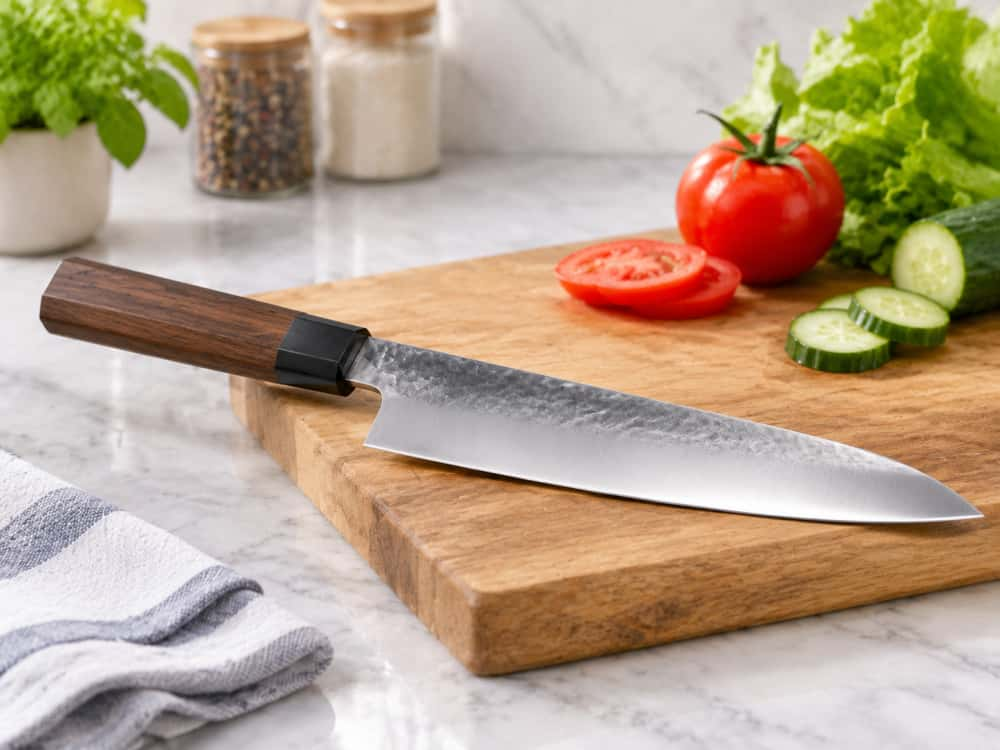
A typical Western-style chef knife has a tapered blade with a curved cutting edge, a pointed tip, and a handle designed for controlled handling. The curved blade belly makes rocking cuts possible, although chef knives can also be used for push cutting, slicing, and straight chopping.
Common chef knife uses include:
- Chopping and slicing vegetables.
- Slicing and portioning boneless meat.
- Mincing garlic, onions, and fresh herbs.
- Cutting fruits and other everyday ingredients.
- Handling a variety of general food preparation tasks.
Chef knives are available in different blade lengths, profiles, materials, and handle designs. Their versatility makes them a common choice for both home kitchens and professional food preparation environments.
3. Nakiri Knife vs Chef Knife: Key Differences
Although both knives can cut vegetables, their blade designs create different cutting experiences. The Nakiri focuses on vegetable preparation, while the chef knife is built for broader kitchen use.
| Comparison | Nakiri Knife | Chef Knife |
|---|---|---|
| Main Purpose | Specialized vegetable preparation | General-purpose kitchen preparation |
| Blade Shape | Wide, rectangular blade | Tapered blade with a curved profile |
| Blade Tip | Usually squared off | Usually pointed |
| Cutting Edge | Generally straight or nearly straight | Usually features a curved belly |
| Cutting Motion | Up-and-down chopping and push cutting | Rocking, slicing, push cutting, and chopping |
| Vegetable Preparation | Highly specialized | Very versatile |
| Meat Preparation | Limited to suitable boneless tasks | More suitable for general boneless meat preparation |
| Best For | Frequent vegetable cutting | Multiple everyday kitchen tasks |
4. Blade Shape and Design: What Makes Them Different?
One of the most noticeable differences between a Nakiri knife and a chef knife is the blade profile. This affects how each knife moves through ingredients and interacts with the cutting board.
Nakiri Knife: Wide Blade and Straight Edge
A Nakiri knife has a broad rectangular blade with a relatively flat cutting edge. This shape supports direct chopping and push-cutting motions.
Its tall blade also provides more clearance for the user's knuckles when using an appropriate grip. The broad blade can be useful for gathering chopped vegetables and transferring them from the cutting board to a cooking container.
Because its blade is designed mainly for vegetables, a Nakiri knife is not intended for tasks that require a pointed tip, such as detailed trimming or piercing ingredients.
Chef Knife: Curved Edge and Pointed Tip
A chef knife usually has a more curved cutting edge and a pointed tip. The curve allows users to rock the blade across the cutting board, making it useful for mincing herbs and chopping ingredients with a repeated rocking motion.
Its pointed tip is also useful for detailed cutting, trimming, and working around smaller ingredients. Together, these features make a chef knife adaptable to a wider range of kitchen tasks.
Key Difference: A Nakiri knife is designed around a flatter cutting edge for vegetable preparation. A chef knife combines a curved blade profile and pointed tip to support a broader range of cutting techniques.
5. Nakiri Knife vs Chef Knife: Which Is Better for Vegetables?
Both knives can prepare vegetables effectively, but the better choice depends on the type of cutting you do most often.
When a Nakiri Knife Is Better
A Nakiri knife is a strong choice when vegetable preparation is your main priority. Its straight cutting edge is particularly suitable for repeated chopping and slicing tasks.
- Leafy vegetables: Useful for chopping cabbage, lettuce, spinach, and other greens.
- Uniform slices: Suitable for slicing cucumbers, carrots, zucchini, and similar vegetables.
- Repeated chopping: Its flatter edge supports a consistent up-and-down cutting motion.
- Vegetable-heavy meals: A practical option for preparing ingredients for salads, soups, and stir-fries.
When a Chef Knife Is Better
A chef knife is a more flexible choice when your vegetable preparation involves different cutting styles and you also work with other ingredients.
- Mixed ingredients: Useful when switching between vegetables, fruits, and boneless meat.
- Rocking cuts: Its curved belly supports rocking motions for mincing and chopping.
- Detailed cutting: The pointed tip helps with trimming and more precise tasks.
- One-knife convenience: A practical option for cooks who prefer a single versatile knife.
6. Nakiri Knife vs Chef Knife: Which Is Better for Meat?
A chef knife is generally the better choice for meat preparation. Its pointed tip and versatile blade profile make it more suitable for slicing, trimming, and portioning boneless meat.
A Nakiri knife is primarily designed for vegetables. While some models can handle certain boneless meat tasks, this is not their main purpose. Their blade geometry and intended use make them less suitable for general meat preparation.
Neither a standard Nakiri knife nor a typical chef knife should be used to cut through bones or frozen food unless the specific knife is designed for those tasks. Using an unsuitable blade can damage the cutting edge.
7. Which Knife Is Easier for Beginners?
Both Nakiri knives and chef knives can be suitable for beginners, but they offer different learning experiences.
Nakiri Knife for Beginners
A Nakiri knife can be relatively straightforward to use for basic vegetable chopping. Its flat cutting profile encourages direct cutting motions rather than relying on a rocking technique.
However, its squared-off tip and specialized blade shape may feel unfamiliar to people who are used to traditional chef knives. Beginners should learn a stable grip, proper hand positioning, and controlled cutting movements before increasing speed.
Chef Knife for Beginners
A chef knife is often a practical first kitchen knife because it can handle many everyday ingredients and cutting tasks. Learning basic slicing, chopping, and rocking techniques with one versatile knife can provide a useful foundation for general cooking.
For someone who wants to build a basic kitchen knife collection, a chef knife is usually a flexible starting point. A Nakiri can be added later when vegetable preparation becomes a frequent or specialized task.
8. How to Choose Between a Nakiri Knife and a Chef Knife
Before choosing between these two kitchen knives, consider your cooking habits, the ingredients you prepare most often, and the cutting techniques you prefer.
| Your Kitchen Needs | Recommended Knife | Why? |
|---|---|---|
| You mainly prepare vegetables | Nakiri Knife | Its blade design is specialized for vegetable cutting. |
| You need one knife for different ingredients | Chef Knife | It supports a wider range of kitchen tasks. |
| You frequently chop cabbage and leafy greens | Nakiri Knife | Its wide blade and straight edge suit repeated chopping. |
| You often mince herbs and use rocking cuts | Chef Knife | Its curved belly supports rocking motions. |
| You regularly prepare boneless meat | Chef Knife | Its blade profile is more versatile for meat preparation. |
| You want a specialized Japanese-style vegetable knife | Nakiri Knife | It offers a dedicated design for vegetable preparation. |
Consider Blade Length and Handle Comfort
Blade length and handle design also matter. Many Nakiri knives have blade lengths around 165–180 mm, while chef knives are commonly available in a wider range of sizes, including 6-inch, 8-inch, and 10-inch options.
The right size depends on the user's hand size, cutting board space, ingredients, and personal preference. A comfortable handle and well-balanced construction can make a noticeable difference during repeated preparation tasks.
Consider Steel and Maintenance Requirements
Both knife types are available in different blade materials. Stainless steel is often selected for its corrosion resistance and relatively convenient maintenance. Carbon steel may appeal to users who value its sharpening characteristics but are willing to provide more careful care.
When comparing models, consider the steel grade, heat treatment, edge geometry, sharpening requirements, and the manufacturer's care recommendations rather than choosing based on material name alone.
9. Should You Own Both a Nakiri Knife and a Chef Knife?
For people who cook frequently, owning both knives can be a practical option. They serve different purposes and can complement each other in a well-equipped kitchen.
A chef knife can handle general food preparation, including boneless meat, herbs, fruits, and different vegetables. A Nakiri knife can then be used for dedicated vegetable preparation, particularly when chopping and slicing large quantities of produce.
For example, when preparing a stir-fry, a chef knife can help with general ingredient preparation, while a Nakiri knife can be used to slice carrots, chop cabbage, and prepare other vegetables.
However, owning both is not necessary for every kitchen. If you have limited storage space or only need one everyday knife, a chef knife is generally the more versatile option.
10. Nakiri Knife and Chef Knife Selection for Kitchenware Buyers
For kitchenware distributors, wholesalers, retailers, and private-label brands, Nakiri knives and chef knives can serve different roles within a kitchen knife collection.
A chef knife is a familiar all-purpose product for many consumer markets, while a Nakiri knife can add a specialized Japanese-style vegetable knife option to a product range.
When sourcing these knife types, buyers should evaluate several factors:
- Target market: Understand whether customers are looking for everyday chef knives, specialized vegetable knives, or a broader kitchen knife collection.
- Blade specifications: Compare blade length, steel material, thickness, geometry, and finish.
- Handle design: Consider ergonomics, material, color, and visual consistency across the product range.
- Product quality: Evaluate sharpening consistency, blade alignment, handle fitting, and overall finish.
- Packaging: Match product presentation and packaging requirements to the intended retail channel.
- Customization: Confirm requirements for branding, logo application, and private-label packaging.
Working with an experienced kitchenware manufacturer can help buyers evaluate product specifications and develop a knife assortment that matches their target customers.
Explore FASAKA kitchen knives and learn more about our OEM and ODM kitchenware services.
11. Frequently Asked Questions
Is a Nakiri knife better than a chef knife?
Neither knife is universally better. A Nakiri knife is better suited to dedicated vegetable preparation, while a chef knife is more versatile for different ingredients and cutting techniques. The right choice depends on your cooking needs.
Can a Nakiri knife replace a chef knife?
A Nakiri knife can handle many vegetable-cutting tasks, but it does not fully replace a chef knife. Its squared-off tip and specialized blade profile make it less versatile for tasks such as detailed trimming and general meat preparation.
Is a Nakiri knife only for vegetables?
A Nakiri knife is primarily designed for vegetables. Some models can handle suitable boneless ingredients, but it should not be used for bones, frozen food, or other hard materials.
Why does a Nakiri knife have a flat blade?
The relatively flat cutting edge allows more of the blade to contact the cutting board during straight chopping motions. This design is useful for slicing, dicing, and chopping vegetables.
Is a chef knife easier to use than a Nakiri knife?
A chef knife may be more familiar to cooks who want one general-purpose knife. A Nakiri knife can be straightforward for vegetable chopping, but its specialized shape may take some adjustment for users accustomed to curved chef knives.
Can you use a chef knife to cut all vegetables?
A chef knife can handle most everyday vegetable preparation tasks, including chopping, slicing, and dicing. A Nakiri knife may be more convenient for cooks who frequently prepare large quantities of vegetables.
Should I buy a Nakiri knife or an 8-inch chef knife first?
If you need one versatile knife for general cooking, an 8-inch chef knife is often a practical first choice. If your cooking mainly involves vegetables and you prefer a straight chopping motion, a Nakiri knife may be a better fit.
Looking for Kitchen Knife Manufacturing Solutions?
FASAKA, under DKS Enterprises Co., Ltd., provides kitchen knife and kitchenware solutions for global buyers. Whether you are a distributor, wholesaler, or private-label brand, our team can help you discuss product requirements and OEM/ODM opportunities.
Contact us to discuss your kitchenware sourcing needs.
Get a Free Quote