




Gyuto Knife vs Santoku: Which One Should You Choose?
Gyuto and Santoku knives are two popular Japanese kitchen knives designed for everyday food preparation. Both can slice meat, cut fish, chop vegetables, and handle a wide range of kitchen tasks. However, they differ in blade length, tip shape, cutting edge profile, and handling style. Choosing between a Gyuto and a Santoku depends on what you cook most often and how you prefer to cut.
Gyuto vs Santoku: Which Is Better?
A Gyuto knife is generally better for longer slicing strokes, cutting larger ingredients, and users who prefer a longer blade with a pointed tip. A Santoku knife is often preferred for everyday chopping, slicing, and dicing, especially by users who like a shorter blade and a relatively flat cutting edge. Both are versatile all-purpose kitchen knives, and neither is universally better.
If you are choosing a Japanese chef's knife for home cooking, professional use, or a kitchen knife product range, understanding these differences can help you make a more practical decision.
1. What Is a Gyuto Knife?
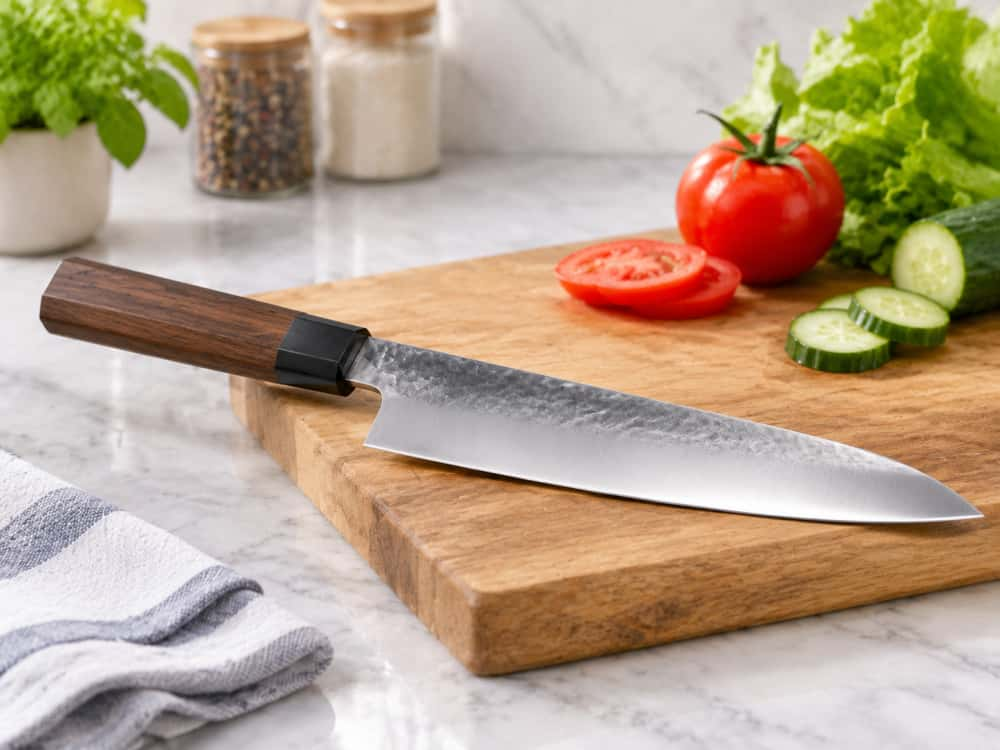
A Gyuto is a Japanese-style chef's knife characterized by a relatively long blade, a pointed tip, and a cutting edge that typically features a gradual curve. It is designed for versatile kitchen preparation, including slicing, chopping, dicing, and mincing.
The name Gyuto is commonly translated as "beef sword," reflecting its historical association with cutting meat. Today, it is widely used for preparing vegetables, meat, fish, and many other ingredients.
Common Gyuto knife characteristics include:
- A relatively long blade, commonly available in sizes such as 180 mm, 210 mm, and 240 mm.
- A pointed tip suitable for detailed cutting and trimming.
- A curved cutting edge that supports rocking and slicing techniques.
- A versatile design suitable for both home kitchens and professional cooking environments.
For a more detailed overview of its applications, read What Is a Gyuto Knife Used For?.
2. What Is a Santoku Knife?
A Santoku is a Japanese multipurpose kitchen knife designed for handling three common food preparation tasks: cutting meat, fish, and vegetables. The word "Santoku" is often interpreted as "three virtues" or "three uses."
Compared with a typical Gyuto, a Santoku often has a shorter blade, a flatter cutting edge, and a rounded or sheep's-foot-style tip. Its design is particularly popular for everyday slicing, chopping, and dicing.
Common Santoku knife characteristics include:
- A shorter blade, often around 165 mm to 180 mm.
- A relatively flat cutting edge, especially toward the heel.
- A rounded or less pointed tip.
- A compact profile that many users find comfortable for daily food preparation.
Santoku knives are popular among home cooks who want one knife for preparing a wide range of ingredients without using a longer blade.
3. Gyuto vs Santoku: Key Differences
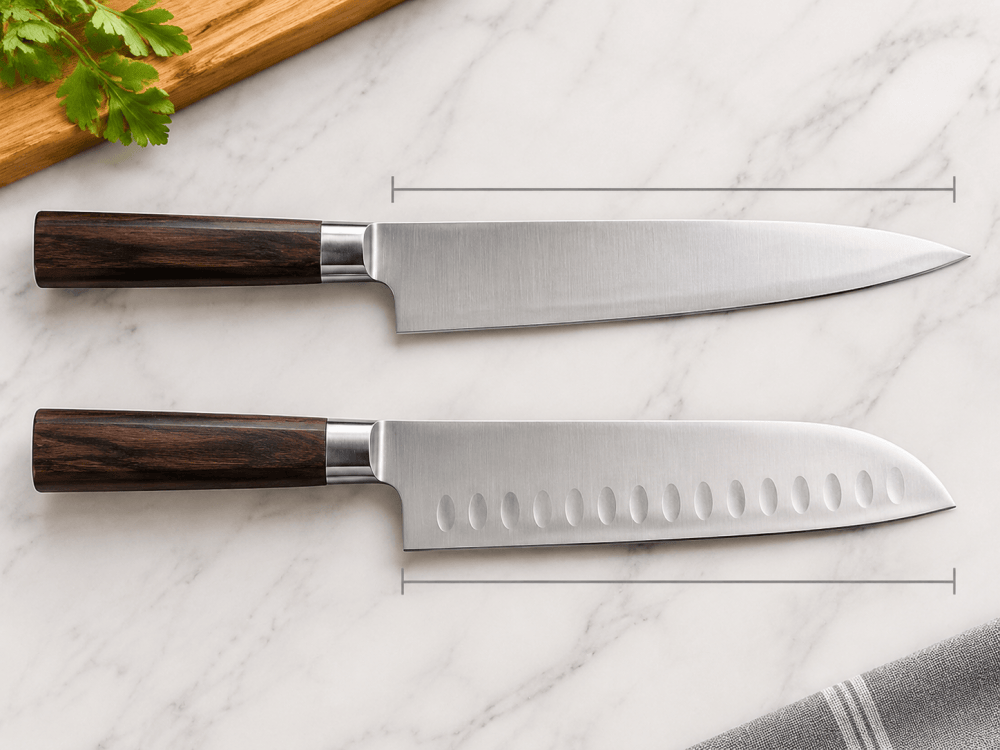
The main differences between Gyuto and Santoku knives are blade length, blade profile, tip shape, and preferred cutting technique. Although both knives are versatile, their designs can influence how they feel and perform during food preparation.
| Feature | Gyuto Knife | Santoku Knife |
|---|---|---|
| Blade length | Commonly 180–240 mm | Commonly 165–180 mm |
| Blade shape | Longer blade with a gradual curve | Shorter blade with a relatively flatter profile |
| Tip shape | Pointed tip | Rounded or sheep's-foot-style tip |
| Cutting style | Push cutting, slicing, and rocking | Push cutting, chopping, and slicing |
| Typical use | Versatile preparation, longer slicing strokes | Everyday chopping, slicing, and dicing |
| Large ingredients | Longer blade may be convenient | Suitable for many everyday ingredients |
| Detailed cutting | Pointed tip offers more tip-oriented precision | Broad cutting edge supports controlled everyday cuts |
| Kitchen environment | Home kitchens and professional kitchens | Home kitchens and professional kitchens |
These are general design differences. Actual performance depends on the blade geometry, steel, thickness, edge angle, handle design, and the user's cutting technique.
4. Blade Length: Which Knife Is Easier to Handle?
Blade length is one of the most noticeable differences between Gyuto and Santoku knives. A longer blade can be useful when cutting larger ingredients or making longer slicing strokes, while a shorter blade may feel more manageable for everyday preparation.
Gyuto: Better for Longer Cutting Strokes
A Gyuto's longer blade provides more cutting length. This can be useful when slicing boneless meat, cutting larger vegetables, or preparing ingredients that benefit from a smooth, continuous stroke.
For users who regularly prepare larger quantities of food, a 210 mm or 240 mm Gyuto may offer more working blade length.
Santoku: Compact and Convenient for Daily Tasks
A Santoku's shorter blade can be easier to maneuver in a compact kitchen or when working with smaller ingredients. Many home cooks prefer its size for routine chopping, slicing, and dicing.
A shorter knife may also feel more comfortable for users who are not accustomed to handling longer chef's knives, although comfort ultimately depends on the individual knife and user.
5. Cutting Edge Profile: Curved vs. Flatter Blade
The cutting edge profile affects how a knife interacts with the cutting board and which cutting motions feel most natural.
Gyuto Knife: A More Curved Cutting Edge
Many Gyuto knives feature a gradual curve from the heel toward the tip. This profile allows users to perform rocking cuts, where the blade moves in a controlled rocking motion while chopping ingredients.
The curved profile can also support push-cutting and slicing, making the Gyuto adaptable to different preparation techniques.
Santoku Knife: A Relatively Flat Cutting Edge
Santoku knives often have a flatter cutting edge, especially near the heel. This profile can work well for users who prefer lifting and lowering the blade or using push-cutting motions rather than rocking the knife extensively.
However, not all Santoku knives have identical profiles. Some models feature more curvature than others, so blade geometry should be evaluated individually.
6. What Foods Can You Cut with a Gyuto or Santoku?
Both knives are designed to handle a broad range of everyday ingredients. The differences are more about handling preference and blade design than strict limitations on the types of food they can cut.
| Ingredient | Gyuto | Santoku |
|---|---|---|
| Boneless beef and pork | Excellent for slicing and portioning | Excellent for everyday slicing |
| Boneless chicken | Suitable for slicing and cutting | Suitable for slicing and cutting |
| Fish fillets | Suitable for portioning and slicing | Suitable for portioning and slicing |
| Onions and peppers | Excellent for slicing and dicing | Excellent for slicing and dicing |
| Carrots and potatoes | Suitable for slicing and chopping | Suitable for everyday preparation |
| Herbs and garlic | Suitable for mincing | Suitable for mincing |
| Large melons and vegetables | Longer blade may offer an advantage | Can handle many tasks, depending on size |
Neither knife should be used to chop bones, cut frozen food, or pry ingredients apart. These tasks can damage the blade and should be handled with a knife designed for heavy-duty cutting.
7. Gyuto vs Santoku: Which Cutting Style Is Better?
Different blade profiles can make certain cutting motions feel more natural. Choosing the knife that matches your preferred technique may improve comfort and efficiency during food preparation.
Choose a Gyuto If You Prefer:
- Rocking cuts when chopping herbs or vegetables.
- Longer slicing strokes for boneless meat and fish.
- A pointed tip for detailed trimming and precise cutting.
- A longer blade for handling larger ingredients.
- A chef's knife with a versatile profile for different cooking tasks.
Choose a Santoku If You Prefer:
- Push-cutting and lifting-and-lowering motions.
- A relatively flatter blade profile for everyday chopping.
- A shorter blade for compact workspaces.
- A knife that feels manageable for routine food preparation.
- A versatile knife for slicing, dicing, and chopping common ingredients.
8. Which Knife Is Better for Beginners?
Both Gyuto and Santoku knives can be good choices for beginners. The best knife is one that feels comfortable, is easy to control, and matches the user's cooking habits.
A Santoku May Be a Good Choice for Beginners Who:
- Prefer a shorter blade.
- Mostly prepare vegetables and everyday ingredients.
- Have a compact kitchen or limited counter space.
- Prefer straightforward chopping and push-cutting techniques.
A Gyuto May Be a Good Choice for Beginners Who:
- Want a versatile knife for a wider range of preparation tasks.
- Regularly slice meat, fish, and larger vegetables.
- Prefer a pointed tip for detailed cutting.
- Want to learn different cutting techniques, including rocking and push cutting.
Beginners should prioritize a comfortable handle, manageable blade length, good balance, and safe cutting technique rather than choosing a knife based only on its name or appearance.
9. Can a Gyuto and Santoku Replace Each Other?
For many everyday kitchen tasks, yes. A Gyuto and a Santoku can both be used for slicing, chopping, dicing, and mincing a wide range of ingredients.
If you mainly prepare vegetables, boneless meat, fish fillets, and fruit, either knife may be able to handle most of your daily cooking needs.
However, some users prefer to keep both knives in their kitchen because their different blade profiles and sizes provide additional flexibility.
- A Gyuto can provide longer cutting strokes and a pointed tip.
- A Santoku can offer a compact profile for everyday chopping and slicing.
Having both knives is not essential for every kitchen. The decision depends on cooking frequency, ingredient variety, available storage, and personal preference.
10. Gyuto vs Santoku: Which One Should You Choose?
| Your Needs | Recommended Knife |
|---|---|
| You frequently slice larger pieces of boneless meat | Gyuto |
| You prefer a longer blade | Gyuto |
| You like a pointed tip for precise cutting | Gyuto |
| You mostly chop and dice vegetables | Santoku |
| You prefer a compact kitchen knife | Santoku |
| You prefer a relatively flat cutting edge | Santoku |
| You want one versatile knife for everyday cooking | Either one |
| You want to build a more versatile knife collection | Both |
Ultimately, the Gyuto is often preferred by users who want a longer, more pointed chef's knife, while the Santoku appeals to users who like a shorter, relatively flatter blade for everyday kitchen preparation.
11. Frequently Asked Questions
1. Is a Gyuto better than a Santoku?
Neither is universally better. A Gyuto offers a longer blade and pointed tip, which can be useful for longer slicing strokes and detailed cutting. A Santoku has a shorter, relatively flatter profile that many users prefer for everyday chopping, slicing, and dicing.
2. What is the main difference between Gyuto and Santoku?
The main differences are blade length, tip shape, and cutting edge profile. Gyuto knives are typically longer with a pointed tip and more curved edge, while Santoku knives are generally shorter with a flatter profile and rounded tip.
3. Which knife is better for cutting vegetables?
Both knives are excellent for cutting vegetables. A Santoku is popular for everyday chopping and dicing, while a Gyuto offers more blade length and supports a variety of slicing and cutting techniques.
4. Which knife is better for meat?
Both can cut boneless meat effectively. A Gyuto may be more convenient for longer slicing strokes and larger pieces of boneless meat because of its longer blade. A Santoku is also suitable for everyday meat preparation.
5. Is a Santoku knife easier to use than a Gyuto?
Some users find a Santoku easier to handle because of its shorter blade and compact profile. Others prefer the longer blade of a Gyuto. Ease of use depends on blade length, weight, handle comfort, cutting technique, and individual preference.
6. Can a Santoku knife replace a chef's knife?
Yes, a Santoku can replace a chef's knife for many everyday kitchen tasks, including chopping vegetables, slicing meat, and cutting fish fillets. However, users who prefer longer slicing strokes or a pointed tip may still prefer a Gyuto or Western chef's knife.
7. Should I buy both a Gyuto and a Santoku?
You do not necessarily need both. One versatile knife may be sufficient for everyday cooking. However, owning both can provide additional flexibility if you regularly prepare different ingredients or prefer different blade profiles for different tasks.
8. What Gyuto or Santoku size is best for home cooking?
A 180 mm Gyuto or a 165–180 mm Santoku can be practical for many home kitchens. A 210 mm Gyuto is also a popular all-purpose option for users who prefer a longer blade. The best size depends on hand comfort, kitchen space, and the types of food you prepare.
Conclusion
Gyuto and Santoku knives are both versatile Japanese kitchen knives, but their designs offer different advantages. A Gyuto's longer blade, pointed tip, and curved cutting edge make it a practical option for longer slicing strokes, detailed cutting, and a wide range of food preparation tasks.
A Santoku's shorter blade and relatively flatter profile make it popular for everyday chopping, slicing, and dicing. It can be especially convenient for users who prefer a compact knife for routine kitchen work.
When choosing between a Gyuto and a Santoku, consider the ingredients you prepare most often, your preferred cutting technique, blade length, handle comfort, and the amount of space available in your kitchen.
Looking for Kitchen Knives for Your Business?
FASAKA, under DKS Enterprises Co., Ltd., supports global buyers with kitchen knife and kitchenware sourcing. We work with distributors, wholesalers, importers, and private-label brands looking for kitchenware products and OEM/ODM solutions.
Explore Kitchen Knives OEM & ODM Services Get a Free Quote