



Knife Block vs. Magnetic Knife Holder: Which Is Better?
Choosing between a knife block and a magnetic knife holder comes down to more than appearance. The right storage solution should protect knife blades, keep your kitchen organized, support safe handling, and fit the space available.
In this guide, we compare both options by blade protection, hygiene, safety, space efficiency, and maintenance to help home cooks, professional kitchens, and kitchenware buyers make a practical decision.
1. What Is the Difference Between a Knife Block and a Magnetic Knife Holder?
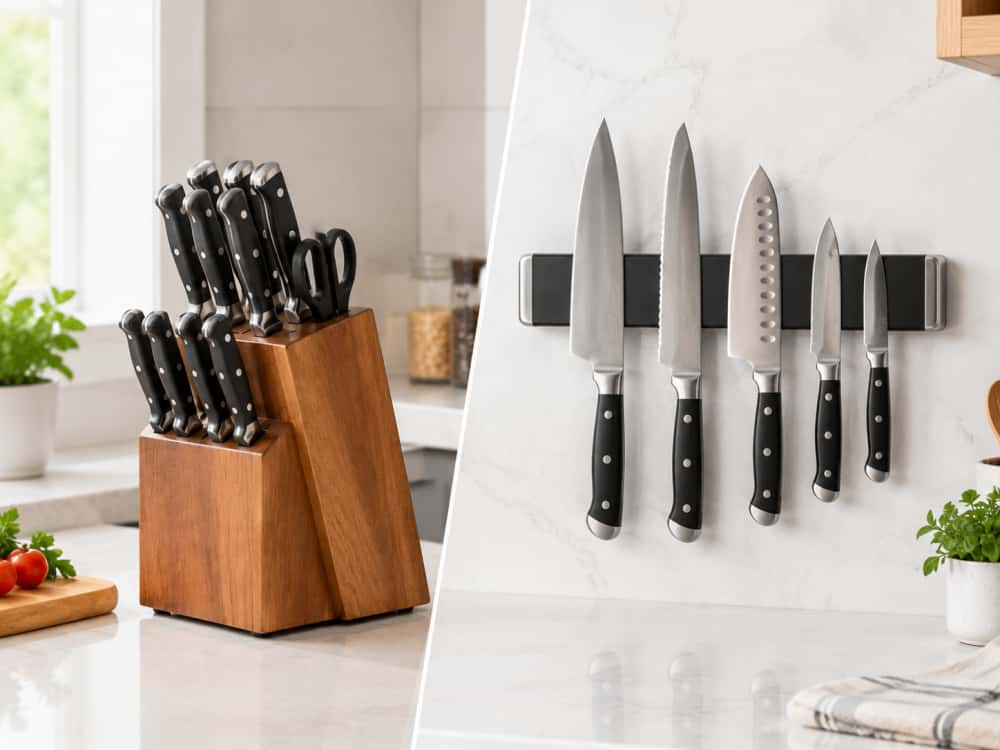
A knife block is usually a countertop stand with individual slots for storing kitchen knives. The blades slide into the slots, keeping the knives arranged in one place. Traditional blocks are commonly made from wood, bamboo, plastic, or a combination of materials.
A magnetic knife holder uses magnets to hold compatible knife blades against a surface. It may be a wall-mounted magnetic strip or a freestanding magnetic knife block. Because knives are attached to the outside rather than inserted into narrow slots, they are generally easier to see and identify.
Traditional Knife Block
Storage style: Blades slide into slots.
- Ready to use without wall installation
- Keeps knives grouped in one countertop location
- Can partially conceal the blades
- Slot sizes may limit knife compatibility
Magnetic Knife Holder
Storage style: Magnets hold compatible blades on a surface.
- Wall-mounted versions free up counter space
- Knives remain visible and easy to identify
- Open surfaces are usually easier to wipe
- Requires secure mounting or a stable freestanding base
2. Knife Block vs. Magnetic Knife Holder: Side-by-Side Comparison
The table below summarizes the main differences. Actual performance depends on the holder's design, materials, installation quality, and how users handle and maintain their knives.
| Comparison Factor | Knife Block | Magnetic Knife Holder |
|---|---|---|
| Counter space | Requires a dedicated countertop area. | A wall-mounted strip keeps the countertop clear; a freestanding magnetic block still uses counter space. |
| Blade visibility | Knives are partly concealed in their slots. | Knives remain visible and can be identified quickly. |
| Blade protection | Slots separate blades, but careless insertion or removal may cause edge contact. | Can reduce contact with other blades when knives are attached and removed carefully. |
| Cleaning | Internal slots can be difficult to inspect and clean. | The exposed surface is generally easier to wipe, but the holder and blades still need regular cleaning. |
| Installation | Usually needs no installation beyond placing it on a stable surface. | Wall-mounted models require secure installation in a suitable location. |
| Knife compatibility | Depends on slot dimensions and the knife set. | Depends on whether the blade material is magnetic and whether the holder can support its size and weight. |
| Safety considerations | Blades are less exposed, but knives must still be inserted and removed carefully. | Blades are exposed, so positioning, secure holding, and controlled removal are essential. |
| Best suited for | Users who want an organized countertop set without wall mounting. | Users who value visibility, quick access, and countertop space savings. |
3. Blade Protection: Which Storage Method Is Better?
Proper storage helps prevent knives from knocking against other utensils or hard surfaces. However, neither a knife block nor a magnetic holder guarantees that a blade will stay sharp indefinitely.
How a Knife Block Affects Blade Edges
A well-designed block keeps knives separated. However, repeatedly sliding a knife into a tight slot can cause unnecessary contact with the slot walls or edge. If a slot is too narrow or the knife is forced into it, the risk of damage increases.
To reduce unnecessary wear:
- Choose slots that fit the knife's blade dimensions.
- Insert and remove knives without forcing or twisting them.
- Keep the blades clean and completely dry before storage.
- Clean the block according to the manufacturer's care instructions.
How a Magnetic Holder Affects Blade Edges
A magnetic holder can reduce contact between a blade's cutting edge and surrounding storage surfaces. Correct handling is still important: allowing the edge to strike or scrape the holder may damage it.
For safer placement and removal:
- Bring the knife's spine or flat side toward the holder first.
- Allow the blade to settle onto the magnetic surface gently.
- Lift the knife away in a controlled motion rather than dragging the edge.
- Check that the holder securely supports the knife before releasing it.
4. Hygiene and Maintenance: Which Is Easier to Clean?
Kitchen knife storage should not trap unnecessary food debris or moisture. The main difference is how easily you can inspect and clean the storage surface.
Knife Block Maintenance
The inside of a slotted block is less accessible than its exterior. Crumbs and moisture may accumulate in the slots, especially when knives are put away before they are completely dry. A block's care requirements also depend on its material and construction.
- Remove loose debris according to the manufacturer's instructions.
- Clean removable inserts separately only if the design permits it.
- Do not soak a wooden block unless the manufacturer specifically allows it.
- Let the block dry completely before returning knives to it.
Magnetic Knife Holder Maintenance
The open surface of a magnetic holder is usually easier to inspect and wipe. However, exposed knives can collect dust, grease, or cooking splashes, and the mounting points also require attention.
- Wipe the holder regularly with a suitable cleaning cloth.
- Clean and dry knives before returning them to storage.
- Keep the holder away from direct food splashes where possible.
- Check mounting hardware and magnetic grip periodically.
Which is more hygienic? A magnetic holder is often easier to clean because its surface is accessible. A properly maintained knife block can also be used effectively, but its internal slots require more attention.
5. Safety: Which Option Is Better for Your Kitchen?
Safety depends on who uses the kitchen, where the knives are stored, and how securely the storage system holds them. A holder that is convenient for one household may not be suitable for another.
When a Knife Block May Be Preferable
- You want to keep blades partly concealed.
- You prefer a countertop solution with no wall drilling.
- You have a knife set that fits the available slots.
- You can place the block on a stable surface away from the edge of the counter.
When a Magnetic Holder May Be Preferable
- You want knives visible for quick identification.
- You need to free up countertop space with a wall-mounted strip.
- You can mount it securely and keep it out of the way of normal movement.
- You can prevent children or other unauthorized users from reaching exposed blades.
6. Which Is Better for Small Kitchens, Home Cooks, and Professional Kitchens?
For Small Kitchens
A wall-mounted magnetic strip is often a strong choice when countertop space is limited. Before installing one, confirm that there is enough wall space, appropriate mounting support, and clearance from cabinets and nearby work areas. A freestanding magnetic block will not offer the same countertop savings.
For Everyday Home Cooking
A traditional knife block is convenient for households that purchase a matching knife set and want a dedicated countertop location. It is also suitable for people who prefer not to drill into a wall. Make sure the block accommodates the knives you use most often.
For Professional and Commercial Kitchens
In busy kitchens, quick identification, cleaning access, secure mounting, and an organized workflow are especially important. A wall-mounted magnetic holder may help free up prep space, while a suitable block can work for a compact station or a fixed knife set.
The final choice should follow the kitchen's cleaning procedures, safety requirements, available space, and the knives being stored. For shared work areas, ensure knives are positioned so staff can retrieve them without reaching across another person's workspace.
7. What Should Kitchenware Buyers Consider When Sourcing Knife Storage Products?
For importers, distributors, retailers, and private-label brands, the comparison is also a product assortment decision. Instead of choosing only by appearance, evaluate how the storage design fits the intended customer and sales channel.
Buyer Checklist
- Target customer: Is the product intended for home users, premium kitchenware buyers, or professional kitchens?
- Knife compatibility: Do the dimensions and storage layout fit the intended knife types?
- Materials and finish: Are the materials, surface finish, and cleaning instructions suitable for the target market?
- Stability and retention: Does the block have a stable base, or does the magnetic holder securely retain the intended knives?
- Packaging: Can the design be packed and shipped securely, with appropriate protection for blades and components?
- Retail positioning: Does the product fit the intended price point, design style, and merchandising strategy?
- Customization: Can the supplier support requested branding, colors, set configuration, and packaging where available?
For brands developing a complete kitchen knife range, the storage accessory should complement the knives in blade size, handle design, overall appearance, and intended use. A coordinated set may also create a clearer retail proposition than selling the knives and storage separately.
Explore FASAKA's kitchen knife and knife set range for product options, or learn more about OEM and ODM kitchenware solutions for custom product development. Confirm the availability and specifications of any requested storage accessory with the FASAKA team before finalizing a project.
8. Frequently Asked Questions
Is a knife block better than a magnetic knife holder?
Neither is universally better. A knife block suits users who prefer countertop storage and partially concealed blades. A magnetic holder is often better for visibility, easy surface cleaning, and saving counter space when wall-mounted.
Do magnetic knife holders damage knife blades?
A magnetic holder does not automatically damage a knife. Blade damage can occur if the cutting edge strikes or scrapes the holder during placement or removal. Handle knives carefully and follow the holder manufacturer's instructions.
Are magnetic knife holders hygienic?
Their exposed surfaces are generally easy to wipe clean, but the holder and knives still need regular maintenance. Keep knives clean and dry, and position the holder away from cooking splashes and other sources of contamination.
Can every kitchen knife be stored on a magnetic holder?
No. Compatibility depends on the blade material, holder strength, knife size, and weight. Ceramic blades are generally not attracted to ordinary magnetic holders. Check compatibility before purchasing or using a holder.
Which knife storage method saves more space?
A wall-mounted magnetic strip generally saves more countertop space because it attaches to a wall. A traditional block and a freestanding magnetic block both occupy counter space.
How should I maintain a knife block?
Remove debris and clean the block according to its material and the manufacturer's instructions. Avoid storing wet knives, and allow the block to dry completely after cleaning.
What should wholesalers consider when choosing knife sets with storage?
Consider target-market preferences, knife configuration, storage compatibility, materials, stability, packaging, price positioning, and customization requirements. Request product specifications and samples where appropriate before placing a bulk order.
Looking for Kitchen Knife Sets for Your Market?
FASAKA supports kitchen knife sourcing and OEM/ODM projects for brands, wholesalers, distributors, and retailers. Discuss your target market, knife configuration, branding, and packaging requirements with our team.
Explore Kitchen Knives Contact FASAKAProduct availability and customization options should be confirmed for each project.