



Mirror vs Satin vs Stonewashed vs Non-Stick-Coated Knife Blades: Durability, Cleaning and Defect Testing
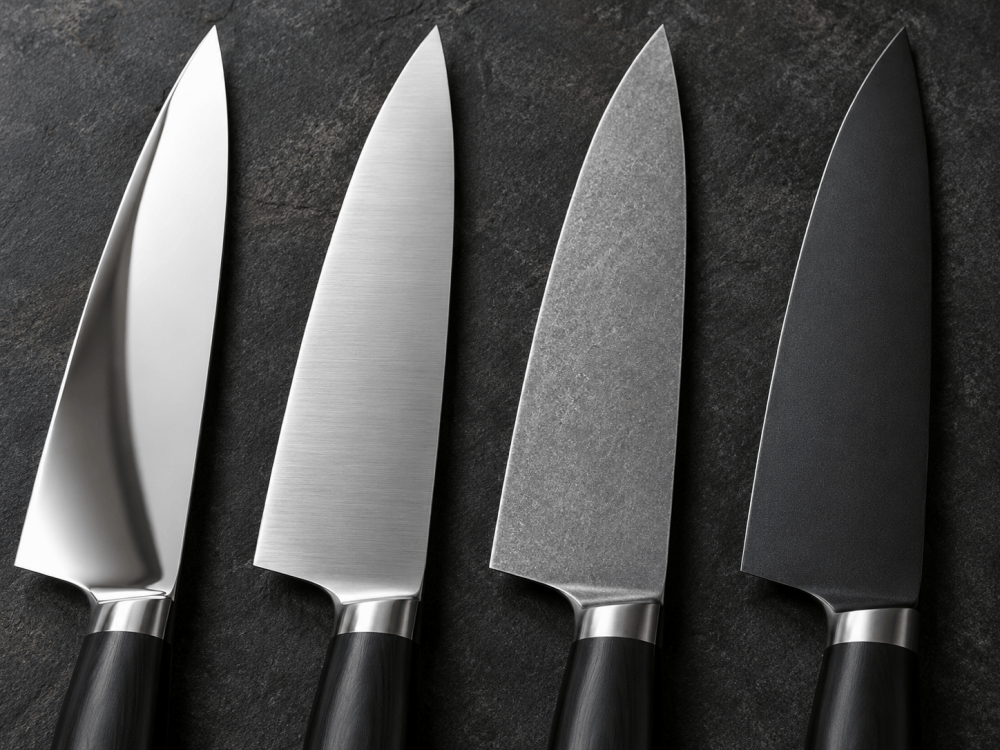
A knife blade's surface finish affects its appearance, how easily it shows scratches and fingerprints, how it should be cleaned, and what quality defects buyers need to inspect. Mirror-polished, satin, stonewashed, and non-stick-coated blades can all serve useful purposes, but they are not interchangeable. Each has different cosmetic requirements, maintenance considerations, and potential production risks.
For importers, wholesalers, retailers, and private-label brands, the best finish is not necessarily the most expensive or visually striking option. It is the one that matches the intended knife, target price, customer expectations, cleaning requirements, and agreed quality standards.
This guide compares four common knife blade finishes, explains their typical defect patterns, and outlines a practical quality-control process for sample approval and bulk production.
1. What Is the Difference Between a Blade Finish and a Coating?
A surface finish describes the appearance and texture produced by processes such as grinding, brushing, polishing, or stonewashing. A coating is an additional layer applied to the blade surface or a specified part of it.
Mirror, satin, and stonewashed are primarily finish descriptions. Non-stick-coated describes a functional surface treatment whose performance depends on the coating material, application process, substrate preparation, and curing or finishing conditions.
The distinction matters because the quality risks differ. A polishing defect may be a visible scratch or uneven reflection. A coating defect may involve poor adhesion, incomplete coverage, peeling, or loss of the intended surface function.
2. Comparison: Mirror, Satin, Stonewashed and Non-Stick-Coated Blades
| Comparison Factor | Mirror Polish | Satin Finish | Stonewashed Finish | Non-Stick Coating |
|---|---|---|---|---|
| Appearance | Bright, highly reflective surface | Soft sheen with directional lines | Irregular, mottled or textured appearance | Varies by coating; may be dark, colored, matte or glossy |
| Scratch visibility | High; fine scratches can stand out clearly | Directional scratches may be visible against the grain | Minor scuffs may blend into the texture | Scratches may expose a contrasting substrate or disrupt the coating |
| Fingerprints and smudges | Often conspicuous under strong light | Usually less visually prominent than on mirror polish | Often less conspicuous, depending on color and texture | Depends on the coating's surface properties and color |
| Cleaning | Smooth surfaces are generally straightforward to wipe, but water spots show easily | Generally straightforward; wipe along the finish direction where practical | Texture may retain residue or moisture if the surface is difficult to access | May release some foods more easily, but still requires appropriate washing |
| Wear appearance | New scratches and dull patches can be noticeable | Scratches may interrupt the original brushed pattern | Minor wear can be less obvious against the irregular pattern | Coating wear can be conspicuous if the underlying steel becomes exposed |
| Primary quality risk | Visible polishing marks, haze, uneven reflection | Inconsistent grain, cross-scratches, uneven brushing | Uneven texture, unwanted pits, inconsistent pattern | Poor adhesion, pinholes, peeling, chipping or abrasion damage |
| Best suited to | Premium presentation and decorative knife ranges | Everyday knives and consistent commercial styling | Knives where a textured, wear-disguising look is desired | Products designed around a verified coating function and care specification |
Important: This is a general comparison, not a guaranteed performance ranking. Steel grade, heat treatment, blade geometry, surface roughness, coating chemistry, and manufacturing quality can change the outcome significantly.
3. Mirror-Polished Knife Blades: Appearance, Cleaning and Defect Risks
What does a mirror finish look like?
A mirror-polished blade has a highly reflective surface produced through progressively finer finishing and polishing operations. The result can create a premium visual impression and a clean, bright appearance for retail presentation.
However, a reflective finish also makes surface irregularities easier to detect. Fine scratches, polishing haze, and uneven reflections may become visible under directional lighting even when they are difficult to see under diffuse light.
Durability considerations
Mirror polish is a surface appearance, not a guarantee of hardness, edge retention, or corrosion resistance. It does not automatically make a knife more durable than a satin-finished knife made from the same steel.
A well-finished, smooth surface can be relatively easy to wipe clean. But mirror polish can show fingerprints, water spots, and fine abrasions more readily, so preserving its original appearance may require more careful handling and storage.
Common mirror-finish defects
- Polishing scratches: Fine linear marks or isolated scratches that interrupt the reflective surface.
- Haze or cloudy patches: Areas that reflect light differently from the surrounding blade.
- Uneven reflection: Wavy or distorted reflected lines that may indicate inconsistent finishing or surface geometry.
- Visible polishing swirls: Circular or overlapping marks that remain after polishing.
- Handling marks: Fingerprints, contact marks, or scuffs introduced during production, inspection, or packaging.
How should mirror-polished blades be cleaned?
Use a soft cloth or non-abrasive sponge with a suitable dishwashing detergent, then rinse and dry thoroughly. Avoid abrasive pads and aggressive polishing compounds unless they are specifically approved for the product. Store blades so that they do not rub against other metal tools.
Best buying fit: Mirror polish can suit premium gift sets, display-oriented collections, and products where reflective appearance is a key selling point. Buyers should define the acceptable scratch level and inspection lighting before bulk production begins.
4. Satin-Finish Knife Blades: Practical Appearance and Consistency
What does a satin finish look like?
A satin finish typically has a soft sheen with fine, directional lines created by controlled grinding or brushing. It is less reflective than mirror polish and gives a restrained, professional appearance.
The direction, spacing, and consistency of the abrasive pattern strongly influence the final look. Two blades may both be described as satin-finished yet appear different if the abrasive grade, process direction, or finishing pressure differs.
Durability considerations
Satin finishes can make some minor marks less conspicuous than mirror polish, particularly when the marks follow the existing grain. However, a deep scratch across the grain may be highly visible.
The brushed pattern does not make the steel immune to corrosion or physical damage. Corrosion performance still depends on the steel grade, surface condition, exposure to moisture and chemicals, and maintenance routine.
Common satin-finish defects
- Cross-scratches: Marks that run across the intended brushing direction.
- Uneven grain: Visible differences in line density, direction, or texture across the blade.
- Over-polished patches: Local areas that appear brighter or smoother than the surrounding finish.
- Grinding lines: Coarse or deep marks that remain visible beneath the final finish.
- Edge-transition inconsistency: Uneven finishing near the bevel, spine, or other transitions.
How should satin-finished blades be cleaned?
Wash with a soft sponge and mild detergent, rinse, and dry. Where practical, wipe in the direction of the brushed grain. Avoid scouring pads that can introduce a different scratch pattern or create shiny patches.
Best buying fit: Satin is a practical option for many everyday kitchen knives because it balances appearance and maintenance. It is particularly useful when a consistent brushed look is more important than a mirror-like presentation.
For a more detailed comparison of the two polished finishes, read FASAKA's Satin Finish vs Mirror Finish Knives guide.
5. Stonewashed Knife Blades: Texture, Wear Concealment and Inspection
What is a stonewashed finish?
A stonewashed finish is generally produced by tumbling or otherwise processing blades with media to create a deliberately irregular surface appearance. The exact texture depends on the media, process conditions, blade preparation, and any additional finishing steps.
Stonewashed blades often have a mottled or subtly distressed look. Unlike satin finishes, which typically show a directional grain, stonewashing creates a less uniform pattern.
Does stonewashing make a blade more durable?
Stonewashing can help disguise some minor surface scuffs because new marks may blend into the existing texture. This is a cosmetic advantage, not proof of improved steel strength, edge retention, or corrosion resistance.
Surface texture also matters during cleaning. Depending on the roughness and geometry, residue or moisture may be harder to remove from certain areas. A stonewashed appearance should not be used as a substitute for appropriate cleaning and drying.
Common stonewashed-finish defects
- Uneven pattern distribution: One area appears much darker, smoother, or more heavily textured than another.
- Unwanted deep pits: Localized depressions that look different from the intended texture and may indicate a process or material issue.
- Incomplete coverage: Areas that retain a different surface appearance from the approved sample.
- Damage near the cutting edge: Unwanted chips, dents, or edge damage that must not be accepted as part of the decorative finish.
- Residual contamination: Media particles, abrasive residue, or process contamination left on the blade.
How should stonewashed blades be cleaned?
Use a suitable soft brush or sponge if the texture makes residue difficult to remove. Rinse thoroughly and dry the knife, including any areas where water could remain. Avoid assuming that a textured surface is self-cleaning simply because it hides visible smudges.
Best buying fit: Stonewashed finishes can suit product lines where a textured, understated appearance is desirable and minor cosmetic wear should be less noticeable. Buyers should approve a physical reference sample because the pattern is inherently less uniform than a directional satin finish.
6. Non-Stick-Coated Knife Blades: Food Release and Coating Failure Risks
What is a non-stick-coated knife blade?
A non-stick-coated blade has an applied surface layer intended to change how food interacts with the blade. Depending on the coating system and product design, it may reduce sticking for certain ingredients or provide a particular color and appearance.
The term "non-stick" does not identify one universal coating chemistry. Buyers should confirm the actual coating type, intended food-contact use, application process, and care limitations rather than assuming that all coated blades have the same performance.
Durability considerations
Unlike a purely mechanical finish, an applied coating introduces an additional interface between the coating and the underlying blade. Its service life can be affected by adhesion, coating thickness and uniformity, abrasion, impact, cleaning methods, and contact with other utensils.
A coating can look attractive when new but lose performance if it scratches, wears, chips, or separates from the substrate. The underlying steel may remain structurally intact even when the coating has failed, but a damaged food-contact coating should be assessed against the product's specifications and applicable requirements.
Common coating defects
- Pinholes or bare spots: Small areas where the coating is absent or incomplete.
- Blistering: Raised areas that may indicate a coating or adhesion problem.
- Peeling or flaking: Coating material separates from the substrate.
- Chipping: Localized coating loss, potentially caused by impact or inadequate adhesion.
- Color variation: Uneven shade or gloss compared with the approved sample.
- Edge build-up: Excess coating or an irregular coating boundary near the blade edge or other transitions.
- Abrasion or loss of function: The coating wears down or no longer provides the intended surface behavior.
How should coated blades be cleaned?
Follow the manufacturer's care instructions. Unless the coating supplier specifically approves otherwise, avoid abrasive scouring pads, aggressive scraping, and cleaning methods that could damage the coating. Dry the blade after washing and store it to minimize contact with other metal objects.
Dishwasher suitability must be confirmed for the complete knife and its coating system. It should not be inferred from the word "stainless steel" or "non-stick."
Best buying fit: A coated blade may be suitable when the target market values a particular appearance or verified food-release benefit. It requires clear specifications and a more focused coating-quality test plan than an uncoated mechanical finish.
7. Knife Blade Finish Defect Map: What Buyers Should Inspect
A defect map helps quality teams separate expected finish characteristics from actual nonconformities. It should be prepared using approved samples, product specifications, agreed lighting conditions, and defined acceptance criteria.
| Defect or Observation | Most Relevant Finish | How to Inspect | Why It Matters |
|---|---|---|---|
| Fine scratches | Mirror, satin, coated | Inspect under consistent lighting and compare with the approved sample | May affect appearance; scratches on a coating may also expose the substrate |
| Haze or cloudy reflection | Mirror | Rotate the blade under diffuse and directional light | Can indicate inconsistent polishing or finishing |
| Cross-grain marks | Satin | Check the blade along and across the intended grain direction | Breaks the visual consistency of the finish |
| Uneven texture or pattern | Stonewashed | Compare multiple blades against an approved reference sample | May indicate uncontrolled process variation |
| Pinholes or bare spots | Coated | Use suitable visual inspection and magnification where specified | May indicate incomplete coating coverage |
| Peeling, flaking or blistering | Coated | Inspect edges and transitions; carry out agreed adhesion tests | May indicate a coating failure |
| Rust spots or discoloration | All finishes | Inspect after the agreed cleaning, drying, and exposure protocol | May be linked to material, contamination, surface condition, or care practices |
| Chipped or damaged cutting edge | All finishes | Inspect the edge under suitable magnification and perform the specified edge check | A functional defect, not an acceptable decorative finish variation |
| Residue or trapped particles | Especially textured finishes and coated surfaces | Inspect after cleaning and drying | May affect cleanliness and indicate inadequate process control |
Not every visible mark has the same severity. For example, a small cosmetic variation in an approved stonewashed pattern is different from a sharp burr, a damaged cutting edge, or a coating that is peeling. Buyers should classify defects by location, size, functional impact, and food-contact implications.
8. How to Test Knife Blade Finish Durability
A useful durability program separates appearance retention, corrosion behavior, coating integrity, and functional performance. One test cannot establish all four.
Test 1: Initial visual inspection
Inspect the blade before testing. Record the finish appearance, visible scratches, coating coverage where applicable, edge condition, and any discoloration. Use the same lighting, viewing distance, and reference sample for every inspection.
For bulk orders, define the inspection method and acceptable cosmetic variation before production. A photograph alone may not capture fine differences in reflection or texture, so physical samples are useful for approval.
Test 2: Repeated cleaning and drying
Wash and dry samples using the cleaning method specified for the product. Repeat the agreed number of cycles and inspect for discoloration, residue retention, finish changes, coating damage, and corrosion indicators.
Use the same detergent, water conditions, washing method, and drying procedure across comparison samples. Do not assume that a laboratory cleaning cycle is equivalent to a specific number of months of consumer use unless a validated correlation exists.
Test 3: Abrasion and scratch resistance
Use a controlled abrasion method appropriate to the material and finish. Keep the abrasive medium, applied load, contact area, movement, and number of cycles consistent. Record visible changes and, where relevant, changes in coating function.
For coated surfaces, ASTM D8380 addresses dry abrasion resistance for thin hydrophobic or omniphobic coatings on planar glass specimens. It may provide useful background on measuring functional changes after abrasion, but it is not a direct pass/fail test for every knife-blade coating. The method and specimen configuration must be suitable for the product being evaluated.
Test 4: Coating adhesion
For non-stick-coated blades, establish a coating-adhesion test with the coating supplier or an appropriate testing laboratory. Select the method according to the coating type, thickness, substrate, and geometry.
ASTM D6677 describes a qualitative knife adhesion assessment for coating films. It is not automatically suitable for every knife blade or coating system. Any test that cuts or damages a coating should be performed on designated test specimens, not treated as a non-destructive inspection of every finished retail knife.
Test 5: Corrosion and staining resistance
Use an exposure method that reflects the intended product and market requirements. Define the exposure medium, concentration if applicable, temperature, duration, rinse procedure, drying method, and inspection criteria in advance.
Record rust spots, staining, pitting, discoloration, and any coating deterioration. A finish name alone cannot establish corrosion resistance. Material grade, surface contamination, coating integrity, and environmental conditions must also be considered.
Test 6: Functional checks after durability testing
After the agreed exposure and cleaning tests, inspect the blade edge, handle connections, and any relevant moving parts. If cutting performance is part of the product specification, use an appropriate repeatable edge-performance test before and after testing.
Surface finish testing should not replace sharpness, edge-retention, handle-strength, or overall product safety evaluations. These are separate performance characteristics.
Suggested quality-control record
| Record Item | What to Document |
|---|---|
| Sample identification | Product model, batch, steel specification, finish type and coating details |
| Baseline condition | Photos, visual observations, dimensions or measurements required by the specification |
| Test conditions | Method, equipment, medium, temperature, duration, cycles and operator |
| Post-test condition | Scratches, haze, texture changes, staining, corrosion, coating loss and functional changes |
| Acceptance criteria | Pre-agreed limits, pass/fail decision, deviations and corrective actions |
| Approval record | Approved reference sample, date, responsible parties and any agreed exceptions |
For reliable supplier comparisons, test the same product design and steel specification where possible. If blade material, coating system, or surface preparation differs, record the difference rather than attributing every performance change to the finish alone.
9. Which Knife Blade Finish Is Best for Wholesale and OEM Projects?
The best choice depends on the target customer and the product's intended position in the market. Buyers should consider not only the appearance of a sample but also the cost of maintaining that appearance, the inspection requirements, and the consequences of a finish defect after delivery.
| Project Objective | Finish to Consider | Key Procurement Focus |
|---|---|---|
| Premium reflective appearance | Mirror polish | Scratch control, polishing consistency, protective packaging and visual inspection |
| Practical everyday presentation | Satin | Consistent grain direction, uniform finish and controlled surface marks |
| Textured appearance with less visible minor scuffing | Stonewashed | Reference-sample consistency, texture uniformity, cleaning and contamination checks |
| Specific food-release function or colored surface | Non-stick-coated | Coating specification, adhesion, abrasion resistance, food-contact suitability and care instructions |
Questions to ask before approving production
- What is the exact blade material and surface-treatment process?
- Does the approved sample define the finish pattern, gloss, color, and acceptable cosmetic variation?
- For coated blades, what is the coating type, and which performance or compliance documents are available?
- Which cleaning, abrasion, adhesion, and corrosion tests will be used, and what are the acceptance criteria?
- How will blades be protected from rubbing, scratching, or coating damage during packing and transport?
- How will deviations be documented and corrected if bulk production differs from the approved sample?
For product options and sourcing discussions, visit FASAKA kitchen knives or review the company's OEM and ODM kitchenware services.
10. Frequently Asked Questions
Which knife blade finish is the most durable?
There is no universal winner. Mirror, satin, and stonewashed finishes describe different surface appearances, while a non-stick coating adds another material layer. Overall durability depends on the steel, heat treatment, surface preparation, coating system where applicable, intended use, and maintenance.
Which knife blade finish is easiest to clean?
A smooth, accessible surface is generally straightforward to wipe clean, but finish names alone do not determine cleanability. Mirror and satin blades are often easy to wipe, stonewashed textures may require extra attention in some areas, and coated blades must be cleaned according to their coating-specific instructions.
Does a mirror finish prevent rust?
No. A mirror finish does not make a blade rust-proof. Corrosion resistance depends on the steel composition, surface condition, contamination, exposure, and care. Clean and dry knives according to the manufacturer's instructions.
Does stonewashing hide scratches?
Stonewashing can make some minor scuffs less noticeable because they blend into the irregular surface pattern. It does not prevent deep scratches, edge damage, or corrosion, and it should not be used to disguise genuine defects.
Can a non-stick coating peel off a knife blade?
Coating failure is possible if adhesion or coating integrity is inadequate, or if the product is exposed to damaging abrasion, impact, or unsuitable cleaning. Buyers should confirm the coating system, care instructions, and appropriate adhesion and durability tests.
Are coated knife blades safe for food contact?
That depends on the coating materials, manufacturing process, intended use, and applicable requirements in the destination market. Request relevant supporting documentation for the specific product rather than relying on a general claim that the coating is non-stick or food-safe.
Does the blade finish affect sharpness?
Surface finish and edge sharpness are different characteristics. Sharpness is influenced by edge geometry, grinding, steel properties, and manufacturing control. A decorative finish should not be treated as evidence of cutting performance.
What should importers inspect in a coated knife sample?
Check coating coverage, color consistency, visible pinholes, blisters, peeling, edge transitions, cleaning instructions, and relevant supporting documentation. Where appropriate, agree on coating adhesion, abrasion, corrosion, and food-contact evaluations before bulk production.
Conclusion
Mirror, satin, stonewashed, and non-stick-coated knife blades offer different combinations of appearance, maintenance requirements, and quality risks. Mirror polish emphasizes reflectivity, satin offers a controlled brushed look, stonewashing creates a textured appearance that can disguise some minor scuffs, and non-stick coatings may provide a specific surface function when properly designed and tested.
For B2B buyers, the most reliable decision comes from matching the finish to the intended use, approving a representative physical sample, documenting acceptable cosmetic variation, and using suitable tests to verify durability and coating integrity. A clear specification helps reduce disagreements between sample approval and mass production.
Looking for Kitchen Knife OEM or ODM Options?
FASAKA is a brand under DKS Enterprises Co., Ltd., a manufacturer and supplier of knives and scissors, BBQ tools, and kitchenware based in Yangjiang, Guangdong, China. Contact the team to discuss your product requirements and confirm suitable knife options, finishes, and quality-control expectations.
Explore Kitchen Knives OEM & ODM Services Contact FASAKA