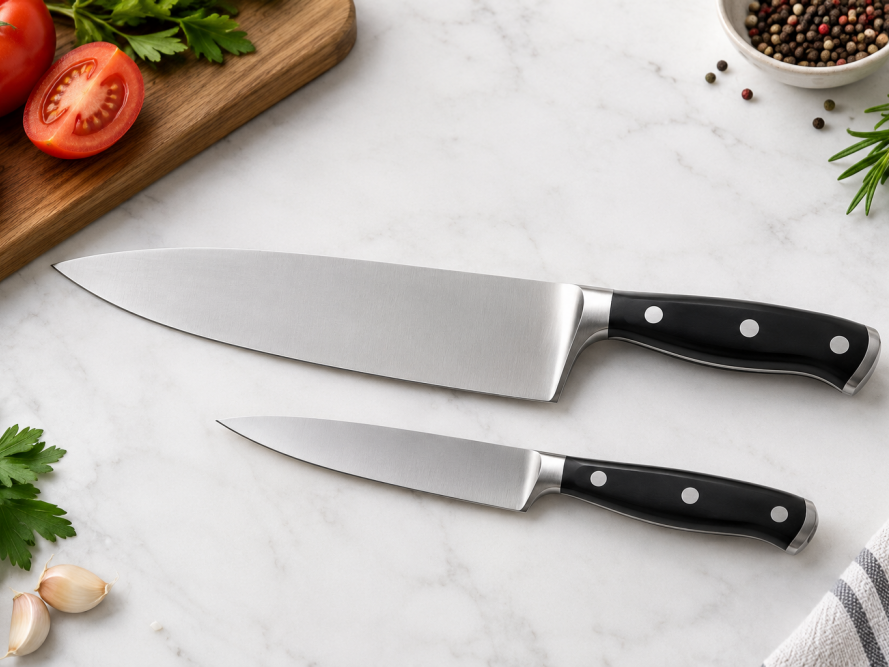




Forged vs Stamped Kitchen Knives: Weight, Strength, Cost, and Batch Consistency
When comparing forged vs stamped kitchen knives, the main differences come from how the blade blank is formed, how the knife is finished, and how the product is controlled during manufacturing. Forged knives are often associated with a substantial feel and premium positioning, while stamped knives are commonly chosen for lightweight handling and cost-efficient production.
For kitchen knife brands, wholesalers, importers, and private-label buyers, neither construction is automatically the better choice. The right option depends on the target selling price, intended use, preferred weight, product specifications, and required production volume.
1. What Is the Difference Between Forged and Stamped Kitchen Knives?
What Are Forged Kitchen Knives?
Forged kitchen knives are made by shaping a steel billet or blank through a forging process, often involving heat and compressive force. The rough blade shape is then finished through operations such as heat treatment, grinding, polishing, sharpening, and handle assembly.
Depending on the design, forging can provide greater freedom to create a shaped bolster, varied blade thickness, and different balance characteristics. These features can support a premium product design, but they do not guarantee superior cutting performance by themselves.
Forging can be performed by hand, machine, or a combination of methods. Therefore, the term hand forged kitchen knives should refer to a specific manufacturing approach rather than being used as a general synonym for all forged knives.
What Are Stamped Kitchen Knives?
Stamped kitchen knives are generally made by cutting a blade-shaped blank from a sheet of steel using a press, die, laser, or another suitable cutting method. The blank then goes through finishing processes such as heat treatment, grinding, sharpening, and handle assembly.
Because the starting material is sheet steel, stamped construction can be efficient for standardized designs and higher-volume production. It also allows manufacturers to develop lightweight knives for everyday food preparation, retail knife sets, and price-sensitive product ranges.
A stamped knife is not necessarily poorly made. With suitable steel, controlled heat treatment, good blade geometry, and accurate finishing, it can deliver reliable performance for its intended application.
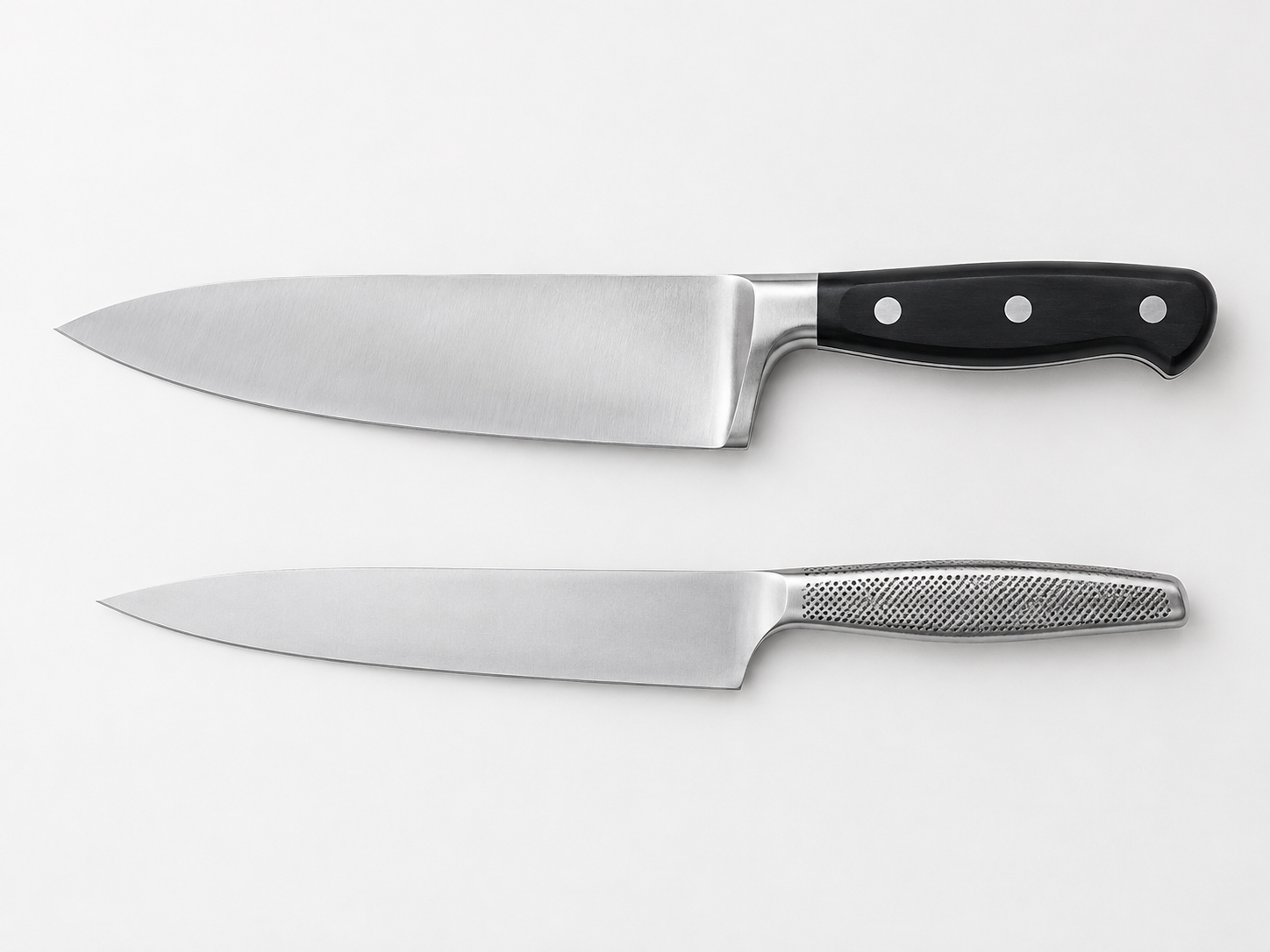
2. Forged vs Stamped Kitchen Knives: Key Differences at a Glance
| Comparison Factor | Forged Kitchen Knives | Stamped Kitchen Knives |
|---|---|---|
| Manufacturing process | Steel is shaped through a forging process before final machining and finishing. | A blade blank is cut from sheet steel before heat treatment and finishing. |
| Typical weight | Often heavier, depending on blade profile, bolster, tang, and handle. | Often lighter, depending on sheet thickness, blade size, and handle construction. |
| Strength and durability | Can support robust construction, but performance depends on material and processing. | Can also be durable when steel, heat treatment, and geometry are properly controlled. |
| Production cost | Often higher because of additional forming and finishing requirements. | Often more cost-efficient for standardized designs and high-volume production. |
| Design flexibility | May offer greater flexibility for shaped bolsters and varied blade profiles. | Works well for repeatable blade outlines and standardized specifications. |
| Batch consistency | Depends on control of forging, heat treatment, grinding, assembly, and inspection. | Can benefit from repeatable blank-cutting processes, but downstream control remains essential. |
| Common market positioning | Premium retail lines, substantial-feel knives, and selected professional ranges. | Everyday kitchen knives, lightweight ranges, value-oriented sets, and large-volume programs. |
These are general manufacturing tendencies, not universal rules. A specific forged knife may be lighter than a particular stamped model, and a well-made stamped knife may outperform a poorly processed forged knife.
3. Weight: Are Forged Kitchen Knives Heavier?
Forged kitchen knives are often heavier than stamped knives, but the difference depends on the complete knife design rather than the production process alone.
Why Forged Knives May Weigh More
- Bolster design: A substantial bolster can add weight near the junction between the blade and handle.
- Blade thickness: A thicker spine or a fuller blade profile may increase the amount of steel used.
- Tang construction: The size and shape of the steel extending into the handle affect total weight and balance.
- Handle materials: Wood, plastic, metal, and composite handles have different weights.
Why Stamped Knives Are Often Lighter
Stamped blades can be produced from relatively thin sheet steel, making lightweight construction easier to achieve. This can be useful for home cooks, entry-level kitchen knife sets, and users who prefer easy handling during repetitive preparation tasks.
However, stamped knives are not always lightweight, and forged knives do not have to be heavy. Blade dimensions, handle design, and the intended balance point all matter.
Which Weight Is Better for Buyers?
A heavier knife may feel substantial and can suit users who prefer momentum during chopping. A lighter knife may offer easier maneuverability and reduce perceived fatigue during extended food preparation.
For wholesale buyers, it is better to evaluate the actual weight in grams, balance point, blade dimensions, and handle comfort rather than using “forged” or “stamped” as a substitute for product specifications.
4. Strength and Durability: Which Construction Is Stronger?
There is no universal rule that every forged kitchen knife is stronger than every stamped kitchen knife. The manufacturing method influences the blade blank, but the finished knife's durability depends on several interacting factors.
Steel Grade and Composition
Different stainless steel grades offer different combinations of hardness potential, toughness, corrosion resistance, and wear resistance. Buyers should confirm the actual steel grade rather than relying on descriptions such as “premium stainless steel” alone.
Heat Treatment and Hardness
Heat treatment affects the final properties of the steel. Inadequate or inconsistent processing can affect edge stability and durability regardless of whether the blade was forged or stamped.
Rockwell hardness, often reported as HRC, is one useful specification. It should be assessed alongside toughness, edge geometry, and the knife's intended use instead of being treated as a complete measure of quality.
Blade Geometry and Grinding
Blade thickness, taper, cutting-edge angle, and grinding accuracy influence how a knife cuts and how well the edge withstands use. A thicker blade may provide a more substantial feel, while a thinner blade can offer lower cutting resistance for certain tasks.
Tang and Handle Construction
The connection between the blade and handle also affects the durability of the complete product. Buyers should inspect handle fit, rivets or other fastening methods, gaps, alignment, and the overall assembly.
5. Cost: Are Stamped Kitchen Knives Cheaper?
Stamped kitchen knives are often more cost-efficient to manufacture because cutting standardized blanks from sheet steel can reduce forming steps and support efficient material use. Forged knives may require more forming operations and additional finishing, particularly when the design includes a shaped bolster or complex profile.
However, the final cost of a kitchen knife depends on much more than whether it is forged or stamped.
| Cost Factor | What Buyers Should Check |
|---|---|
| Steel material | Steel grade, thickness, material price, and sourcing consistency. |
| Manufacturing process | Blank preparation, forging or stamping, machining, and material utilization. |
| Heat treatment | Processing requirements, hardness targets, and inspection frequency. |
| Grinding and polishing | Blade geometry, surface finish, edge preparation, and cosmetic standards. |
| Handle and assembly | Handle material, tang design, fastening method, and assembly complexity. |
| Packaging | Individual packaging, gift boxes, knife blocks, inserts, and retail presentation. |
| Order quantity | Production volume, tooling requirements, customization, and order scheduling. |
Which Option Is Better for a Target Price?
- For value-oriented retail: Stamped knives may offer a practical route to competitive pricing and lightweight designs.
- For premium positioning: Forged construction may support a substantial feel and a design with a more pronounced bolster or refined profile.
- For mixed product ranges: Offering both constructions can help brands serve different budgets and customer preferences.
For B2B sourcing, compare quotations using the same steel grade, blade dimensions, hardness requirements, handle materials, packaging, inspection standards, and order quantity. Otherwise, a price comparison between a forged knife and a stamped knife may not be meaningful.
6. Batch Consistency: Which Is Better for Large Orders?
Batch consistency is especially important for importers, wholesalers, retailers, and private-label brands. Customers expect knives from the same product line to have consistent dimensions, weight, balance, appearance, and cutting performance.
Stamped production can make standardized blank dimensions easier to repeat because the blade outline is cut from sheet steel using a defined process. However, this does not guarantee that the finished knives will be identical in every important respect.
Forged production can also achieve consistent results when forming parameters, heat treatment, grinding, assembly, and inspection are controlled. The key is whether the manufacturer has a repeatable process and measurable acceptance criteria.
What Should Be Checked in Every Production Batch?
- Dimensions: Blade length, overall length, width, and thickness at specified measurement points.
- Weight: Confirm that finished products fall within the agreed tolerance.
- Hardness: Verify the agreed target and testing method where hardness specifications apply.
- Blade geometry: Inspect edge alignment, grinding symmetry, and visible defects.
- Sharpness and cutting performance: Use an agreed test method with clear acceptance criteria.
- Handle assembly: Check fit, fastening, alignment, and gaps.
- Surface finish: Inspect polishing, coating, scratches, stains, and other cosmetic requirements.
- Packaging and labeling: Verify barcode, logo, product information, and carton specifications.
Buyers should establish a written product specification and approved reference sample before mass production. Inspection frequency, sampling plans, and defect acceptance criteria should also be agreed with the supplier.
For large orders, the most reliable choice is not simply the knife made by one process or the other. It is the product backed by repeatable manufacturing procedures, traceable specifications, and effective quality control.
7. Hand Forged Kitchen Knives: Are They Always Better?
Hand forged kitchen knives appeal to customers who value traditional craftsmanship, distinctive finishing, and the story behind a product. Some artisan knives include visible hammer marks or other features associated with their manufacturing process.
However, hand forging does not automatically mean a knife is sharper, stronger, or more durable than a machine-forged or stamped alternative. Steel selection, heat treatment, grinding, and final inspection remain important.
For brands developing a premium knife range, it is useful to distinguish between three concepts:
- Hand forged: Describes a manufacturing approach involving substantial manual forging work.
- Machine forged: Uses mechanized equipment to shape the steel through forging.
- Stamped: Uses a cutting process to produce the blade blank from sheet steel.
These terms describe production methods, not a complete ranking of finished knife quality. Buyers should also verify what a supplier means by “hand forged” and ensure that product descriptions accurately reflect the manufacturing process.
What About Hand Forged Kitchen Knives Made in USA?
The search phrase “hand forged kitchen knives made in USA” reflects interest in both craftsmanship and manufacturing origin. These are two separate attributes: a knife's production method does not establish where it was manufactured.
Buyers evaluating U.S.-made products should verify the actual country of origin and the applicable origin-labeling requirements. They should not infer U.S. origin simply from a brand name, a seller's location, or the phrase “hand forged.”
What About Hand Forged Japanese Kitchen Knives?
Hand forged Japanese kitchen knives are often searched for because of their association with Japanese knife-making traditions and particular blade styles. Nevertheless, Japanese origin, hand-forged construction, steel type, blade geometry, and intended use are different characteristics.
When sourcing Japanese-style knives or developing a similar product concept, buyers should specify the desired blade profile, steel, hardness, finish, handle, and country of origin independently. A Japanese-style design does not automatically mean that the knife was made in Japan.
8. How to Choose Between Forged and Stamped Knives for Wholesale
For a wholesale or private-label program, the best construction depends on the product's intended customer, retail price, and expected usage.
| Buyer Requirement | Construction to Evaluate | Key Consideration |
|---|---|---|
| Premium-looking knife sets | Forged and selected stamped designs | Balance, finish, handle construction, and perceived value. |
| Lightweight everyday knives | Stamped designs and lightweight forged alternatives | Total weight, maneuverability, and comfortable handling. |
| Competitive entry-level sets | Often stamped designs | Target cost, acceptable performance, and packaging cost. |
| Large repeat orders | Either construction | Process capability, specification control, and batch inspection. |
| Distinctive blade profiles | Compare designs individually | Manufacturing feasibility, tooling, finishing, and cost. |
| Private-label development | Based on the target product specification | Customization, approved samples, quality standards, and supply planning. |
A Practical Checklist for Importers and Brand Owners
Before placing a bulk order, ask the manufacturer:
- Is the blade forged or stamped, and what production process does that description refer to?
- What steel grade and finished blade thickness are specified?
- What hardness target and verification method will be used?
- What are the target weight and acceptable weight tolerance?
- How are blade dimensions, edge quality, and handle assembly inspected?
- Can the supplier provide samples for evaluation before mass production?
- How are changes to materials, components, or production processes controlled?
- What logo, handle, finish, and packaging customization options are available?
These questions help buyers compare suppliers on measurable requirements instead of relying on broad claims such as “professional quality” or “premium forged construction.”
9. Can FASAKA Support Custom Kitchen Knife Programs?
FASAKA is a kitchenware brand under DKS Enterprises Co., Ltd., based in Yangjiang, Guangdong, China. Its product range includes kitchen knives, scissors, BBQ tools, and related kitchenware, with OEM and ODM solutions for brands, wholesalers, and distributors.
For buyers developing a kitchen knife program, the starting point should be the intended market and product specification. Weight, blade dimensions, steel requirements, handle design, finish, packaging, and quality inspection criteria should be defined before comparing manufacturing options.
Explore the FASAKA kitchen knife range to review available product styles, or learn more about OEM and ODM kitchenware customization.
For a private-label project, share your target product type, estimated order quantity, desired specifications, and packaging requirements to discuss suitable options.
10. Frequently Asked Questions
Are forged kitchen knives stronger than stamped knives?
Not automatically. Forging can support particular blade and bolster designs, but strength and durability also depend on steel composition, heat treatment, blade geometry, and manufacturing quality.
Are stamped kitchen knives lower quality?
No. Stamped knives can deliver reliable cutting performance when made with suitable steel and controlled heat treatment, grinding, sharpening, and assembly. Manufacturing method alone does not determine overall quality.
Are forged knives always heavier?
No. Forged knives are often heavier because of their blade profiles or bolsters, but total weight also depends on blade dimensions, tang construction, and handle materials. Compare the actual product weight and balance.
Why do stamped kitchen knives often cost less?
Stamping can reduce forming steps and support efficient production of standardized blade blanks. Final pricing still depends on steel, heat treatment, finishing, handle construction, packaging, and order quantity.
Which type is better for bulk production?
Either type can be suitable. Stamped production can be efficient for standardized designs, while forged production can also support repeatable large-volume programs. Buyers should evaluate process control, product specifications, inspection procedures, and sample results.
Do hand forged kitchen knives hold an edge longer?
Not necessarily. Edge retention depends on factors such as steel composition, heat treatment, hardness, edge geometry, and use. Hand forging alone does not establish how long a knife will stay sharp.
Are hand forged Japanese kitchen knives always made in Japan?
No. The terms “hand forged” and “Japanese-style” do not independently prove country of origin. Verify the actual manufacturing location and origin information when that distinction matters.
What should buyers compare when sourcing forged vs stamped kitchen knives?
Compare the steel grade, blade dimensions, hardness requirements, weight, handle construction, finish, cutting performance, packaging, order quantity, and quality control standards. Use comparable specifications when evaluating supplier quotations.
Looking for a Kitchen Knife Manufacturing Partner?
FASAKA supports kitchenware sourcing and OEM/ODM projects for brands, importers, wholesalers, and distributors. Define your target price, knife specifications, design preferences, and order quantity to evaluate a suitable product solution.