




German vs Japanese vs Standard Stainless Steel Kitchen Knives: Key Differences
German vs Japanese vs Standard Stainless Steel Kitchen Knives: Key Differences
Choosing a kitchen knife involves more than comparing brands or prices. The steel used in the blade affects hardness, sharpness, edge retention, corrosion resistance, and how much maintenance the knife requires.
German stainless steel knives, Japanese high-carbon steel knives, and standard stainless steel knives are often compared as three distinct options. However, these categories are not exactly equivalent: German and Japanese describe manufacturing traditions or common knife styles, while stainless steel and carbon steel describe material characteristics.
This guide explains the practical differences so home cooks, chefs, retailers, importers, and kitchenware buyers can choose the right knife for their needs.
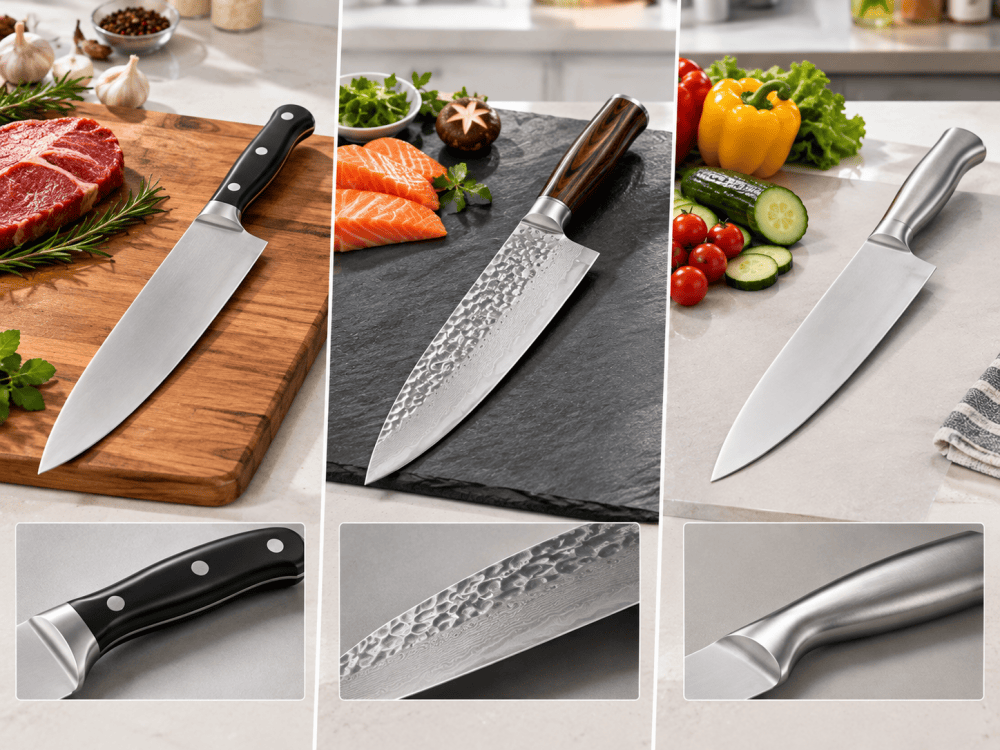
Quick Answer: What Is the Difference?
German-style stainless steel knives generally prioritize toughness, ease of sharpening, and everyday versatility.
Japanese high-carbon steel knives can offer excellent sharpness and edge retention. Traditional non-stainless carbon steel requires more careful drying, while Japanese high-carbon stainless steel provides better corrosion resistance.
Standard stainless steel knives are often designed for affordability, corrosion resistance, and easy care, although their performance varies significantly with the exact steel grade and heat treatment.
There is no universally best option. The right choice depends on cutting tasks, maintenance habits, budget, and the balance between sharpness, durability, and convenience.
1. German vs Japanese vs Standard Stainless Steel: Comparison Table
The following table summarizes common characteristics. These are general tendencies, not guarantees for every knife. Steel composition, heat treatment, blade thickness, and edge geometry can produce substantial differences within each category.
| Feature | German-Style Stainless Steel | Japanese High-Carbon Steel | Standard Stainless Steel |
|---|---|---|---|
| Typical hardness | Often around 55–58 HRC for common German-style chef knives | Often around 60–65 HRC for harder Japanese knives; traditional carbon steels vary | Varies widely; many entry-level blades are softer than premium knife steels |
| Sharpness | Can achieve an excellent working edge; often designed for versatile everyday use | Can support a very fine, precise edge, depending on steel and blade geometry | Can be very sharp when properly ground and sharpened; budget models may have less refined edges |
| Edge retention | Generally balanced; may require more frequent sharpening than harder steels | Often strong when using hard, wear-resistant steel and suitable heat treatment | Highly dependent on grade and heat treatment; some blades lose sharpness sooner |
| Corrosion resistance | Generally good for common stainless grades such as X50CrMoV15 | Good for stainless grades such as VG-10; limited for traditional non-stainless carbon steel | Usually good, but depends on chromium content, alloy composition, and care |
| Resistance to chipping | Often relatively forgiving because of the balance between hardness and toughness | Harder, thinner edges may be more vulnerable to chipping if twisted or used on hard materials | Many softer blades resist chipping reasonably well but may roll or deform at the edge |
| Sharpening | Usually straightforward for routine maintenance | Harder grades may require more skill and suitable sharpening stones | Often easy to sharpen, especially softer grades; performance varies |
| Daily maintenance | Hand-wash and dry after use | Stainless versions are relatively easy to care for; carbon steel needs prompt drying | Generally easy to maintain, but hand-washing and drying are still recommended |
| Best suited for | General-purpose preparation, busy kitchens, and users who value versatility | Precision slicing, fine vegetable preparation, and users who prioritize edge performance | Everyday home cooking, budget-conscious buyers, and large-volume product ranges |
Important: The phrase “standard stainless steel” does not identify a single steel grade. Always check the actual grade and manufacturer's specifications instead of judging performance from a broad label.
2. Hardness: Which Kitchen Knife Steel Is Harder?
Knife hardness is commonly measured using the Rockwell C scale, abbreviated as HRC. Hardness affects how well a blade supports a fine edge and resists wear, but it is not the same as overall durability.
German-Style Stainless Steel
Many traditional German-style chef knives use stainless steel such as X50CrMoV15 and are hardened to approximately 55–58 HRC. This range offers a practical balance of hardness, toughness, and ease of sharpening.
For general-purpose cooking, this balance can be useful when a knife is shared among several users or used for a variety of ingredients. The blade is often more forgiving of everyday handling mistakes than a very hard, thin-edged knife.
Japanese High-Carbon Steel
Many Japanese knives use harder steels or heat treatments, with some stainless models around 60–63 HRC and certain premium steels reaching higher levels. Traditional Japanese carbon steels can also be hardened to high levels.
Higher hardness can help a knife maintain a fine edge for longer. However, a harder blade is not automatically better. It may be less tolerant of twisting cuts, impacts, or contact with bones and frozen food, depending on its toughness and geometry.
Standard Stainless Steel
Standard stainless steel knives cover a wide range of products. Some entry-level blades use relatively soft steel for affordability and straightforward sharpening, while better stainless grades can deliver strong edge performance.
For buyers comparing knives, the stated steel grade and target HRC are more useful than the phrase “stainless steel” alone.
Key takeaway: Higher HRC generally supports better wear resistance and edge retention, but toughness, heat treatment, blade thickness, and cutting technique determine how well a knife performs in real use.
3. Sharpness: Which Knife Cuts Better?
Sharpness is not determined by steel type alone. It also depends on the edge angle, the quality of sharpening, the blade's geometry, and how the edge is finished.
German Knives: Versatile Everyday Cutting
German-style chef knives often have a robust blade profile and are designed to handle a broad range of kitchen tasks. They can cut meat, vegetables, herbs, and many everyday ingredients effectively while offering a forgiving balance of cutting performance and durability.
Their edges may need more frequent sharpening than those on harder, wear-resistant knives, depending on the specific models and how they are used.
Japanese Knives: Precision and Fine Edges
Japanese knives are often designed with thinner blades and fine edge geometry. This can reduce cutting resistance and make them especially suitable for precise slicing, fine vegetable work, and clean cuts through boneless ingredients.
A properly sharpened Japanese knife can feel exceptionally sharp. However, a thin edge should not be used to pry, twist through hard ingredients, or cut frozen food unless the manufacturer specifically says the knife is designed for those tasks.
Standard Stainless Steel Knives: Practical Performance
A standard stainless steel knife can perform very well when the steel, heat treatment, and grinding are appropriate. Lower-cost knives may require more frequent sharpening, but price and steel labels alone do not determine how sharp a knife will be when purchased.
When comparing products, evaluate both initial sharpness and edge retention. Initial sharpness describes how well the blade cuts when new or freshly sharpened. Edge retention describes how well it maintains that performance over time.
4. Corrosion Resistance: Which Steel Is Least Likely to Rust?
Corrosion resistance depends largely on the alloy's composition, particularly its chromium content, along with heat treatment, surface condition, and exposure to moisture, salt, and acidic foods.
German Stainless Steel
Common German stainless knife steels, including X50CrMoV15, generally provide good resistance to rust and staining. This makes them practical for everyday kitchen use.
However, stainless steel is not completely rust-proof. Leaving a knife wet, exposing it to salt for long periods, or placing it in a harsh dishwasher environment can still cause corrosion or surface damage.
Japanese High-Carbon Steel: Stainless vs Non-Stainless
This is the most important distinction to understand. Some Japanese knives use high-carbon stainless steel, such as VG-10. These steels combine relatively high hardness with useful corrosion resistance when properly maintained.
Other Japanese knives use traditional non-stainless carbon steel, such as Shirogami (White Steel) or Aogami (Blue Steel). These steels can take a very fine edge, but they are more reactive to moisture and acidic ingredients. They can develop a patina and may rust if left wet.
Standard Stainless Steel
Many standard stainless knife steels offer good corrosion resistance, especially when designed for everyday kitchen use. But the exact performance depends on the grade. A product described only as “stainless steel” does not provide enough information to make a reliable comparison.
Practical advice: If low maintenance and rust resistance are priorities, choose a reputable stainless steel knife and follow its care instructions. If choosing traditional carbon steel, be prepared to wipe and dry the blade promptly throughout use.
5. Maintenance: Which Kitchen Knife Is Easiest to Care For?
German-Style Stainless Steel: Straightforward Maintenance
- Wash by hand with mild dish soap and warm water.
- Dry the blade and handle promptly after washing.
- Maintain the edge with a method suitable for the knife's hardness and edge geometry.
- Sharpen when routine honing or touch-ups no longer restore cutting performance.
German-style knives are often a practical choice for users who want dependable everyday performance without a demanding maintenance routine.
Japanese High-Carbon Steel: More Attention May Be Needed
- Use an appropriate cutting board, such as wood or suitable plastic.
- Avoid twisting, prying, or striking hard materials with a fine edge.
- Use a sharpening method suited to the specific steel and blade geometry.
- For traditional carbon steel, wipe the blade during use when needed and dry it immediately after washing.
Stainless Japanese knives are generally easier to maintain than non-stainless carbon steel knives. The amount of care required depends on the specific blade, not simply on whether it is Japanese.
Standard Stainless Steel: Convenient for Everyday Use
- Hand-wash and dry after use.
- Store the knife so the edge does not rub against other utensils.
- Sharpen regularly according to the steel and the frequency of use.
- Follow the manufacturer's care instructions, including any restrictions on dishwashers or sharpening tools.
For most kitchen knives, hand-washing and immediate drying are safer long-term habits than relying on dishwasher compatibility. Dishwasher heat, detergent, movement, and contact with other utensils can damage edges and handles.
6. Which Kitchen Knife Should You Choose?
Choose a German-Style Stainless Steel Knife If:
- You need one versatile chef knife for everyday preparation.
- You value toughness and straightforward sharpening.
- Several people will use the knife in a household or kitchen.
- You prefer a practical balance between edge performance and ease of care.
Choose a Japanese High-Carbon Steel Knife If:
- You prioritize precise slicing and a fine cutting edge.
- You regularly prepare vegetables, fish, herbs, and boneless ingredients.
- You are comfortable using appropriate sharpening tools and techniques.
- You understand the extra care required by traditional non-stainless carbon steel, if that is the material you choose.
Choose a Standard Stainless Steel Knife If:
- You want a practical, easy-care knife for general home cooking.
- You are buying a kitchen knife set or stocking a value-oriented product range.
- You prioritize corrosion resistance and accessible maintenance.
- You can verify the actual steel grade, quality control, and performance requirements before purchasing.
For many kitchens, a well-made stainless steel chef knife is a sensible starting point. Enthusiasts and professional users may prefer a harder Japanese knife for precision work, while a German-style knife can be a dependable all-purpose option. The best choice is the one that matches the user's technique, ingredients, and care routine.
7. What Should B2B Buyers Consider When Sourcing Kitchen Knives?
For importers, wholesalers, retailers, and private-label brands, comparing knife materials requires more than identifying a country of origin. Product consistency, target customers, production requirements, and quality control all affect the long-term value of a sourcing decision.
Confirm the Exact Steel Grade
Ask for the specific steel designation instead of accepting descriptions such as “German steel,” “Japanese steel,” or “premium stainless steel” without supporting specifications. The steel name, composition, and heat-treatment target help buyers make meaningful comparisons.
Specify Hardness and Performance Requirements
Request the target HRC range and ask how hardness is verified. Higher hardness may improve edge retention, but a product also needs suitable toughness and blade geometry for its intended use.
Evaluate the Complete Knife
Steel is only one part of the finished product. Buyers should also assess blade thickness, edge angle, handle ergonomics, balance, finish, corrosion performance, packaging, and consistency between production batches.
Match the Product to the Target Market
Different customer groups may have different priorities. A value-oriented household range may emphasize easy care and competitive pricing, while a premium range may focus on edge performance, material specifications, finish, and product presentation.
Ask for Quality-Control Documentation
Before placing a bulk order, clarify the agreed inspection criteria, acceptable tolerances, sample approval process, packaging specifications, and any testing requirements relevant to the destination market.
For brands developing customized kitchenware, FASAKA provides an entry point to discuss product requirements and OEM/ODM possibilities. Learn more about FASAKA OEM/ODM kitchenware services or contact the team through the FASAKA contact page.
8. Frequently Asked Questions
Is German stainless steel better than Japanese steel?
Neither is universally better. German-style stainless steel knives often prioritize toughness, versatility, and easy sharpening. Japanese knives often emphasize precise cutting and fine edge performance. The result depends on the actual steel grade, heat treatment, blade geometry, and intended use.
Are Japanese high-carbon steel knives sharper than stainless steel knives?
Japanese high-carbon steel knives can achieve very fine, sharp edges, but stainless steel knives can also be extremely sharp. Initial sharpness depends heavily on sharpening quality and edge geometry, while steel composition and heat treatment influence how long the edge lasts.
Does higher HRC mean a better kitchen knife?
No. Higher HRC can improve wear resistance and edge retention, but it may also make an edge more susceptible to chipping under unsuitable use. A good kitchen knife balances hardness, toughness, edge geometry, and ease of maintenance.
Do all Japanese kitchen knives rust easily?
No. Many Japanese knives use stainless steel, including high-carbon stainless grades such as VG-10. Traditional non-stainless carbon steel knives are more reactive and require prompt drying to help prevent rust.
Which kitchen knife steel is easiest to maintain?
A good-quality stainless steel knife is generally easier to maintain than traditional non-stainless carbon steel. German-style stainless knives are often straightforward to sharpen, while softer standard stainless knives may also be easy to touch up. The exact grade and manufacturer's instructions matter.
Can a stainless steel kitchen knife rust?
Yes. Stainless steel resists corrosion but is not completely immune to it. Moisture, salt, acidic foods, harsh cleaning conditions, and poor storage can contribute to rust or staining. Wash and dry the knife after use.
What should wholesale buyers check when comparing kitchen knife steel?
Wholesale buyers should confirm the exact steel grade, target hardness, blade geometry, corrosion-resistance expectations, sharpening requirements, quality-control procedures, and consistency between samples and mass production. Product specifications should match the intended customer and price positioning.
Is “high-carbon stainless steel” the same as carbon steel?
No. High-carbon stainless steel contains enough chromium to provide meaningful corrosion resistance while retaining a relatively high carbon content. Traditional non-stainless carbon steel generally has much lower corrosion resistance and requires more careful maintenance.
Conclusion: Choose Steel Based on Performance, Not Labels
German stainless steel, Japanese high-carbon steel, and standard stainless steel kitchen knives each offer different advantages. German-style knives often provide a practical balance of toughness and easy maintenance. Japanese knives can deliver excellent precision and edge retention, with care requirements depending on whether the steel is stainless or non-stainless. Standard stainless steel knives offer a broad range of options, from basic everyday models to high-performance products.
Before choosing a knife, compare the actual steel grade, hardness, edge geometry, corrosion resistance, and maintenance requirements. For B2B buyers, confirming these details with the manufacturer is essential for building a consistent and competitive product range.
Looking for a Kitchen Knife Manufacturing Partner?
FASAKA is a brand under DKS Enterprises Co., Ltd., a manufacturer and supplier of hardware knives and scissors, BBQ tools, and kitchenware based in Yangjiang, Guangdong, China.
If you are sourcing kitchen knives or developing a customized kitchenware range, discuss your product specifications, target market, and customization requirements with the team.


