


How to Clean and Store a Chef Knife Safely
How to Clean and Store a Chef Knife Safely
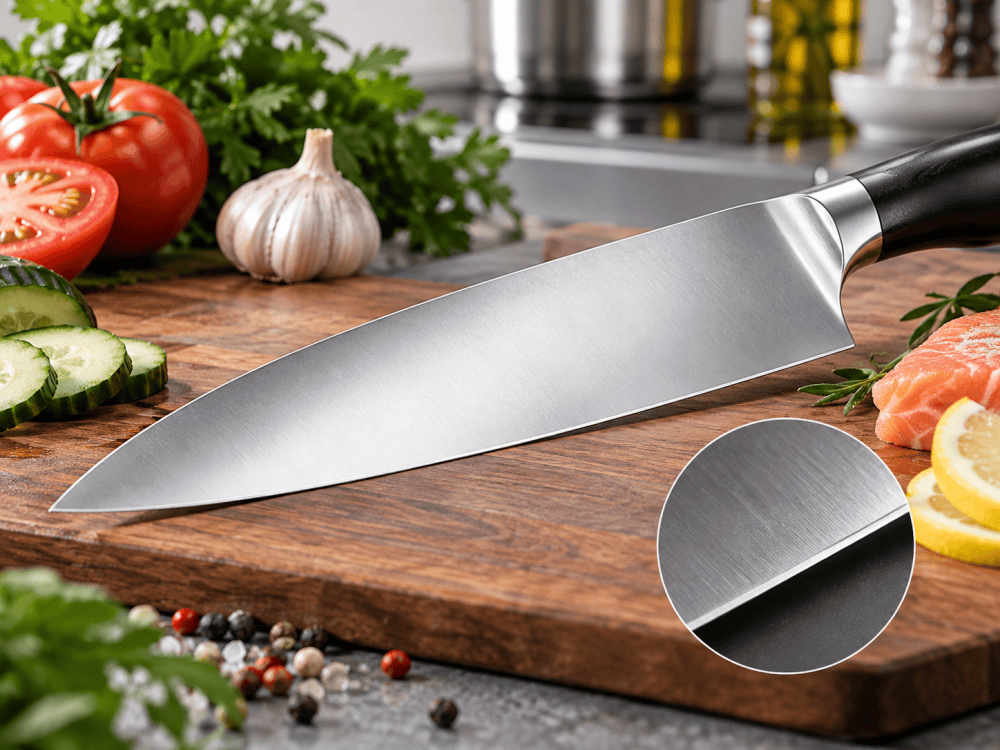
A chef knife is one of the most frequently used tools in a kitchen. Proper cleaning and storage help maintain its cutting performance, reduce the risk of accidental injuries, and protect the blade and handle from unnecessary wear.
Whether you use a chef knife at home or in a professional kitchen, the basic routine is simple: clean it carefully after use, dry it thoroughly, and store it in a way that protects the blade and keeps it away from unintended contact.
This guide explains how to clean a chef knife safely, whether it belongs in a dishwasher, which storage methods are suitable, and which mistakes to avoid.
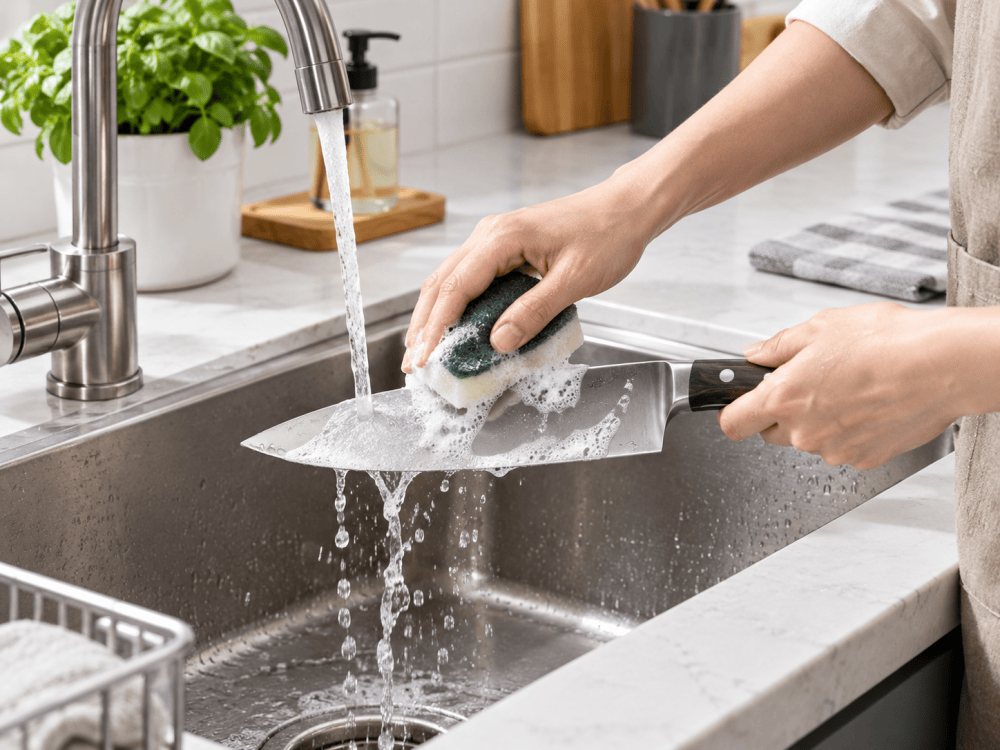
- Wash the knife by hand with warm water, mild dish soap, and a soft sponge or cloth.
- Keep the sharp edge pointed away from your hands while cleaning.
- Rinse away food residue and dry the blade and handle immediately with a clean towel.
- Store the knife in a suitable knife block, secure magnetic holder, drawer insert, or blade guard.
- Never leave a sharp knife loose in a drawer or hidden in a sink full of dishes.
For most chef knives, hand washing and immediate drying are the preferred care routine. Always follow the care instructions supplied with the specific knife.
1. Why Is Proper Chef Knife Care Important?
Cleaning and storage are not just cosmetic concerns. They affect kitchen hygiene, user safety, and the condition of the knife over time.
Maintain food hygiene
Food residue, grease, and moisture can remain on a blade after cutting. Cleaning the knife between tasks helps prevent unwanted food transfer. After handling raw meat, poultry, fish, or known allergens, wash the knife thoroughly before using it for another ingredient.
Protect the blade
Prolonged moisture, food acids, salts, harsh cleaning products, and contact with other metal utensils can contribute to staining, corrosion, or edge damage. Stainless steel is corrosion-resistant, but it is not completely immune to poor care.
Reduce accidental injuries
A sharp blade left loose in a sink or drawer can be difficult to see and handle safely. A consistent cleaning and storage routine helps keep the cutting edge under control.
Preserve cutting performance
When a blade repeatedly strikes other utensils or hard surfaces, its edge can become damaged or dull. Suitable storage helps protect the edge between uses.
2. How to Clean a Chef Knife Step by Step
For most household chef knives, hand washing is the simplest routine. Prepare a clean sponge or cloth, mild dish soap, warm water, and a clean drying towel before starting.
Step 1: Clear the work area
Move food, clutter, and other utensils away from the sink or cleaning area. Make sure you have enough room to handle the knife without bumping into another person or object.
Step 2: Hold the knife securely
Grip the handle firmly. Keep the blade pointed away from your body and keep your fingers away from the cutting edge. Do not leave the knife submerged in a sink where it may be difficult to see.
Step 3: Wash with mild dish soap
Use warm water, a small amount of mild dish soap, and a soft sponge or cloth. Clean both sides of the blade carefully, working in controlled movements with the sharp edge directed away from your fingers.
Pay attention to the area near the handle, where food residue can collect. Do not grip the blade or run your fingers along its edge to remove debris.
Step 4: Rinse away all residue
Rinse the blade and handle with clean water. Remove soap, grease, and food particles before drying. If the knife has a wooden handle, avoid prolonged water exposure and follow the manufacturer's care instructions.
Step 5: Dry the knife immediately
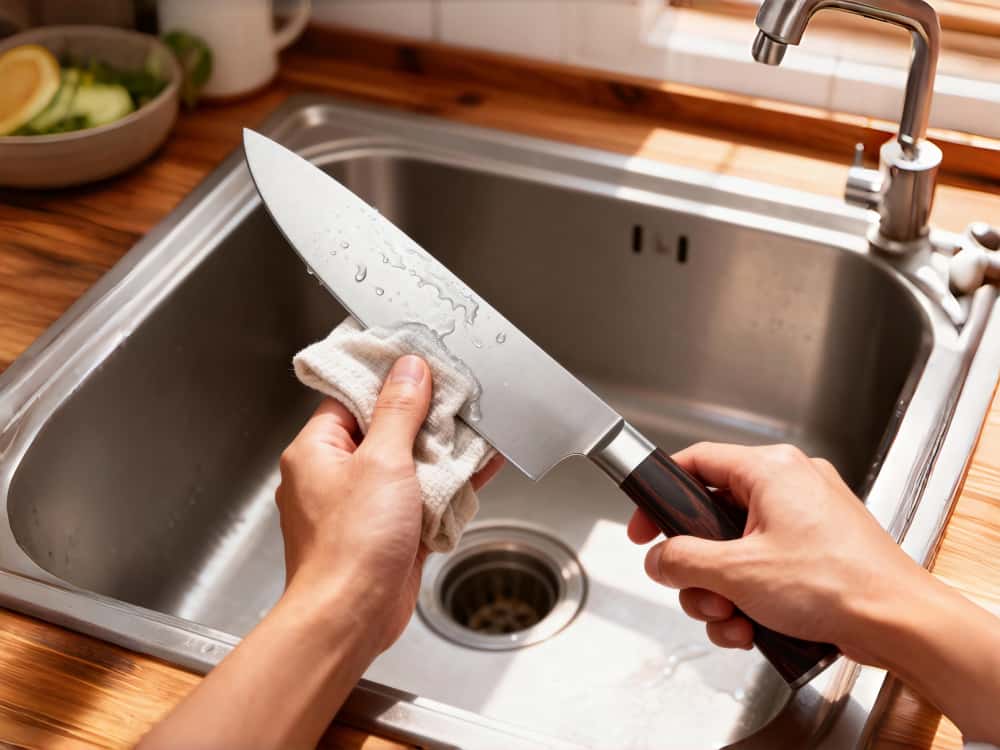
Use a clean, soft towel to dry the blade and handle thoroughly. Keep the sharp edge directed away from your hand and wipe carefully rather than dragging your fingers or palm along the blade.
Do not put the knife away while it is wet. Moisture trapped in a storage block, sheath, or drawer can contribute to staining and corrosion.
Step 6: Return the knife to safe storage
Once the knife is clean and completely dry, place it in a suitable storage system. Make sure the blade is protected and the handle remains easy to reach without touching the cutting edge.
3. Can You Put a Chef Knife in the Dishwasher?
For most chef knives, hand washing is recommended, even when the manufacturer describes the knife as dishwasher-safe.
A dishwasher can expose a knife to high temperatures, detergents, prolonged moisture, and movement against other items. These conditions may damage certain handles, dull or chip the edge, or contribute to stains and corrosion. A loose sharp knife can also create a hazard when the dishwasher is loaded or unloaded.
| Cleaning method | Advantages | Potential concerns | Recommendation |
|---|---|---|---|
| Hand washing | Controlled handling and gentle cleaning | Requires careful handling and immediate drying | Preferred for most chef knives |
| Dishwasher | Convenient for some compatible utensils | Heat, detergent, blade contact, moisture, and handling hazards | Avoid unless the knife's instructions explicitly permit it; hand washing is still preferable for most chef knives |
| Soaking in a sink | May loosen dried food residue | Hidden blade hazard and prolonged moisture exposure | Do not leave a chef knife soaking in the sink |
If food has dried onto the blade, clean it carefully rather than leaving the knife submerged for an extended period. Always check the manufacturer's instructions for knives with special coatings, wooden handles, or unusual construction.
4. How Should You Store a Chef Knife Safely?
The right storage method should keep the blade separated from other utensils, protect the cutting edge, remain clean and dry, and allow the knife to be retrieved without reaching blindly toward a sharp blade.
Option 1: Knife block
A knife block is a practical choice for many home kitchens. It keeps knives organized on the countertop and separates their blades.
- Choose slots that fit the blade dimensions.
- Clean the block according to its care instructions.
- Insert only clean, dry knives.
- Do not force a blade into a slot that is too narrow.
Option 2: Magnetic knife strip
A properly installed magnetic strip can keep knives visible and free up countertop space. The strip should be securely mounted and suitable for the knives it holds.
- Install it where children cannot easily reach it.
- Make sure the knife is securely supported before letting go.
- Remove knives carefully, controlling the blade rather than pulling abruptly.
- Keep the strip and the blade contact area clean.
Option 3: In-drawer knife organizer
A dedicated drawer insert keeps knives out of sight and can be useful in kitchens with limited countertop space.
- Use an insert designed to fit the blade and handle.
- Keep each knife separated from other utensils.
- Do not store knives loosely in a crowded drawer.
- Ensure the insert remains clean and dry.
Option 4: Blade guard or sheath
A fitted blade guard is useful when a knife must be stored in a drawer, carried between locations, or packed for transport. It can protect the edge and reduce accidental contact.
- Choose a guard that fits the full blade securely.
- Dry the knife completely before covering it.
- Inspect the guard for cracks, loose parts, or trapped debris.
| Storage method | Best suited for | What to check |
|---|---|---|
| Knife block | Organized countertop storage | Slot fit, cleanliness, and dryness |
| Magnetic strip | Visible wall storage and easy access | Secure installation and stable blade support |
| Drawer insert | Concealed storage | Individual blade separation and secure placement |
| Blade guard | Drawer storage or transport | Correct fit and complete drying before covering |
No single storage method is best for every kitchen. Choose one that fits your space, the knife dimensions, the users in the household, and your ability to keep the storage area clean and dry.
5. What Should You Never Do When Cleaning or Storing a Chef Knife?
- Do not leave a knife loose in the sink. It can be hidden under water or dishes and cause an injury.
- Do not reach blindly into a drawer. A loose blade may be difficult to see or avoid.
- Do not put a wet knife into storage. Trapped moisture can contribute to corrosion and staining.
- Do not use abrasive pads unnecessarily. They may scratch blade surfaces or damage coatings.
- Do not leave the knife soaking for long periods. Prolonged exposure to water and food residue can affect the blade and handle.
- Do not assume every knife is dishwasher-safe. Follow the instructions for the specific product.
- Do not test sharpness with your finger. Use an appropriate cutting test with a suitable food item, keeping your hands away from the edge.
- Do not store knives where children can reach them. Use a secure location appropriate for the household.
6. How Do You Clean Different Chef Knife Handle Materials?
The blade is only one part of the knife. Handle materials may require different care, especially when exposed to moisture, heat, or cleaning chemicals.
| Handle material | Care considerations | What to avoid |
|---|---|---|
| Wood | Hand wash quickly and dry immediately; follow any recommended handle treatment | Long soaking, prolonged moisture, and unapproved cleaning products |
| Plastic or synthetic material | Clean with mild soap and water; inspect the handle and joints periodically | Assuming all polymers tolerate high heat or harsh detergents |
| Stainless steel | Clean and dry thoroughly, including joints and textured areas | Leaving residue or moisture in seams and crevices |
| Composite or coated handles | Follow the product-specific cleaning instructions | Abrasive cleaners or chemicals that may damage the finish |
Handle material alone does not determine the knife's overall cleaning requirements. Construction, rivets, coatings, adhesives, and the manufacturer's care guidance also matter.
7. How Often Should You Clean a Chef Knife?
Clean the knife after each use and whenever it becomes contaminated. Do not wait until the end of the day to remove food residue.
- After cutting raw meat, poultry, or seafood: wash thoroughly before using the knife for other foods.
- After cutting acidic or salty ingredients: clean promptly to reduce the risk of surface staining or corrosion.
- Between different food-preparation tasks: clean the knife when needed to prevent cross-contamination.
- Before storage: confirm that the blade and handle are completely dry.
- Before use after long-term storage: inspect the knife and clean it as needed.
Cleaning removes food residue, but it is not automatically the same as sanitizing. In food-service environments, follow the applicable food-safety procedures and product instructions when sanitizing is required.
8. Does Proper Cleaning Keep a Chef Knife Sharp?
Cleaning alone cannot restore a dull edge, but good care helps reduce avoidable wear. A chef knife that is regularly washed by hand, dried promptly, and stored separately from other metal tools is less likely to suffer unnecessary edge damage.
To help maintain cutting performance:
- Use a suitable cutting board rather than glass, stone, metal, or other hard surfaces that can damage the edge.
- Avoid scraping food with the sharp edge against the cutting board; use the spine of the blade or a suitable utensil instead.
- Store the knife in a suitable block, insert, magnetic holder, or blade guard.
- Inspect the edge regularly and use an appropriate honing or sharpening method when needed.
If a knife begins crushing soft ingredients instead of slicing cleanly, it may need maintenance or sharpening. Follow the instructions for the blade type rather than using an unsuitable sharpener.
9. What Should B2B Buyers Look for in a Chef Knife?
For importers, wholesalers, retailers, and private-label brands, knife care is also relevant to product selection. A well-designed knife should be suitable for its intended use and supplied with clear instructions that help end users maintain it correctly.
- Blade material and product specifications are clearly documented.
- Handle material and care requirements are identified.
- Blade-to-handle construction is checked for fit and finish.
- Cutting performance and overall product quality are evaluated using samples.
- Care and safety instructions are available for the intended market.
- Packaging protects the blade during transport and retail handling.
- Any dishwasher-safe or other performance claims are supported by appropriate product information or testing.
- MOQ, lead time, branding options, and packaging requirements are confirmed before ordering.
For private-label projects, buyers should also confirm that the care instructions match the actual knife construction. For example, a knife with a wooden handle may require different care from one with a synthetic handle, even when the blade material is similar.
10. Why Knife Care Instructions Matter for OEM and Private Label Brands
Clear care instructions can improve the customer experience and help reduce avoidable product damage caused by incorrect washing or storage.
For a chef knife OEM project, brands can consider including the following information with the product:
- Recommended cleaning method.
- Instructions to dry the blade and handle after washing.
- Storage recommendations and warnings against loose drawer storage.
- Handle-specific care information.
- Safe handling and maintenance guidance.
- Contact or warranty information, where applicable.
These details should reflect the actual product design and any verified manufacturer instructions. Avoid using blanket claims such as “rust-proof” or “dishwasher-safe” unless the specific product supports them.
Frequently Asked Questions
How do I clean a chef knife safely?
Wash the knife by hand with warm water, mild dish soap, and a soft sponge or cloth. Keep the cutting edge away from your fingers, rinse thoroughly, dry immediately, and store the knife securely.
Can I put my chef knife in the dishwasher?
Hand washing is recommended for most chef knives. Dishwasher heat, detergent, moisture, and contact with other utensils can damage the blade or handle and may create handling hazards. Follow the instructions for your specific knife.
Should I dry a chef knife immediately after washing?
Yes. Dry the blade and handle thoroughly with a clean, soft towel before storage. This helps reduce water spots, staining, and corrosion.
What is the safest way to store a chef knife?
Use a suitable knife block, securely installed magnetic holder, dedicated drawer insert, or fitted blade guard. The knife should be clean, dry, protected from contact with other utensils, and stored away from children.
Can I store a chef knife in a kitchen drawer?
Yes, if you use a dedicated knife insert or a properly fitted blade guard. Do not leave a sharp knife loose among other utensils.
Can stainless steel chef knives rust?
Yes. Stainless steel is corrosion-resistant, not completely rust-proof. Prolonged moisture, food residue, salt, and unsuitable cleaning conditions can cause staining or corrosion. Clean and dry the knife promptly.
How should I clean a chef knife with a wooden handle?
Wash it by hand, avoid prolonged soaking, and dry the handle immediately. Follow the manufacturer's recommendations for any additional wood care.
Does cleaning a chef knife keep it sharp?
Proper cleaning and storage help prevent avoidable damage, but they do not replace honing or sharpening. Inspect the blade regularly and maintain it using a method suitable for the knife.
Conclusion: Clean, Dry, and Store Your Chef Knife Properly
The safest routine is straightforward: wash your chef knife carefully after use, rinse away food residue, dry the blade and handle immediately, and return the knife to a suitable storage system.
Avoid leaving knives in the sink, placing them loosely in drawers, or assuming that every chef knife can go in the dishwasher. These simple habits help protect the blade, support kitchen hygiene, and reduce the risk of accidental cuts.
Looking for a Chef Knife Manufacturing Partner?
FASAKA is a brand under DKS Enterprises Co., Ltd., a manufacturer and supplier based in Yangjiang, Guangdong, China, specializing in hardware knives and scissors, BBQ tools, and kitchenware. Contact FASAKA to discuss kitchen knife product options and potential OEM/ODM requirements for your market.
Explore FASAKA OEM/ODM Services Contact Us