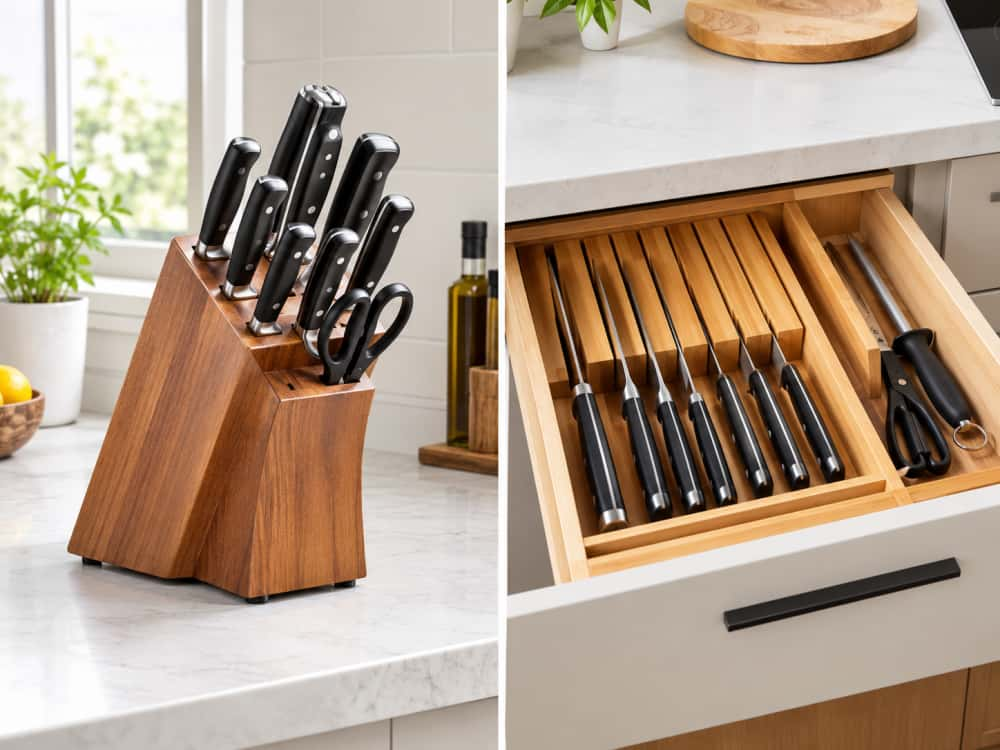




How to Choose a Knife Block for a Kitchen Knife Set
Choosing the right knife block for a kitchen knife set involves more than matching its color to your kitchen. A well-designed knife block should accommodate the included knives, protect their blades, remain stable during everyday use, and fit the available counter space. Cleaning requirements, material quality, and the possibility of expanding the knife collection are also important considerations.
For retailers, wholesalers, importers, and private-label brands, these factors influence not only the user experience but also product compatibility, packaging, and customer satisfaction.
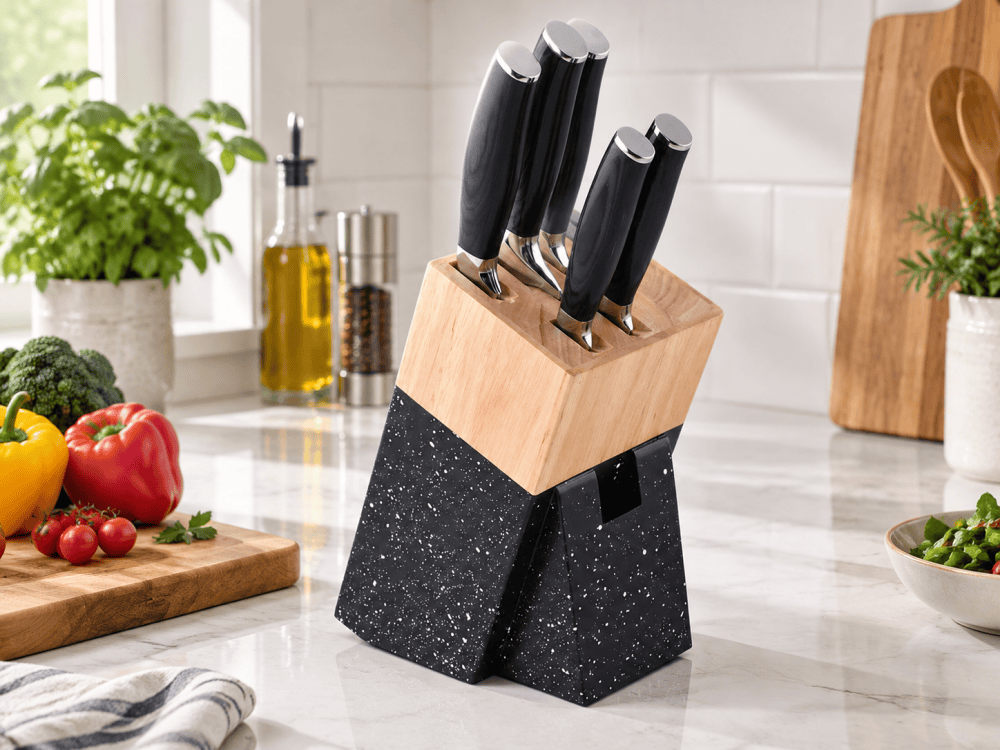
Start by checking the number and dimensions of your knives, including blade length, height, thickness, and handle clearance. Then choose a block with compatible slots, a stable base, an easy-to-maintain design, and dimensions that fit your counter. If you are buying a complete knife block set, confirm that every included knife has a designated storage position and that the block is suitable for the intended knives.
1. Match the Knife Block to Your Kitchen Knife Set
The first step is to evaluate the knives you intend to store. A block that looks suitable may still be incompatible with a particular knife set if its slots are too short, narrow, shallow, or poorly positioned.
Count the Knives and Accessories
Make a list of the knives and accessories included in the set. A typical kitchen knife collection may contain:
- Chef's knife for general food preparation
- Paring knife for peeling and precision cutting
- Bread knife with a serrated edge
- Utility knife for smaller cutting tasks
- Santoku or slicing knife, depending on the set
- Steak knives for serving at the table
- Kitchen shears or a honing steel, if included
Not every knife set contains the same combination of tools. Check whether the block has dedicated positions for the actual contents rather than relying only on the advertised piece count.
For example, a set advertised as containing 15 pieces may count the block, shears, and sharpening accessory as pieces. The number of knives may therefore be considerably lower than 15.
Check Blade Dimensions and Slot Compatibility
Blade length is only one part of the compatibility check. Blade height, thickness, profile, and the position of the handle can all affect whether a knife fits correctly.
| What to Check | Why It Matters | What to Look For |
|---|---|---|
| Blade length | A long blade may extend too far into the block or fail to fit. | Confirm that the usable slot depth accommodates the blade. |
| Blade height | A tall blade may not enter a narrow opening comfortably. | Check the opening width and internal clearance. |
| Blade thickness | A thick blade may be difficult to insert into a narrow slot. | Make sure the blade slides in without forcing it. |
| Blade profile | Serrated, curved, or unusually shaped blades may require specific storage. | Confirm that each knife is compatible with its assigned position. |
| Handle clearance | Nearby slots or a poorly designed layout can make knives difficult to remove. | Allow enough space to grip each handle securely. |
| Slot orientation | The way a blade enters and rests in the block affects handling and blade contact. | Follow the block manufacturer's loading instructions. |
Practical tip: If you are purchasing a replacement block for an existing knife set, compare the actual knife dimensions with the block specifications. Do not assume that blocks with the same advertised capacity are interchangeable.
2. Choose the Right Knife Block Style
Knife blocks are available in several designs. The best option depends on the knife collection, available space, cleaning preferences, and desired appearance.
Traditional Slotted Knife Block
A traditional slotted knife block has separate openings for designated knives. Many complete knife sets use this design because the storage positions can be arranged around the included blades.
- Advantages: Organized storage, convenient countertop access, and dedicated positions for compatible knives.
- Limitations: Fixed slots can restrict future additions, and narrow internal spaces may be difficult to inspect and clean.
- Best for: Buyers purchasing a complete knife set with a predetermined selection of knives.
Universal Knife Block
A universal knife block typically uses flexible internal supports, such as removable rods or bristles, to accommodate a broader range of blade shapes. Compatibility still depends on the block's dimensions and design.
- Advantages: Greater flexibility when storing knives from different collections.
- Limitations: Internal components may collect debris and need regular cleaning; some designs may contact blade surfaces.
- Best for: Households with mixed knife collections or buyers who expect to change their selection over time.
Magnetic Knife Block
A magnetic knife block holds compatible knives against a magnetic surface rather than placing each blade inside an individual slot. Some designs display the blades, while others incorporate magnets into a countertop structure.
- Advantages: Convenient visibility and, in some designs, easier access to the blade surfaces for cleaning.
- Limitations: Magnetic strength, stability, blade compatibility, and safe handling must be evaluated. Ceramic knives generally do not attach to conventional magnets.
- Best for: Buyers who prefer visible knife storage and whose knives are compatible with the magnetic system.
Knife Block with Additional Accessory Slots
Some blocks include dedicated spaces for kitchen shears, a honing steel, or other accessories. This can create a coordinated storage solution, but the accessory positions should not compromise knife clearance or stability.
Choose this style when the additional storage serves a genuine purpose. Extra slots are not automatically an advantage if they take up unnecessary counter space or remain unused.
| Knife Block Style | Storage Flexibility | Key Consideration |
|---|---|---|
| Traditional slotted block | Usually limited to designated knife shapes | Match every knife to its intended slot. |
| Universal block | Generally accommodates more blade variations | Inspect internal supports and cleaning access. |
| Magnetic block | Depends on magnetic compatibility and surface design | Check holding strength, stability, and safe placement. |
| Block with accessory slots | Depends on the included storage positions | Confirm that all accessories fit without crowding. |
3. Select a Suitable Knife Block Material
Material influences the block's appearance, weight, maintenance requirements, and suitability for different kitchen environments. No single material is automatically best for every knife block.
Wood and Bamboo
Wooden and bamboo knife blocks are popular for their natural appearance and compatibility with many traditional kitchen designs. Their weight and construction can also contribute to stability.
However, moisture management is important. Knives should be clean and completely dry before storage, and wooden blocks should be maintained according to the manufacturer's instructions. Avoid prolonged soaking or exposure to standing water unless the product instructions specifically allow it.
Plastic
Plastic knife blocks are available in different shapes, colors, and internal configurations. Depending on the design, plastic may offer a practical option for coordinated kitchen products or contemporary interiors.
When evaluating a plastic block, check the rigidity of the structure, the quality of the internal supports, the stability of the base, and whether the design allows effective cleaning. Material suitability should be assessed alongside the complete product construction.
Stainless Steel and Other Metal Components
Some knife blocks incorporate stainless steel or other metal components in their outer structure, support system, or magnetic surfaces. These designs may suit modern kitchens, but their performance depends on the specific construction.
Check the finish, resistance to corrosion in the intended environment, edge-contact points, and overall stability. A metal exterior alone does not guarantee better blade protection or easier maintenance.
| Material or Construction | Potential Benefits | Points to Evaluate |
|---|---|---|
| Wood | Natural appearance and substantial feel | Moisture control, slot cleaning, and surface maintenance |
| Bamboo | Natural appearance and a lightweight-to-moderate structure, depending on construction | Finish quality, moisture exposure, and care instructions |
| Plastic | Design flexibility and a range of colors and shapes | Structural rigidity, internal support, and cleanability |
| Metal components | Contemporary appearance and potential structural support | Finish quality, corrosion resistance, stability, and blade contact |
For buyers comparing materials, review the complete block rather than choosing solely by the material name. Internal construction, fit, finish, and maintenance requirements are equally important.
4. Consider Counter Space, Height, and Stability
A knife block may fit the countertop footprint but still be inconvenient to use. Height, handle clearance, cabinet overhang, and the space needed to remove knives all affect everyday usability.
Measure the Available Countertop Area
Before buying, measure the intended location and compare it with the block's published dimensions. Allow additional space around the block so you can remove knives without hitting a wall, backsplash, nearby appliance, or cabinet.
If the block will sit beneath an upper cabinet, check the full height of the block and knives when inserted. Consider whether you can lift each knife out comfortably without striking the cabinet above.
Check the Base and Weight Distribution
A stable knife block should remain firmly positioned when a knife is inserted or removed. Look for a sufficiently broad base, balanced construction, and non-slip features where appropriate.
Heavier construction can contribute to stability, but weight alone is not a guarantee. The base shape, center of gravity, surface contact, and arrangement of the stored knives all matter.
Plan for Future Knife Additions
If you expect to add knives later, consider a block with compatible spare slots or a universal design. However, unused space should not come at the expense of a practical footprint.
For a fixed-slot block, confirm that the additional slots are suitable for the intended future knives. An empty slot is useful only when it can safely accommodate the blade you plan to store.
- Countertop width and depth
- Available height beneath cabinets
- Block dimensions and base footprint
- Space needed to grip and remove each knife
- Clearance from sinks, cooktops, and high-traffic areas
- Capacity for the current knife set and any planned additions
5. Prioritize Blade Protection and Safe Handling
A suitable knife block should store knives securely without requiring excessive force to insert or remove them. Poorly matched slots may allow a blade to rub against internal surfaces, become difficult to retrieve, or sit in an unsafe position.
Look for Appropriate Internal Clearance
The blade should fit its designated slot without being forced. Follow the manufacturer's instructions for blade orientation, especially for blocks designed around specific knife shapes.
For compatible slotted blocks, the storage design should minimize unnecessary contact with the cutting edge. Always insert and remove knives carefully rather than dragging the edge along the slot.
Keep Knives Clean and Dry
Even a well-designed block cannot compensate for poor knife care. Food residue and moisture left on a blade can affect cleanliness and may contribute to corrosion, depending on the blade material and conditions.
- Clean knives after use according to the knife manufacturer's instructions.
- Dry the blade and handle thoroughly before storage.
- Do not return wet knives to enclosed slots.
- Keep the block away from persistent splashes and excessive steam.
- Inspect the block periodically for residue, moisture, damage, or persistent odors.
Consider Household Safety
Knives should remain out of reach of young children. A countertop block is not automatically childproof simply because it keeps blades organized. Consider the block's location, stability, and accessibility, and use a more secure storage arrangement when necessary.
6. Evaluate Cleaning and Maintenance Requirements
Cleaning is an important part of choosing a knife block, especially when the design contains narrow slots or enclosed internal components.
Before buying, consider the following questions:
- Can loose debris be removed easily?
- Are the internal slots accessible for cleaning?
- Does the design include removable inserts or components?
- Can the block dry thoroughly after cleaning?
- Are the care instructions clear and practical?
Removable inserts can simplify cleaning in some universal blocks, but they still need to be maintained according to the manufacturer's directions. A fixed-slot wooden block may require a different cleaning method from a plastic or magnetic design.
Do not assume that every knife block is dishwasher-safe or suitable for soaking. Use the cleaning method recommended for the specific product, and allow all cleaned components to dry completely before reassembly or reuse.
7. Decide Whether to Buy a Knife Block Separately or as a Complete Set
Buyers generally have two options: purchase a knife block with a matching kitchen knife set or select a block for knives they already own.
| Buying Option | Advantages | What to Check |
|---|---|---|
| Knife block set | Coordinated knives and storage; compatibility is easier to verify when designed as one set | Knife selection, actual knife count, block dimensions, and accessory inclusion |
| Separate knife block | Allows buyers to retain existing knives or customize their storage setup | Blade dimensions, slot compatibility, handle clearance, and stability |
| Expandable storage solution | May accommodate future additions to a knife collection | Usable spare slots and compatibility with the intended additional knives |
If you already own a knife set, a separate block may be the more practical option, provided it accommodates every knife safely. If you are starting from scratch, a coordinated block set can simplify purchasing and ensure that the storage arrangement is designed for the included knives.
8. Knife Block Buying Checklist for Wholesale Buyers and Private-Label Brands
For importers, distributors, retailers, and private-label brands, selecting a knife block requires additional attention to product specifications, compatibility, presentation, and supply requirements.
Define the Target Market and Product Positioning
Decide whether the product is intended for entry-level household use, everyday family kitchens, premium gift sets, or a more specialized retail segment. The target market helps determine the appropriate knife assortment, storage design, material, appearance, and packaging.
Confirm Product Specifications
Before approving a sample or placing an order, prepare a specification sheet that covers:
- Number and types of knives included
- Blade and handle dimensions
- Knife block dimensions and slot layout
- Block material and finish
- Stability and base construction
- Cleaning and care instructions
- Retail packaging and product labeling
- Applicable market requirements and testing documentation
Review the Complete Set Before Mass Production
Do not evaluate the knife block separately from the knives it is intended to hold. Check the complete set to confirm that each knife fits its assigned position, handles remain accessible, and the block stays stable during normal use.
For private-label projects, confirm artwork, branding placement, packaging specifications, approved samples, and production details before mass production. Any customization options, minimum order quantities, lead times, and testing requirements should be verified with the manufacturer for the specific project.
Assess Long-Term Customer Experience
A successful knife block set should be practical to use, easy to understand, and consistent with the expectations created by its product listing and packaging. Clear dimensions, accurate photographs, a complete list of included items, and straightforward care instructions can help reduce buyer confusion and unnecessary returns.
For businesses developing a broader kitchenware range, explore FASAKA's OEM/ODM kitchenware services to discuss project requirements and available customization options.
9. Common Mistakes to Avoid When Choosing a Knife Block
Choosing by Slot Count Alone
A block with more slots is not necessarily better. The slots must accommodate the knives you use, and the overall design must fit your kitchen.
Ignoring the Longest Blade
The longest knife in a set may require a deeper slot and sufficient clearance above the block. Always check the largest blade rather than judging compatibility by a paring knife or utility knife.
Assuming Every Block Fits Every Knife
Slot dimensions and internal layouts vary. Confirm compatibility with the actual knives, particularly when mixing knives from different collections.
Overlooking Maintenance
Internal slots can collect debris and moisture. Consider how the block will be cleaned and dried before committing to a design.
Buying a Block That Is Too Large for the Kitchen
A large block can consume valuable preparation space or be difficult to use under cabinets. Measure the intended location and allow room for safe knife removal.
Assuming Appearance Guarantees Quality
A polished exterior does not necessarily mean the block is stable, compatible, or easy to maintain. Evaluate the base, internal construction, fit, finish, and care instructions together.
Frequently Asked Questions
1. How many slots should a knife block have?
Choose a knife block with enough compatible slots for the knives you intend to store. Count the actual knives rather than relying on the total piece count of a set. If you plan to expand your collection, consider additional slots only when they can accommodate your future knives safely.
2. Does a knife block need to match the knife brand?
No. A knife block does not always need to come from the same brand as the knives. However, the slot dimensions, blade profiles, and handle clearance must be compatible. A block specifically designed for a particular knife set may simplify this process.
3. Is a wooden or plastic knife block better?
Neither material is universally better. Wood and bamboo offer a natural appearance, while plastic allows a range of shapes and colors. Compare construction, stability, internal slot design, cleaning requirements, and the manufacturer's care instructions before choosing.
4. Can a knife block damage kitchen knife blades?
A poorly matched or damaged slot may cause unnecessary blade contact. Choose a block designed for the knives, avoid forcing blades into narrow openings, and insert and remove them carefully. Keep knives clean and dry before storage.
5. How do I know if a knife block will fit under my kitchen cabinets?
Measure the available vertical clearance and compare it with the block height and the height of the knives when inserted. Also allow enough space to grip each handle and lift the knife out without striking the cabinet.
6. Are universal knife blocks suitable for every kitchen knife?
No. Universal blocks accommodate a broader range of knives, but their usable dimensions and internal supports still impose limits. Check the maximum blade length, blade dimensions, and compatibility with the knives you plan to store.
7. How should a knife block be cleaned?
Cleaning methods depend on the material and construction. Remove knives first, follow the manufacturer's instructions, remove debris, and make sure the block dries thoroughly. Avoid soaking or dishwasher cleaning unless specifically permitted by the product instructions.
8. What should wholesale buyers check before ordering knife block sets?
Wholesale buyers should verify knife specifications, slot compatibility, block dimensions, material and finish, stability, packaging, labeling, applicable testing requirements, minimum order quantities, and production lead times. Approve a complete sample before mass production whenever possible.
Develop Your Next Kitchenware Product Range with FASAKA
Looking for a manufacturing partner for kitchen knives, scissors, BBQ tools, or other kitchenware products? FASAKA, a brand under DKS Enterprises Co., Ltd., supports B2B customers exploring product development, OEM/ODM, and private-label opportunities.
Share your target market, product specifications, and sourcing requirements with our team.
Get a Free Quote