





Knife Block vs. Drawer Knife Organizer: Pros and Cons
Knife Block vs. Drawer Knife Organizer: Pros and Cons
Choosing between a knife block and a drawer knife organizer depends on your kitchen layout, available space, knife collection, cleaning routine, and safety preferences. A countertop knife block keeps knives visible and accessible, while a drawer organizer stores blades inside a drawer and helps keep the countertop clear.
Neither option is automatically better for every kitchen. The best solution is one that holds your knives securely, protects their cutting edges, stays clean and dry, and fits the way you prepare food.
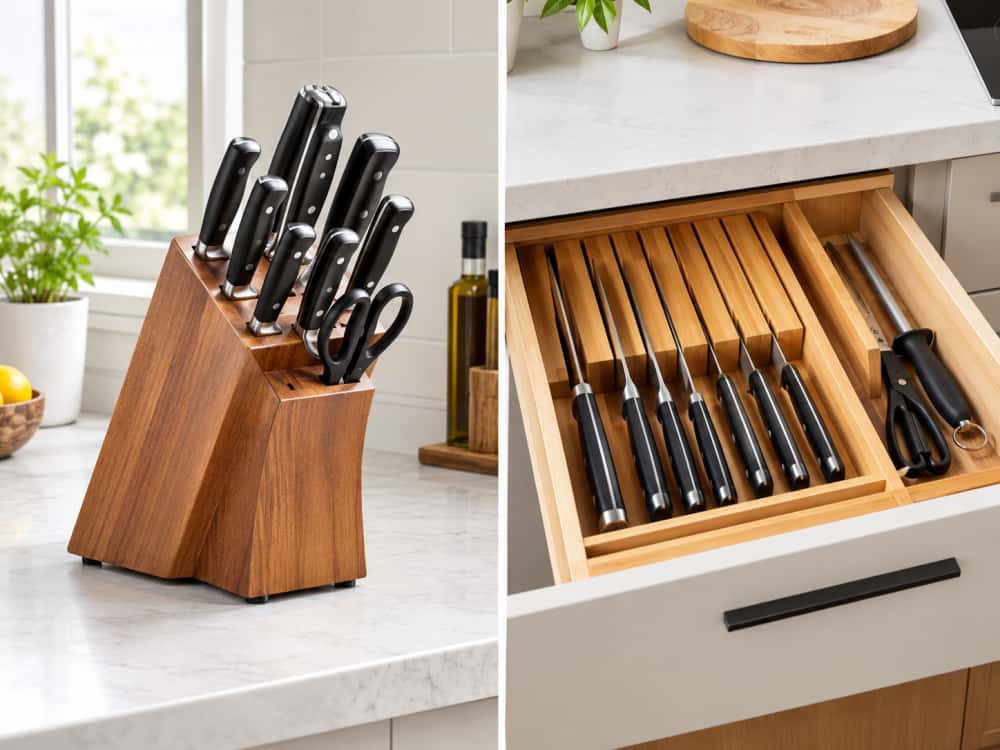
A knife block is generally a good choice if you want convenient countertop access and have enough space for a dedicated storage area. A drawer knife organizer is often better if you want a clear countertop and have a suitable drawer. Both can protect knife edges when properly designed, correctly sized, and kept clean and dry. For households with children, choose a storage solution that can be secured against unauthorized access.
1. What Is the Difference Between a Knife Block and a Drawer Knife Organizer?
A knife block is a countertop or freestanding storage unit with slots or another retention system designed to hold knives. Traditional blocks often use wood or bamboo, while other versions use plastic, removable inserts, or flexible bristles.
A drawer knife organizer is an insert or tray fitted inside a kitchen drawer. It typically uses individual channels, grooves, or shaped compartments to keep knives separated and prevent the blades from moving freely when the drawer opens or closes.
| Feature | Knife block | Drawer knife organizer |
|---|---|---|
| Installation | Usually placed on a countertop or another stable surface. | Placed inside a drawer with suitable dimensions. |
| Countertop space | Uses dedicated countertop space. | Keeps knives off the countertop. |
| Accessibility | Knives are usually easy to see and retrieve. | Requires opening the drawer and selecting the correct slot. |
| Blade protection | Depends on slot design, fit, and insertion method. | Depends on slot separation, dimensions, and how securely knives are held. |
| Cleaning | Narrow slots can be difficult to clean and dry. | Many trays are easier to remove and clean, depending on their design. |
| Space requirements | Needs a suitable countertop location. | Needs enough drawer width, depth, and clearance. |
| Best suited for | Users who prefer visible, accessible knife storage. | Users who prefer organized, concealed storage and clear counters. |
2. Knife Block: Pros and Cons
Knife blocks are popular because they keep frequently used knives within reach and give a kitchen a dedicated place for blade storage. However, their usefulness depends on the block's dimensions, slot design, material, and maintenance requirements.
Advantages of a knife block
- Easy access: Knives are usually visible and convenient to retrieve during food preparation.
- Dedicated storage: A block keeps knives together instead of allowing them to move around in a drawer.
- Potential blade protection: Properly sized slots help prevent blades from rubbing against other utensils or hard surfaces.
- Suitable for frequent use: A countertop location can work well for cooks who regularly reach for the same knives.
- Multiple design options: Knife blocks are available in different materials, sizes, colors, and configurations to suit different kitchen styles.
Disadvantages of a knife block
- Uses countertop space: A large block may be inconvenient in a small kitchen with limited work surfaces.
- Slots can be difficult to clean: Food particles and dust may accumulate inside narrow openings if the block is not maintained.
- Moisture can become trapped: Putting wet knives into a block can create damp conditions that encourage corrosion or, in some materials, mold growth.
- Limited compatibility: Some blocks cannot accommodate wider blades, long knives, or unusual handle shapes.
- Potential tipping or movement: A lightweight or poorly designed block may move when knives are inserted or removed.
Best for: Kitchens with available countertop space, users who value quick access, and households that want a dedicated visible knife storage area.
3. Drawer Knife Organizer: Pros and Cons
A drawer knife organizer stores knives inside a fitted tray or insert. It can create a more streamlined countertop and keep blades separated, but only if the drawer and organizer are compatible with the knife collection.
Advantages of a drawer knife organizer
- Clear countertops: Storing knives inside a drawer frees up visible work surfaces.
- Concealed storage: Knives remain out of sight when the drawer is closed.
- Organized compartments: Individual slots help separate knives by size or type and can reduce blade-to-blade contact.
- Potentially easier cleaning: Removable trays and organizers with smooth surfaces may be easier to clean than blocks with deep, fixed slots.
- Flexible kitchen layouts: A well-fitted organizer can work well in kitchens where countertop space is limited but drawer space is available.
Disadvantages of a drawer knife organizer
- Requires a suitable drawer: The drawer must have enough usable width, depth, and height for both the organizer and the knives.
- Accessibility depends on layout: Knives may be less convenient to retrieve if the drawer is far from the food preparation area.
- Compatibility can be restrictive: Deep blades, long knives, or unusually shaped handles may not fit every slot.
- Drawer movement matters: A poorly fitted tray may shift when the drawer opens or closes, potentially allowing knives to move.
- Concealed moisture risk: A closed drawer does not guarantee that knives are dry. Wet knives or a damp tray can still create corrosion problems.
Best for: Small kitchens, minimalist layouts, households that prefer clear countertops, and users who have a suitable drawer near their food preparation area.
4. Which Option Protects Kitchen Knife Blades Better?
Neither a knife block nor a drawer knife organizer automatically provides better blade protection. The result depends more on the quality of the storage design and how the knives are used and maintained.
A suitable storage system should keep blades separated, prevent unnecessary contact with hard surfaces, and hold knives securely without forcing them into undersized compartments.
What to look for in a knife block
- Slots that accommodate the blade length and width of the intended knives.
- A stable base that does not slide or tip easily.
- Slot construction that minimizes unnecessary blade contact.
- A design that can be cleaned and dried according to the manufacturer's instructions.
What to look for in a drawer knife organizer
- Separate channels that help keep blades from touching one another.
- Enough room for handles to sit comfortably without crowding.
- A tray that fits the drawer and stays in place during normal use.
- Clearance for the drawer to close without pressing against knife handles or blade tips.
5. Which Is More Hygienic: A Knife Block or a Drawer Organizer?
Hygiene depends on cleaning access, moisture control, food residue, and routine maintenance—not simply on whether knives are stored on the counter or inside a drawer.
Traditional knife blocks can have deep slots that are difficult to inspect and clean. Crumbs, dust, or moisture may accumulate inside if the block is not maintained properly. Removable inserts or designs that provide better access may make cleaning easier.
Drawer organizers can be simpler to maintain when the tray can be removed and its surfaces are easy to reach. However, debris may still collect in grooves, and a closed drawer can retain moisture if knives or the organizer are damp.
How to maintain either storage system
- Wash knives according to the manufacturer's instructions.
- Dry each blade and handle completely before storage.
- Remove crumbs, dust, and food residue from the storage area regularly.
- Clean removable components according to their material and care instructions.
- Allow cleaned storage components to dry completely before returning knives.
- Inspect periodically for persistent odors, mold, damaged surfaces, or signs of corrosion.
Do not assume that every knife block or drawer insert is dishwasher-safe. Follow the care instructions for the specific material and product. Wooden products in particular may be damaged by prolonged soaking or unsuitable cleaning methods.
6. Which Knife Storage Option Is Safer for Families?
Both options can be used safely when properly designed and handled, but neither should be treated as childproof by default.
A countertop knife block may make knives accessible to children who can reach the counter. A drawer organizer conceals knives when the drawer is closed, but children may still be able to open it. The best choice depends on the kitchen layout, children's access, and whether the storage location can be secured.
- Keep knives out of children's reach and use appropriate drawer or cabinet locks where needed.
- Choose stable blocks that will not tip easily.
- Use organizers that hold knives securely and prevent blades from shifting when drawers move.
- Store knives with their cutting edges protected from accidental contact.
- Return knives to their designated storage location after use.
For households with young children, a secured drawer or cabinet may be preferable to an accessible countertop block. The storage location and any child-safety measures are just as important as the organizer itself.
7. How to Choose the Right Knife Storage for Your Kitchen
Before choosing between a knife block and a drawer knife organizer, consider the size of your knife collection, the available space, and your preferred cleaning routine.
| Your situation | Option to consider | Why |
|---|---|---|
| You have enough countertop space. | Knife block | Keeps commonly used knives visible and accessible. |
| You want to keep countertops clear. | Drawer knife organizer | Moves knife storage into an existing drawer. |
| You have a large or varied knife collection. | Compare both options carefully | Slot dimensions and knife compatibility may matter more than the storage category. |
| You want easier access for cleaning. | A removable drawer tray or accessible block design | Choose a structure that allows residue to be removed and surfaces to dry thoroughly. |
| You have young children at home. | A storage location that can be secured | Child access and secure storage should take priority over appearance or convenience. |
| You have limited drawer space. | Knife block, if counter space is available | A block may avoid using valuable drawer capacity. |
Measure before purchasing
For a drawer organizer, measure the usable internal width, depth, and height of the drawer. Account for hinges, rails, handles, and other obstructions. Check the overall height of the organizer and the clearance needed for knife handles when the drawer is closed.
For a knife block, check the block's footprint, stability, slot dimensions, and compatibility with your longest and widest knives. Do not assume that every block designed for a knife set can accommodate additional knives purchased later.
8. What Should Retailers and Buyers Consider When Sourcing Knife Storage Products?
For kitchenware brands, importers, wholesalers, and retailers, knife storage products can be evaluated as part of a broader kitchen organization range. The right design depends on the target consumer, product assortment, available materials, retail price point, and packaging requirements.
Product design and compatibility
Evaluate slot dimensions, capacity, stability, ease of access, and compatibility with common knife sizes. For drawer organizers, consider the range of drawer dimensions they are intended to fit. For blocks, assess footprint and whether the slot arrangement matches the intended knife collection.
Materials and maintenance
Material selection affects appearance, durability, cleaning requirements, and the product's suitability for different kitchen environments. Buyers should review material specifications and care instructions, including whether components are removable and how they should be cleaned and dried.
User safety and usability
Consider how securely knives are retained, whether the product moves during normal use, and whether the storage arrangement makes it easy to retrieve a knife without unnecessary contact with the blade. Clear instructions can help users store and maintain knives correctly.
Packaging and private-label requirements
For retail and private-label programs, buyers may need to coordinate dimensions, colors, product labeling, packaging, and the assortment with their existing kitchenware range. These requirements should be defined before production so that samples can be reviewed against the intended specifications.
FASAKA provides OEM/ODM kitchenware manufacturing solutions for B2B customers developing customized product ranges. If you are evaluating a knife storage or kitchenware project, discuss the intended product category, target market, materials, design requirements, packaging, and applicable quality expectations with the team. Confirm product availability and manufacturing capabilities for the specific project before finalizing specifications.
Frequently Asked Questions
Is a knife block better than a drawer knife organizer?
Neither is universally better. A knife block is convenient when countertop space is available and visible access is preferred. A drawer organizer is useful when keeping countertops clear is a priority and the drawer has enough space. Blade protection and hygiene depend on design and maintenance.
Do drawer knife organizers damage knife blades?
They do not have to. A properly sized organizer that separates blades and keeps knives from shifting can help protect edges. Damage is more likely when knives are crowded, placed in unsuitable slots, or allowed to move against other objects.
Are wooden knife blocks hygienic?
A wooden knife block can be suitable for kitchen storage when maintained correctly. Keep it clean and dry, remove debris where possible, and follow the manufacturer's care instructions. Avoid inserting wet knives or soaking the block.
Can I store kitchen knives loose in a drawer?
It is not recommended. Loose knives can move around, contact other utensils, damage their edges, and create a risk of accidental cuts. Use a suitable drawer organizer, blade guard, or another secure storage method.
Which knife storage option is better for a small kitchen?
A drawer knife organizer is often a good option if you have enough drawer space and want to free up the countertop. If your drawers are already full, a compact, stable knife block may be more practical.
How often should I clean a knife block or drawer organizer?
Remove visible debris promptly and clean the storage system regularly according to its material and care instructions. The appropriate frequency depends on use and the storage design. Always ensure the storage area is completely dry before putting knives away.
Can one knife block fit every kitchen knife?
No. Slot length, width, depth, and arrangement vary by design. Check compatibility with your actual knives, especially long blades, wide blades, and knives with unusually shaped handles.
Developing a Kitchenware Product Range?
FASAKA supports B2B customers with OEM/ODM kitchenware project discussions. Share your target market, product requirements, material preferences, design needs, and packaging expectations with our team.
Contact FASAKA

