
2026-09-04

Best Kitchen Knife Sets for European Cooking: What Should Be Included?

Best Kitchen Knife Sets for European Cooking: What Should Be Included?

Published by FASAKA | Kitchen Knife Set Guide

Choosing the right kitchen knife set for European cooking is not simply about how many knives are included in the package. Different European cuisines require different cutting techniques, ingredients, and knife shapes. A practical knife set should therefore provide the essential blades needed for everyday food preparation without including too many unnecessary pieces.

For retailers, distributors, importers, and private-label kitchenware brands, understanding what should be included in a European kitchen knife set is also important when developing products for the European market. The right combination of chef knives, utility knives, paring knives, bread knives, and other accessories can directly influence product positioning, retail value, and consumer usability.

In this guide, FASAKA explains what a good European kitchen knife set should include, which knives are essential, how European cooking differs from other culinary styles, and how brands can develop practical knife sets for wholesale and OEM markets.
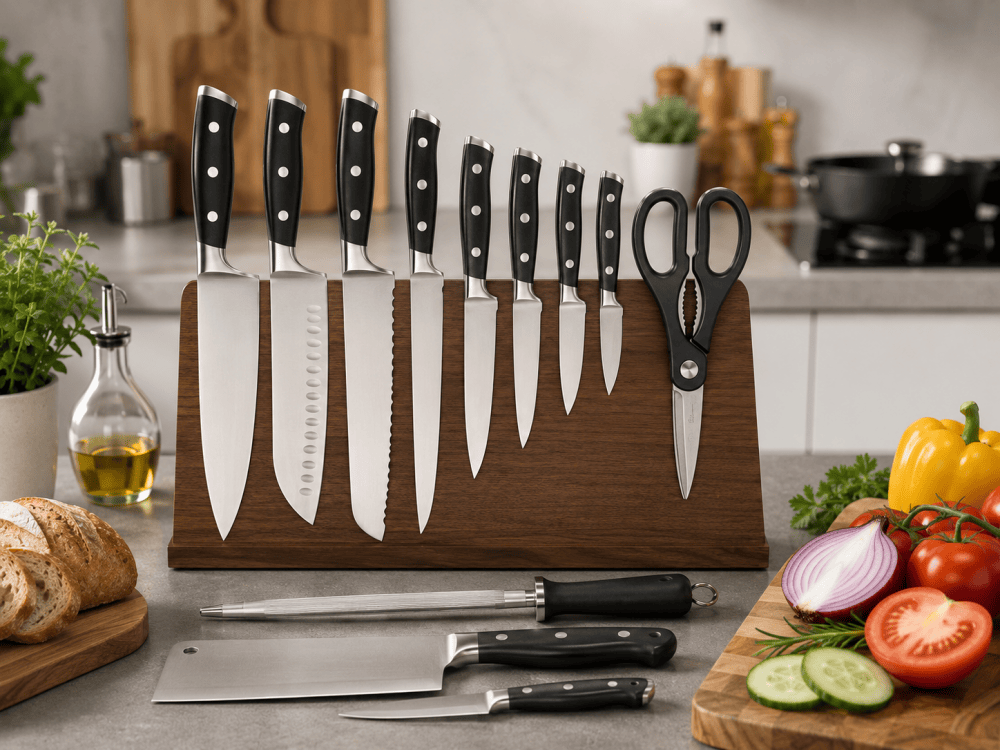
Best kitchen knife sets for European cooking
B2B Sourcing Insight:

For the European market, a practical 5- to 7-piece kitchen knife set is often easier to position than an oversized collection. The key is to create a balanced assortment covering the most common preparation tasks while keeping the product competitive in terms of cost, packaging size, and retail value.

What Makes European Cooking Different?

European cuisine covers a wide range of cooking traditions, from French and Italian cooking to Spanish, German, British, Scandinavian, and Eastern European cuisines. Although these cuisines are very different, many share common preparation tasks involving vegetables, meat, fish, bread, cheese, herbs, and fresh produce.

This means a European kitchen knife set needs to be versatile. Consumers may use the same knife set to prepare vegetables for pasta, slice meat for a Sunday roast, cut bread for breakfast, prepare fruit, or portion ingredients for soups and stews.

Common Food Preparation Tasks in European Kitchens

  • Chopping vegetables and herbs
  • Slicing meat and poultry
  • Preparing fish and seafood
  • Cutting bread and baked foods
  • Peeling and trimming fruits and vegetables
  • Slicing cheese and cured foods
  • Preparing salads and fresh ingredients
  • Carving roasted meat

Because these tasks require different blade shapes, a well-designed knife set should include several complementary knives instead of relying on one multipurpose blade.

What Knives Should a European Kitchen Knife Set Include?

The exact number of knives depends on the target market and product positioning. However, several knife types are particularly useful for European cooking.

A practical kitchen knife set may include:

  • Chef knife – the main all-purpose preparation knife
  • Paring knife – for small ingredients and precision work
  • Utility knife – for medium-sized ingredients and slicing
  • Bread knife – for bread, cakes, and soft foods with firm crusts
  • Carving knife – for roasts and larger cuts of meat
  • Kitchen scissors – for herbs, packaging, poultry, and general kitchen tasks

Not every set needs to contain all six products. The best combination depends on whether the product is designed for entry-level consumers, everyday households, professional users, or premium kitchenware buyers.

1. Chef Knife: The Essential Knife for European Cooking

A chef knife is usually the most important knife in a European kitchen knife set. It is designed for a wide range of preparation tasks, including chopping vegetables, slicing meat, cutting herbs, and preparing larger ingredients.

For European-style cooking, chef knives commonly feature a relatively broad blade that provides enough surface area for chopping and slicing. A blade length around 8 inches is a popular choice for general household use, although larger and smaller versions are also suitable for different users.

Why Include a Chef Knife?

  • Suitable for everyday food preparation
  • Useful for vegetables, meat, herbs, and fruit
  • Provides good balance between cutting control and efficiency
  • Can serve as the primary knife for many household cooking tasks

For B2B knife set development, the chef knife is usually the product that should receive the most attention in terms of blade geometry, handle ergonomics, balance, and overall visual design.

2. Paring Knife: Small but Essential

A paring knife is a small kitchen knife designed for detailed preparation work. Its compact blade provides greater control when peeling, trimming, coring, and cutting small ingredients.

European households frequently prepare fresh vegetables, fruit, herbs, and other ingredients that benefit from a smaller blade. Including a paring knife makes a kitchen knife set significantly more versatile.

Typical Paring Knife Applications

  • Peeling apples and other fruits
  • Trimming vegetables
  • Removing seeds
  • Cutting garlic and small ingredients
  • Making detailed cuts
  • Preparing garnishes

3. Utility Knife: A Flexible Middle-Sized Blade

A utility knife fills the gap between a chef knife and a paring knife. Its narrower and smaller blade makes it useful for foods that are too large for a paring knife but too small for a chef knife.

Utility knives can be used for slicing vegetables, fruit, sausages, sandwiches, cheese, and other medium-sized foods.

For European kitchen knife sets, a utility knife can increase the practical value of the collection without adding significant manufacturing or packaging complexity.

4. Bread Knife: Important for European Households

Bread plays an important role in many European food cultures, which makes a bread knife a particularly useful addition to a European kitchen knife set.

Unlike a standard chef knife, a bread knife normally uses a serrated blade. The teeth allow users to cut through crusty bread without applying excessive downward pressure that could crush the softer interior.

A Bread Knife Can Also Be Used For:

  • Baguettes
  • Sourdough bread
  • Sandwich bread
  • Cakes and pastries
  • Large soft fruits with firm skins

For European retail markets, including a bread knife can make a kitchen knife set feel more complete and purpose-built for everyday household use.

5. Carving Knife: Useful for Meat and Roasts

A carving knife is designed for slicing cooked meat, especially larger roasts. It typically has a long, relatively narrow blade that allows users to create smooth slices.

Although carving knives are not essential in every entry-level kitchen knife set, they can add significant value to premium or family-oriented collections.

For markets where roast meat and traditional Sunday meals are popular, a carving knife can be an attractive addition to a 7-piece or 8-piece kitchen knife set.

6. Kitchen Scissors: A Useful Additional Tool

Although kitchen scissors are not technically knives, they are often included in complete kitchen knife sets because they provide functions that knives cannot easily perform.

Kitchen scissors can be used for cutting herbs, opening food packaging, trimming poultry, cutting kitchen twine, and other everyday tasks.

For B2B buyers, adding kitchen scissors can also increase the perceived value of a set without requiring another large blade product.

For more information about kitchen scissors, see the FASAKA Kitchen Scissors Collection.

5-Piece vs 7-Piece vs 8-Piece Kitchen Knife Sets

There is no universal ideal number of pieces for a kitchen knife set. Different configurations serve different retail positions and consumer expectations.

Set Size Typical Contents Best For
3-Piece Chef knife, paring knife, utility knife Entry-level buyers and small kitchens
5-Piece Chef, paring, utility, bread, carving Everyday household cooking
7-Piece 5 knives + kitchen scissors + storage solution Mainstream retail and family kitchens
8-Piece+ Multiple specialty knives and accessories Premium collections and larger households

For many European retail programs, a 5-piece or 7-piece kitchen knife set offers a practical balance between product variety, packaging cost, shelf space, and consumer value.

What Materials Should European Kitchen Knife Sets Use?

Blade material is one of the most important factors when developing a kitchen knife set. The right material should provide a suitable balance between hardness, corrosion resistance, sharpness retention, manufacturability, and cost.

Common Stainless Steel Options

  • 3Cr13 stainless steel: A cost-effective option commonly used in affordable kitchen knives and knife sets.
  • 5Cr15MoV: A commonly used stainless steel for household and mid-range kitchen knives.
  • 7Cr17MoV: Often selected for kitchen knives requiring a combination of corrosion resistance and improved edge performance.
  • High-carbon stainless steel: Often used for premium products where edge retention and hardness are important selling points.

Material selection should be based on the target retail price, intended use, production process, and performance requirements rather than simply choosing the highest-cost steel available.

For more information about stainless steel knife materials, you can read the FASAKA guide: Is 3Cr13 Steel Good for Kitchen Knives?

Choosing the Right Knife Handle

The handle has a major influence on how consumers perceive the quality of a kitchen knife set. It also affects grip comfort, product appearance, manufacturing cost, and overall product positioning.

Common Handle Materials

  • PP: Cost-effective, lightweight, and suitable for mass-market kitchen knives.
  • PP + TPR: Provides additional grip and can improve ergonomic comfort.
  • Pakkawood: Offers a premium wood-like appearance with improved stability compared with untreated natural wood.
  • Natural wood: Provides a traditional appearance and is often used in premium or classic knife collections.
  • Stainless steel: Creates a modern appearance and is commonly used in contemporary knife designs.

For European private-label brands, handle material can be used as an important product differentiation factor. For example, a simple stainless steel blade can be positioned differently depending on whether it is paired with a basic PP handle, ergonomic TPR handle, or premium wood-style handle.

Learn more about Pakkawood in our guide: What Is Pakkawood? Why It's Popular for Kitchen Knife Handles .

How Should a European Kitchen Knife Set Be Designed?

Beyond the individual knives, the overall design of the set is important. European consumers often look for products that combine functionality with a clean and coordinated appearance.

1. Keep the Knife Selection Practical

Avoid adding too many specialty knives that consumers rarely use. A smaller set with carefully selected knives can provide better value than a large collection filled with redundant products.

2. Maintain Consistent Design

The blades, handles, rivets, and packaging should create a visually consistent product family. This is particularly important for private-label brands selling through supermarkets, homeware retailers, department stores, and e-commerce platforms.

3. Consider Storage

Knife blocks, protective sleeves, magnetic storage solutions, and compact packaging can make a set more attractive to consumers while also improving product organization.

4. Balance Retail Price and Product Value

A kitchen knife set should provide enough functionality to justify its retail price without creating unnecessary manufacturing costs. For OEM buyers, the number of knives, steel type, handle material, packaging, and accessories should all be considered together.

How to Develop a Kitchen Knife Set for the European Market

For importers and private-label brands, developing a successful European kitchen knife set requires more than choosing several products from a supplier catalog.

Step 1: Define Your Target Consumer

Determine whether the product is intended for entry-level households, mainstream consumers, premium home cooks, professional users, or gift markets.

Step 2: Select the Right Knife Combination

Choose the knives according to actual cooking requirements. For a mainstream household set, chef, paring, utility, bread, and carving knives can provide broad coverage.

Step 3: Choose Blade Materials

Select steel according to the target price and performance requirements. Stainless steel is generally preferred for household kitchen knives because of its corrosion resistance and ease of maintenance.

Step 4: Customize the Handle

Handle color, material, shape, and finish can help differentiate the collection from competing products.

Step 5: Develop Retail Packaging

Packaging should clearly communicate the knife set's contents, product benefits, brand identity, and usage information. For European retail markets, packaging requirements and labeling should also be confirmed according to the destination country and sales channel.

Step 6: Confirm Quality and Compliance Requirements

Before mass production, buyers should confirm blade material, dimensions, hardness requirements, sharpness, handle construction, packaging specifications, and applicable market requirements.

FASAKA Kitchen Knife Sets for European Market Requirements

FASAKA supports international buyers developing kitchen knife sets for different retail and distribution markets. Our product range includes forged kitchen knives, stainless steel knife sets, wood handle knives, hollow handle knives, plastic handle knives, and other kitchen cutting tools.

For European-focused projects, buyers can work with FASAKA to develop a product combination based on target price, cooking habits, retail positioning, and market requirements.

  • Customized kitchen knife sets
  • OEM and ODM development
  • Custom blade specifications
  • Handle material and color customization
  • Private-label logo application
  • Custom retail packaging
  • Kitchen scissors and related kitchen tools
  • Bulk production for international buyers

Explore the full FASAKA Kitchen Knife Collection to see different knife styles and set configurations.

For customized product development, visit our OEM & ODM Kitchenware Service.

Recommended Kitchen Knife Set Configurations for European Buyers

Different retail channels may require different product configurations. The following combinations can be used as a starting point when developing a European kitchen knife collection.

Target Market Suggested Set Positioning
Entry-Level Chef + Paring + Utility Affordable everyday cooking
Mainstream Chef + Paring + Utility + Bread + Kitchen Scissors Complete household set
Family / Premium Chef + Paring + Utility + Bread + Carving + Scissors + Storage Complete kitchen solution
Premium Multiple specialty knives + premium handles + storage Premium kitchenware collection
Key Takeaway:

The best kitchen knife set for European cooking is not necessarily the set with the most knives. A well-designed collection should cover the most common preparation tasks, including chopping, slicing, peeling, bread cutting, and meat preparation. For most mainstream applications, a carefully selected 5- to 7-piece set can provide a strong balance between functionality, retail value, and production cost.

Frequently Asked Questions (FAQ)

What knives should be included in a European kitchen knife set?

A practical European kitchen knife set can include a chef knife, paring knife, utility knife, bread knife, and optionally a carving knife and kitchen scissors. The final configuration depends on the target market and retail positioning.

What is the most important knife in a kitchen knife set?

The chef knife is generally the most important knife because it can handle many everyday tasks, including chopping vegetables, slicing meat, cutting herbs, and preparing larger ingredients.

Do European kitchen knife sets need a bread knife?

A bread knife is highly useful for many European households because bread and baked foods are common parts of everyday meals. A serrated bread knife can cut through crusty bread while reducing crushing.

How many knives should a kitchen knife set have?

There is no fixed number. A 3-piece set can cover basic preparation, while a 5- to 7-piece set provides broader functionality for everyday household cooking. Larger sets are generally better suited to premium collections.

What is the best material for European kitchen knives?

Stainless steel is a common choice because it provides good corrosion resistance and relatively easy maintenance. The exact steel should be selected according to the required performance, price point, and manufacturing process.

Can kitchen knife sets be customized for European retailers?

Yes. OEM and ODM manufacturers can customize knife combinations, blade specifications, handle materials, colors, logos, packaging, and accessories according to the buyer's requirements.

Looking for a Kitchen Knife Set Manufacturer for the European Market?

FASAKA supports OEM and ODM kitchen knife projects for retailers, distributors, importers, and private-label brands. Develop practical kitchen knife sets with customized blades, handles, branding, and packaging.

Start Your Kitchen Knife Project →