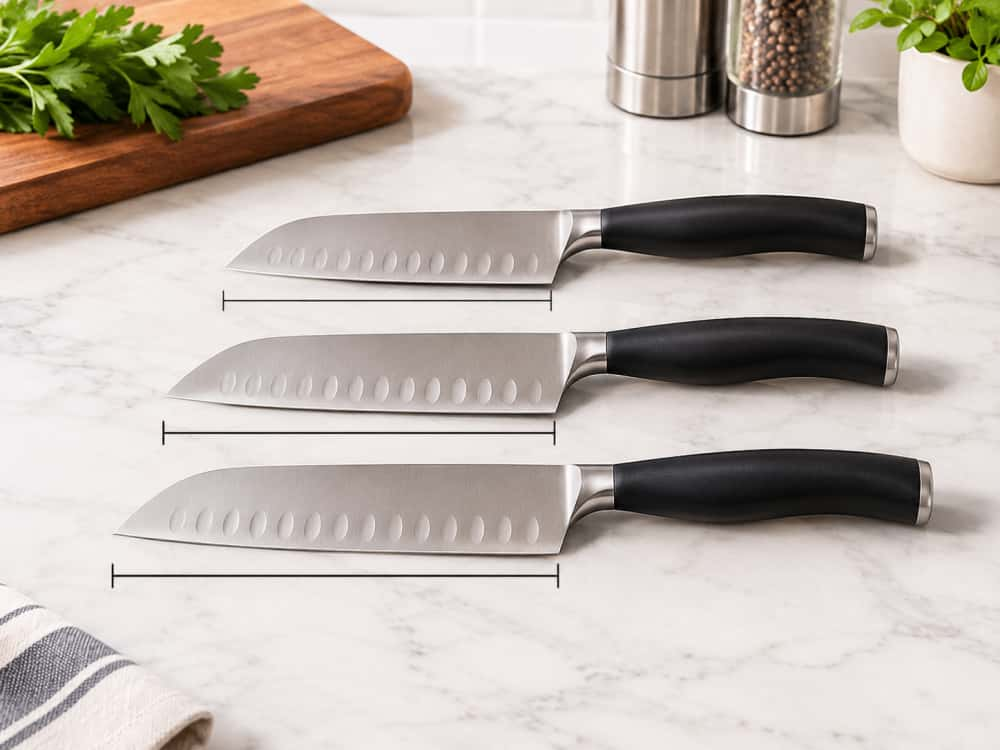




Santoku Knife with Granton Edge vs Plain Edge: Which Is Better?
When choosing a Santoku knife, the blade shape is not the only feature worth considering. Some Santoku knives have a smooth blade face, while others feature small indentations along the sides of the blade. These indentations are commonly known as a Granton edge or a Granton-style edge.
Both designs are used for everyday kitchen cutting, including slicing vegetables, cutting meat, and preparing fish. However, they can offer different food-release characteristics and visual styles.
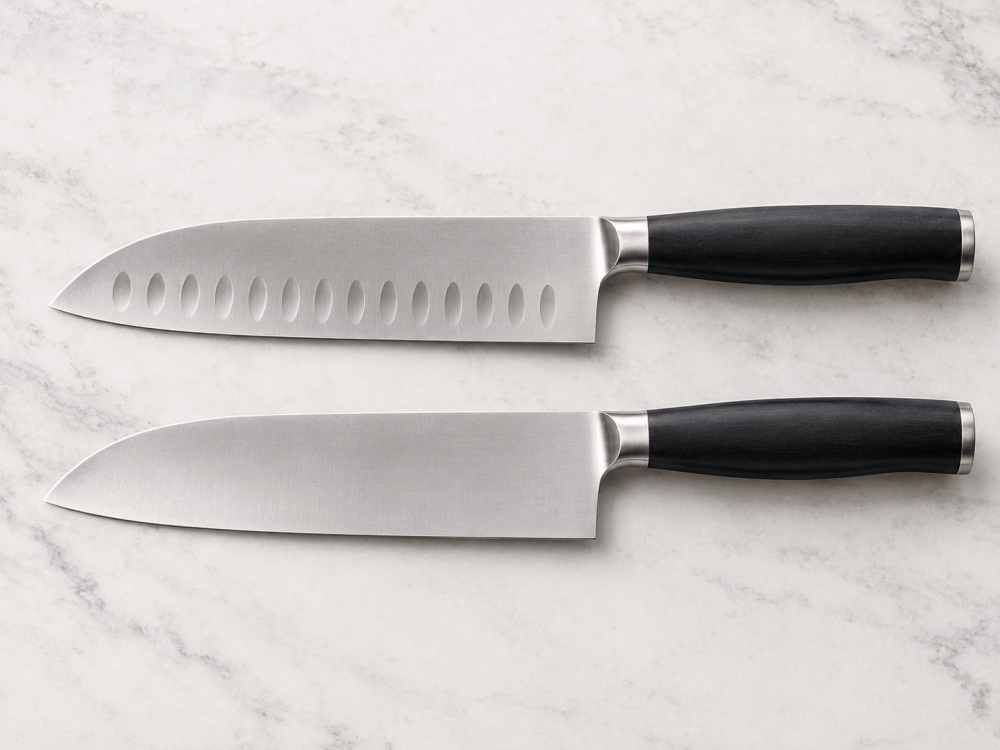
The main difference is that a Granton edge has small hollowed-out indentations along the blade face, while a plain-edge Santoku has a smooth blade face. The indentations may help reduce food sticking by creating small air pockets between the blade and the ingredient. A plain-edge blade has a simpler surface and is easy to maintain.
Quick Answer: Granton Edge vs Plain Edge Santoku
- Granton edge: Features small indentations on the blade face that may help reduce food sticking during slicing.
- Plain edge: Has a smooth blade face, offering a traditional appearance and straightforward maintenance.
- Best choice: Choose a Granton-style blade if food release is a priority. Choose a plain-edge blade if you prefer a simple, traditional blade design.
In this guide, we compare Santoku knives with Granton edges and plain edges, explain how the blade designs work, and help you choose the right option for your kitchen or product range.
What Is a Granton Edge on a Santoku Knife?
A Granton edge refers to a blade design with a series of small, rounded indentations along the blade face near the cutting edge. These indentations are sometimes called hollows or scallops.
On a Santoku knife, they are usually arranged in a line along the side of the blade. Depending on the knife design, the indentations may appear on one side or both sides.
The purpose of these indentations is to reduce the contact area between the blade and certain foods during slicing. Small air pockets can form between the food and the blade, which may make ingredients easier to release after cutting.
A Granton-style design is commonly found on knives used for slicing vegetables, meat, and other ingredients that may cling to a flat blade surface.
How Do the Indentations Work?
When a knife cuts through a moist ingredient, the cut surface may adhere to the flat side of the blade. This can happen with vegetables such as potatoes and cucumbers, as well as certain meats and other ingredients.
The indentations on a Granton-style blade create small recessed areas where the food has less direct contact with the blade. This may reduce the suction effect that causes some ingredients to stick.
However, a Granton edge does not eliminate food sticking completely. The result depends on the ingredient, moisture level, slice thickness, blade geometry, surface finish, and cutting technique.
Important Terminology
A Granton edge is not a serrated cutting edge. The knife still has a smooth cutting edge; the indentations are located on the blade face above the edge.
What Is a Plain Edge Santoku Knife?
A plain-edge Santoku knife has a smooth blade face without the hollowed-out indentations found on a Granton-style design.
This is a traditional and widely used blade configuration. Its clean surface gives the knife a simple appearance and makes it straightforward to inspect, clean, and maintain.
Plain-edge Santoku knives can handle a wide range of everyday kitchen tasks, including:
- Slicing onions, tomatoes, and cucumbers
- Chopping leafy vegetables and herbs
- Cutting boneless meat
- Preparing fish and seafood
- Chopping and portioning everyday ingredients
A smooth blade face does not mean that the knife has less cutting ability. Cutting performance depends on several factors, including blade steel, sharpness, edge geometry, blade thickness, and overall construction.
For many home cooks and professional kitchens, a well-made plain-edge Santoku is a versatile choice for daily food preparation.
Granton Edge vs Plain Edge Santoku: Quick Comparison
Both designs can perform the same basic cutting tasks, but their blade surfaces create some practical differences.
| Feature | Granton Edge Santoku | Plain Edge Santoku |
|---|---|---|
| Blade face | Small indentations or hollows | Smooth surface |
| Food release | May help reduce sticking | Food may cling to the blade |
| Cutting ability | Depends on blade quality and sharpness | Depends on blade quality and sharpness |
| Blade appearance | More detailed, distinctive appearance | Simple, traditional appearance |
| Cleaning | Requires attention to the indentations | Generally straightforward |
| Maintenance | Requires care around the hollowed areas | Simple blade-face maintenance |
| Best suited for | Users who value food release during slicing | Users who prefer a simple, versatile blade |
The most important point is that the Granton design changes the blade surface, not the fundamental purpose of the Santoku knife. Both versions can be excellent kitchen knives when properly designed and manufactured.
5 Key Differences Between Granton Edge and Plain Edge Santoku Knives
1. Food Sticking and Release
Food sticking is one of the main reasons some buyers prefer Granton-style Santoku knives.
When slicing moist or starchy ingredients, thin slices may cling to the side of a smooth blade. This can slow down repetitive cutting and require the cook to remove food from the blade more frequently.
The small indentations on a Granton-style blade reduce the amount of flat surface in contact with the food. This may help slices release more easily, especially when working with ingredients such as:
- Potatoes
- Cucumbers
- Zucchini
- Carrots
- Boneless meat