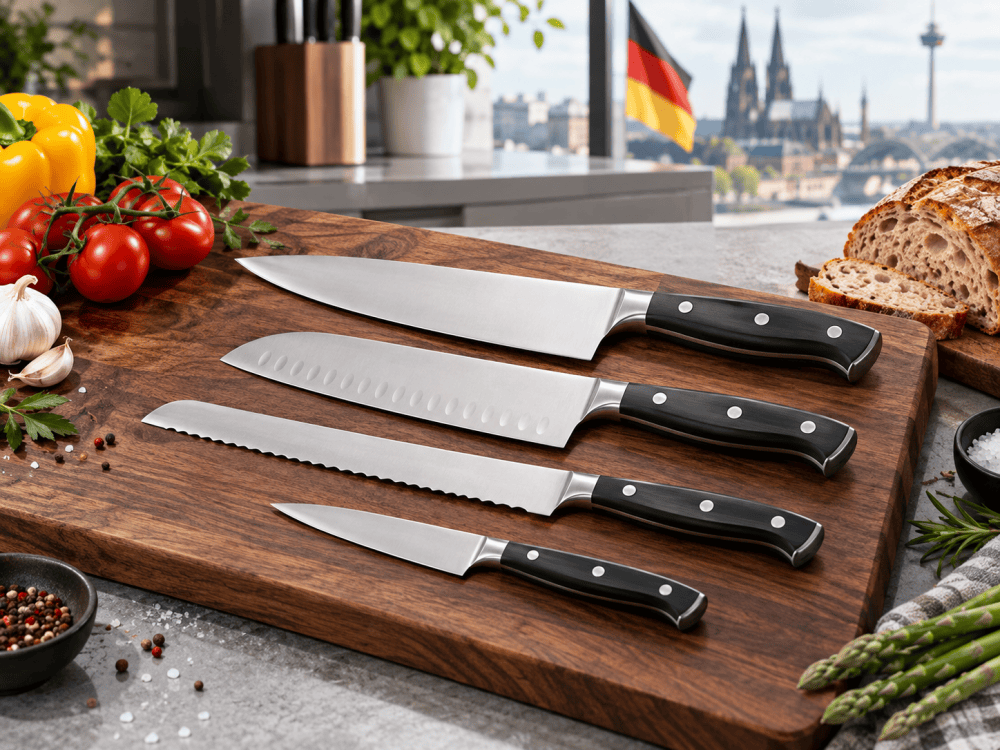



What Is 2Cr13 Stainless Steel? Is 2Cr13 Good for Knives?
What Is 2Cr13 Stainless Steel? Is 2Cr13 Good for Knives?
2Cr13 stainless steel is a commonly used martensitic stainless steel for cost-conscious cutting tools and other applications. It is known for its combination of corrosion resistance, hardness after heat treatment, machinability, and relatively low material cost.
But is 2Cr13 stainless steel good for knives? The answer depends on the type of knife, expected cutting performance, target price, and heat treatment. 2Cr13 can be a practical choice for budget and everyday knives, but it is not designed to provide the same edge retention as many harder or more wear-resistant premium knife steels.
Quick answer: 2Cr13 is a basic martensitic stainless steel that can be used for knife blades. It offers reasonable corrosion resistance, can be hardened through heat treatment, and is relatively easy to sharpen. Its main limitation is that its edge retention and wear resistance are generally more limited than those of higher-performance knife steels.
For B2B knife sourcing, the steel grade should therefore be evaluated together with heat treatment, finished hardness, blade geometry, thickness, intended use, and target price.
What Is 2Cr13 Stainless Steel?
2Cr13 is a Chinese designation for a martensitic stainless steel. In the current Chinese designation system, the material is commonly identified as 20Cr13, with 2Cr13 used as its former designation. It contains approximately 12–14% chromium and 0.16–0.25% carbon under commonly referenced specifications.
Because it is a martensitic stainless steel, 2Cr13 can be heat treated to increase hardness and strength. This makes it suitable for applications where a combination of hardness, cutting performance, and corrosion resistance is required.
2Cr13 Stainless Steel Composition
The typical chemical composition of 2Cr13/20Cr13 includes chromium and carbon as the key alloying elements. Chromium provides the stainless characteristics, while carbon contributes to hardness and strength after suitable heat treatment.
| Element | Typical / Standard Range | Role in the Material |
|---|---|---|
| Carbon (C) | 0.16–0.25% | Contributes to hardness and strength after heat treatment. |
| Chromium (Cr) | 12.00–14.00% | Provides corrosion resistance and contributes to the stainless properties of the steel. |
| Nickel (Ni) | Up to 0.60% | Present at a relatively low level compared with many austenitic stainless steels. |
| Silicon (Si) | Up to 1.00% | Controlled alloying element used in steel production. |
| Manganese (Mn) | Up to 1.00% | Controlled alloying element that contributes to steel processing and properties. |
The exact specification should always be confirmed against the applicable material standard and the supplier's material documentation when purchasing in bulk.
Is 2Cr13 Stainless Steel Good for Knives?
Yes, 2Cr13 can be a good choice for certain types of knives. It is particularly suitable when the product needs reasonable corrosion resistance, straightforward sharpening, practical everyday performance, and controlled manufacturing cost.
However, “good for knives” does not mean that 2Cr13 is the best choice for every knife. A knife designed for heavy-duty cutting, long edge retention, or premium positioning may require a different steel or a different heat-treatment specification.
Budget-Friendly
2Cr13 is relatively economical, making it suitable for products where material cost is an important part of the target price.
Easy to Sharpen
Compared with harder, more wear-resistant knife steels, 2Cr13 is generally easier for users to resharpen.
Useful Corrosion Resistance
Its chromium content provides useful corrosion resistance for everyday cutting applications, although stainless steel should not be considered completely rust-proof.
What Are the Advantages of 2Cr13 Stainless Steel?
Advantages
- Relatively low material cost
- Suitable for mass-market knife production
- Can be hardened through heat treatment
- Reasonable corrosion resistance
- Easy to sharpen compared with many harder steels
- Suitable for many everyday cutting applications
- Can be used for cost-conscious kitchen and utility knives
Limitations
- Lower edge retention than many higher-performance knife steels
- Limited wear resistance compared with premium blade steels
- Performance depends strongly on heat treatment
- Not automatically suitable for every heavy-duty application
- Material grade alone does not guarantee final knife quality
- May require more frequent sharpening in demanding use
Does 2Cr13 Stainless Steel Rust?
2Cr13 has useful corrosion resistance because it contains approximately 12–14% chromium, but it is not completely immune to rust or staining.
Corrosion performance depends on more than the nominal steel grade. Surface finish, heat treatment, exposure to moisture, salt, acidic substances, cleaning chemicals, and maintenance can all influence the actual result.
For kitchen knives and other products used around food and water, proper cleaning and drying remain important even when stainless steel is used.
How Hard Is 2Cr13 Stainless Steel?
2Cr13 is a hardenable martensitic stainless steel, but there is no single HRC value that applies to every finished 2Cr13 knife.
Heat treatment has a major influence on the final hardness. Different products can use different quenching and tempering processes, and knife manufacturers may specify different target hardness values according to blade design and intended application.
For example, published knife specifications can show 2Cr13 blades in different hardness ranges, illustrating why buyers should request the actual finished hardness rather than relying only on the steel grade name.
Why Does Hardness Matter for a Knife?
Hardness influences several aspects of knife performance, including edge stability, wear resistance, sharpening behavior, and resistance to deformation.
However, higher hardness is not automatically better. The optimal hardness depends on the knife design, blade thickness, edge geometry, intended cutting material, and required toughness.
What Does Heat Treatment Do to 2Cr13 Knife Blades?
Heat treatment is one of the most important manufacturing steps when using 2Cr13 for knife blades.
Proper heat treatment can increase the hardness and strength of the steel and help the finished blade achieve the performance expected from the material.
This is why two knives made from nominally identical 2Cr13 steel can have noticeably different cutting performance.
When evaluating a 2Cr13 knife supplier, ask about:
- Target finished hardness
- Heat-treatment process
- Quenching and tempering specifications
- Blade thickness
- Edge angle
- Blade geometry
- Surface finish
- Production consistency between batches
What Is 2Cr13 Used for?
2Cr13 can be used in a variety of cutting and mechanical applications where moderate hardness, corrosion resistance, and cost efficiency are required.
In the knife industry, it may be used for entry-level and budget-oriented blades, utility knives, everyday cutting tools, and other products where extreme edge retention is not the primary requirement.
| Application | Suitability of 2Cr13 | Main Consideration |
|---|---|---|
| Budget kitchen knives | Suitable | Cost, corrosion resistance, sharpening convenience |
| Everyday utility knives | Suitable for selected designs | Blade geometry and required durability |
| Entry-level knife sets | Suitable | Target price and expected usage |
| Premium chef knives | Application-dependent | Edge retention and product positioning may require another steel |
| Heavy-duty cutting tools | Application-dependent | Hardness, toughness, wear resistance, and blade geometry must be evaluated together |
Is 2Cr13 Good for Kitchen Knives?
2Cr13 can be used for kitchen knives, particularly for budget-oriented and everyday kitchen products.
Its advantages for this market include relatively low material cost, useful corrosion resistance, and straightforward sharpening. For high-volume retail products where the target price is important, these characteristics can make 2Cr13 worth considering.
However, buyers should consider the expected usage before selecting the grade. A low-cost kitchen knife for occasional household use has different requirements from a professional knife designed for intensive daily cutting.
For B2B Kitchen Knife Sourcing
Instead of asking only “Is 2Cr13 good?”, a more useful sourcing question is:
“Is the specific 2Cr13 specification, heat treatment, blade geometry, and target hardness appropriate for my product's intended market?”
This approach gives buyers a much better basis for comparing suppliers and quotations.
2Cr13 vs 3Cr13: What Is the Difference?
2Cr13 and 3Cr13 are both commonly discussed as entry-level martensitic stainless steels for knives and cutting tools. One of the main material differences is their carbon content.
| Feature | 2Cr13 | 3Cr13 |
|---|---|---|
| Material family | Martensitic stainless steel | Martensitic stainless steel |
| Typical carbon range | About 0.16–0.25% | About 0.26–0.35% |
| Chromium | About 12–14% | About 12–14% |
| Hardness potential | Generally lower than higher-carbon grades | Generally higher than 2Cr13 with suitable heat treatment |
| Sharpening | Generally easy | Generally easy to moderate |
| Typical positioning | Cost-conscious / entry-level | Entry-level / budget cutting tools |
The comparison should not be reduced to carbon content alone. Finished hardness, heat treatment, blade geometry, edge angle, and manufacturing consistency all affect the actual knife.
Is 2Cr13 the Same as 420 Stainless Steel?
2Cr13 is commonly mapped to the 420 family in cross-standard references, with 20Cr13 / 2Cr13 corresponding to designations such as AISI 420 and X20Cr13 in commonly cited equivalency tables. However, buyers should be careful when using the word “equivalent.” Standards from different countries do not always define materials with exactly identical chemical and mechanical requirements.
For an OEM purchase order, it is better to specify the actual grade, applicable standard, required composition, finished hardness, and testing or documentation requirements rather than relying only on a broad term such as “420 stainless steel.”
2Cr13 vs 420J2: Are They the Same?
2Cr13 and 420J2 are often compared because they belong to similar martensitic stainless-steel families and can both be used in cost-conscious cutting applications.
However, buyers should not assume that two steel names are interchangeable simply because they are both associated with the 420 family. The exact chemical specification and applicable standard should be checked before ordering.
For private-label knife sourcing, specifying the exact grade in the purchase order can reduce material ambiguity between the buyer and supplier.
How Does 2Cr13 Compare with Premium Knife Steel?
Premium knife steels can be engineered for higher hardness, greater wear resistance, improved edge retention, or a different balance of toughness and corrosion resistance.
2Cr13 occupies a different position. Its strengths are mainly related to cost efficiency, manufacturability, practical corrosion resistance, and ease of sharpening rather than maximum edge retention.
| Requirement | 2Cr13 | Higher-Performance Knife Steel |
|---|---|---|
| Low material cost | Strong fit | Depends on grade |
| Easy sharpening | Generally favorable | Depends on hardness and steel type |
| Basic corrosion resistance | Suitable for many everyday applications | Depends on grade |
| Long edge retention | More limited | Often a major design objective |
| Premium positioning | Usually less suitable | Often more suitable |
| Mass-market production | Cost-effective option | Depends on target price and product positioning |
What Should B2B Buyers Check When Sourcing 2Cr13 Knives?
If you are sourcing 2Cr13 kitchen knives, utility knives, or other cutting tools from China, the material grade should be only one part of your supplier evaluation.
Ask the supplier to clarify:
- Exact stainless steel grade and applicable standard
- Material certificate or supporting documentation where required
- Target finished hardness
- Heat-treatment process
- Blade thickness
- Blade dimensions
- Edge angle
- Surface finish
- Handle material and construction
- Logo customization options
- Packaging options
- MOQ
- Sample availability
- Production lead time
- Required compliance documentation for the target market
How Should You Specify 2Cr13 in an OEM Knife RFQ?
If you are requesting a quotation from a knife manufacturer, avoid sending only the phrase “2Cr13 knife.” A more detailed RFQ gives the supplier enough information to quote the correct product.
Example OEM RFQ:
Product: Stainless steel kitchen knife
Blade material: 2Cr13 / 20Cr13
Blade thickness: [required specification]
Blade length: [required specification]
Target hardness: [required HRC range]
Handle material: [required material]
Surface finish: [polished / satin / other]
Logo: Custom brand logo
Packaging: Custom retail packaging
Estimated quantity: [quantity]
Target market: [country / sales channel]
Required documents: [applicable requirements]
This type of specification makes it easier to compare quotations from different suppliers because you are comparing the same basic product requirements.
Is 2Cr13 a Good Choice for Your Knife?
There is no universal answer because the right knife steel depends on the product's intended use and target market.
| Buyer Requirement | 2Cr13 Consideration |
|---|---|
| Budget-oriented knife | Good candidate to consider |
| Large-volume retail product | Cost efficiency can be an advantage |
| Easy sharpening | Generally favorable |
| Everyday kitchen use | Can be suitable with appropriate design and heat treatment |
| Maximum edge retention | Consider higher-performance knife steels |
| Premium knife positioning | Evaluate alternative steels and overall construction |
| OEM/private-label project | Suitable when the material specification matches the product requirements |
How FASAKA Approaches Knife Material Selection
For B2B knife sourcing, selecting a steel grade is only one part of product development. The final product also depends on blade design, heat treatment, grinding, edge geometry, handle construction, finishing, packaging, and target-market requirements.
FASAKA is a brand under DKS Enterprises Co., Ltd., a manufacturer and supplier based in Yangjiang, Guangdong, China, specializing in hardware knives and scissors, BBQ tools, and kitchenware.
For OEM, ODM, and private-label projects, buyers can discuss product specifications, materials, dimensions, handle designs, finishing, logos, packaging, quantities, and other sourcing requirements with the FASAKA team.
Explore FASAKA OEM & ODM solutions
Frequently Asked Questions About 2Cr13 Stainless Steel
2Cr13 is a martensitic stainless steel commonly used for cutting tools and other applications. In the current Chinese designation system, it is commonly identified as 20Cr13, with 2Cr13 used as the former designation.
Yes. 2Cr13 can be suitable for budget and everyday knives because it offers useful corrosion resistance, can be heat treated for hardness, and is relatively easy to sharpen. Its edge retention is generally more limited than that of many higher-performance knife steels.
2Cr13 can be used for kitchen knives, particularly budget-oriented and mass-market products. The suitability depends on the knife design, heat treatment, hardness, blade geometry, intended use, and target price.
2Cr13 has corrosion resistance because it contains approximately 12–14% chromium, but it is not completely rust-proof. Moisture, salt, acidic substances, surface condition, cleaning chemicals, and maintenance can affect corrosion behavior.
2Cr13 is a hardenable martensitic stainless steel. Its final hardness depends strongly on heat treatment, so buyers should request the finished hardness specification for a particular knife rather than assuming one HRC value from the steel grade alone.
2Cr13 is commonly used as the former designation for 20Cr13 in Chinese stainless-steel standards. Buyers should confirm the applicable standard when specifying material in an OEM order.
Neither grade is universally better. 3Cr13 generally contains more carbon than 2Cr13 and can achieve a different hardness and performance balance after heat treatment. The better choice depends on the knife design, target hardness, application, and price.
Yes. 2Cr13 can be considered for OEM and private-label knives when its performance characteristics match the product requirements. Buyers should specify the exact grade, hardness, heat treatment, blade geometry, dimensions, logo, packaging, MOQ, and other requirements in the RFQ.
2Cr13 Stainless Steel Buyer Checklist
Before ordering a 2Cr13 knife, check these points:
- Confirm the exact material grade.
- Confirm the applicable material standard.
- Ask for the target finished hardness.
- Understand the heat-treatment process.
- Check blade thickness and geometry.
- Check edge angle and grinding quality.
- Evaluate corrosion resistance according to the intended application.
- Request samples before a large production order.
- Confirm MOQ and production lead time.
- Specify logo and packaging requirements.
- Confirm applicable compliance requirements for your target market.
Looking for Custom Kitchen Knives from China?
FASAKA supports B2B buyers looking for kitchen knives, scissors, BBQ tools, and kitchenware, including OEM, ODM, and private-label sourcing projects. Discuss your required steel grade, blade specifications, handle design, packaging, quantity, and target market with our team.
Contact FASAKA