


Paring Knife vs Utility Knife: What’s the Difference?
Paring Knife vs Utility Knife: What’s the Difference?
Published by FASAKA | Kitchen Knife Buying Guide
When choosing kitchen knives, many home cooks and buyers often confuse the paring knife and the utility knife. While both are smaller than a chef knife, they are designed for different cutting tasks and offer unique advantages in the kitchen.
Understanding the differences between these two knife types can help users improve cooking efficiency, precision, and comfort. In this guide, FASAKA explains the structure, uses, pros, and ideal applications of paring knives and utility knives.
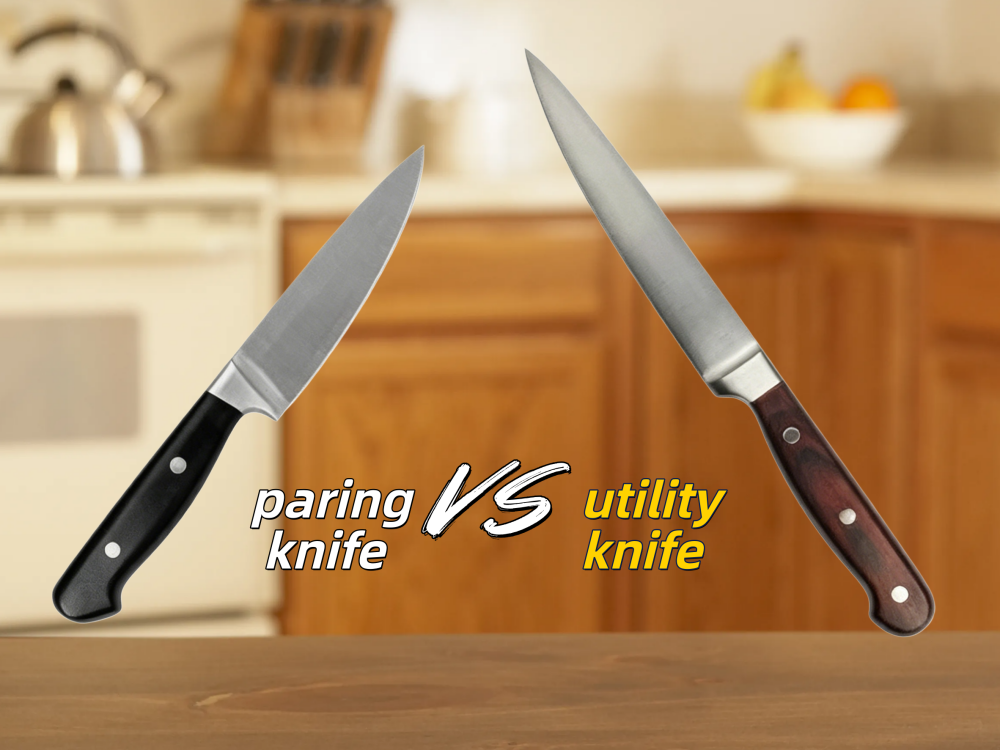
What Is a Paring Knife?
A paring knife is a small precision knife typically featuring a blade length between 3 and 4 inches. It is designed for delicate cutting tasks that require control and accuracy.
- Ideal for peeling fruits and vegetables
- Excellent for trimming, coring, and garnishing
- Lightweight and easy to maneuver
- Designed for detailed hand-held cutting work
Paring knives are one of the most essential tools in both professional and home kitchens because they allow precise cuts where larger knives feel bulky.
What Is a Utility Knife?
A utility knife is positioned between a paring knife and a chef knife. Most utility knives feature blades between 4 and 7 inches, making them versatile for medium-sized kitchen tasks.
- Suitable for slicing sandwiches, fruits, and cooked meats
- Longer blade provides more cutting reach
- Useful for ingredients too small for a chef knife but too large for a paring knife
- Can handle both precision and light-duty slicing tasks
Many kitchen users consider the utility knife an “everyday helper” because it bridges the gap between large and small kitchen knives.
Paring Knife vs Utility Knife: Key Differences
| Feature | Paring Knife | Utility Knife |
|---|---|---|
| Blade Length | 3–4 inches | 4–7 inches |
| Main Purpose | Precision tasks | General slicing |
| Best For | Peeling & trimming | Sandwiches & fruits |
| Control | Very high | Moderate |
| Versatility | Low-medium | High |
Which Knife Should You Choose?
The choice depends on your cooking habits and the type of food preparation you do most often.
- Choose a paring knife if: you frequently peel fruits, trim vegetables, or perform decorative cutting.
- Choose a utility knife if: you want a versatile small knife for slicing sandwiches, fruits, cheese, or boneless meat.
- Choose both if: you want a complete kitchen setup with maximum flexibility.
Professional kitchens often use both knives because each serves a different role in food preparation.
Important Factors When Buying Small Kitchen Knives
Beyond blade shape and size, buyers should also consider material quality and ergonomic design.
- Food-grade stainless steel for corrosion resistance
- Comfortable non-slip handle materials
- Proper blade hardness for edge retention
- Balanced weight distribution
- Easy sharpening and maintenance
At FASAKA, we manufacture a wide range of kitchen knives using stainless steel materials such as 3Cr13, 5Cr15MoV, and 420J2 for different market needs and price levels.
Related Kitchen Knife Resources
Explore more professional kitchen knife guides from FASAKA:
Frequently Asked Questions (FAQ)
Can a utility knife replace a paring knife?
A utility knife can handle some precision tasks, but it is usually less effective for peeling and detailed cutting compared to a paring knife.
What size is best for a utility knife?
Most kitchen utility knives range from 5 to 6 inches, offering a balance between control and cutting versatility.
Do professional chefs use paring knives?
Yes. Paring knives are essential in professional kitchens for precision cutting, peeling, trimming, and decorative work.
Which knife is better for everyday kitchen use?
A utility knife is generally more versatile for daily food preparation, while a paring knife excels in small detailed tasks.
Looking for Professional Kitchen Knife Manufacturing?
FASAKA provides OEM/ODM kitchen knife solutions for global brands, distributors, and retailers, including chef knives, utility knives, paring knives, and complete knife sets.
Contact Us