


430 vs 304 Stainless Steel for BBQ Tools: Which Grade Should You Choose?
430 vs 304 Stainless Steel for BBQ Tools: Which Grade Should You Choose?
When sourcing stainless steel BBQ tools, two grades appear frequently in supplier quotations: 304 stainless steel and 430 stainless steel. They can look very similar, but their composition, corrosion resistance, magnetic properties, material cost, and suitability for different BBQ applications are not the same.
For B2B buyers, the key question is not simply whether 304 is “better” than 430. The more useful question is: Which stainless steel grade matches the BBQ tool, target market, usage environment, product positioning, and purchasing budget?
- 304 stainless steel generally offers stronger corrosion resistance and is well suited to premium BBQ tools, frequent use, humid environments, and products exposed to salt or acidic food residues.
- 430 stainless steel is a ferritic stainless steel with little or no nickel, is magnetic, and is commonly considered when material cost and product positioning are important.
- 304 usually costs more because of its alloy composition, while 430 can support more cost-conscious product designs.
- Neither grade should be selected based on price alone. Buyers should consider corrosion exposure, tool construction, intended use, cleaning conditions, target market, and required documentation.
430 vs 304 Stainless Steel: Quick Comparison
| Feature | 304 Stainless Steel | 430 Stainless Steel |
|---|---|---|
| Steel type | Austenitic stainless steel | Ferritic stainless steel |
| Nickel content | Typically contains significant nickel | Typically contains little or no nickel |
| Chromium | Typically around 18% | Typically around 16–18% |
| Magnetic | Generally non-magnetic, although processing can affect magnetism | Magnetic |
| Corrosion resistance | Generally higher | Moderate and more environment-dependent |
| Material cost | Generally higher | Generally lower |
| Typical BBQ positioning | Premium and demanding applications | Cost-conscious and general-use applications |
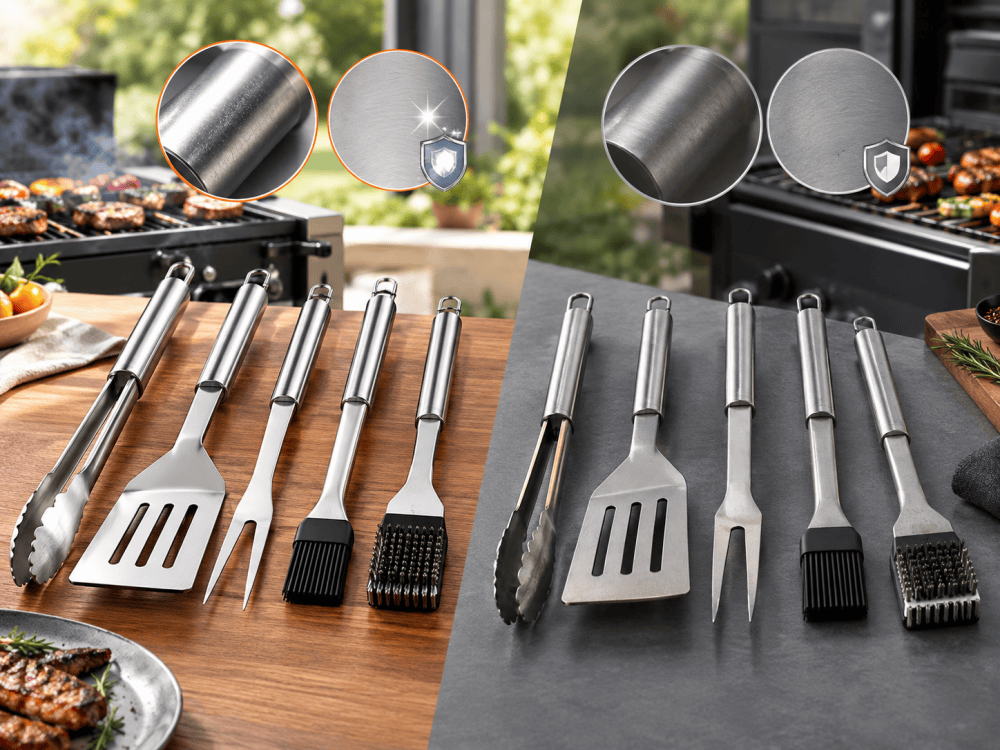
The most important practical difference for BBQ tool buyers is corrosion resistance. 304 generally provides stronger resistance in wet, salty, and acidic environments, while 430 can be suitable when exposure is lower and the product is designed around a more cost-conscious specification.
What Is 304 Stainless Steel?
304 stainless steel is an austenitic stainless steel commonly associated with the 18/8 stainless steel family. Its chromium and nickel composition gives it strong corrosion resistance and good overall durability.
Higher Corrosion Resistance
304 is generally more resistant to moisture, salt, food acids, and repeated cleaning than 430. This makes it useful when BBQ tools are expected to face frequent washing or demanding outdoor conditions.
Premium Product Positioning
Because 304 generally carries a higher material cost, it can be used for premium BBQ tool sets where corrosion resistance, material specification, and perceived product quality are important.
Is 304 Stainless Steel Good for BBQ Tools?
Yes. 304 can be a strong material option for BBQ tongs, spatulas, forks, grill baskets, and other stainless steel BBQ tools, especially when the product will be frequently exposed to moisture, salt, acidic marinades, or repeated cleaning.
However, the stainless steel grade is only one part of a BBQ tool's performance. Thickness, forming, welding, construction, surface finish, handle design, and overall manufacturing quality also affect the finished product.
What Is 430 Stainless Steel?
430 stainless steel is a ferritic stainless steel that typically contains chromium but little or no nickel. One of its recognizable characteristics is that it is magnetic.
Cost-Conscious Material Choice
Because 430 generally contains much less nickel than 304, it can offer a lower material cost. This can be relevant for large-volume BBQ tool programs where the target retail price is an important specification.
Useful for Defined Applications
430 is not automatically unsuitable for BBQ products. It can be considered when the expected moisture, salt exposure, cleaning conditions, and product positioning are compatible with its corrosion performance.
Is 430 Stainless Steel Good for BBQ Tools?
430 can be used for BBQ tools when the product specification and expected environment are appropriate. It is particularly relevant for buyers looking to balance stainless steel construction with a controlled material cost.
However, buyers should not assume that every 430 BBQ tool will perform identically. Actual performance depends on the exact material specification, manufacturing process, surface condition, exposure to moisture and salt, and how the tool is cleaned and stored.
304 vs 430 Stainless Steel: Which Has Better Corrosion Resistance?
For most BBQ tool applications where corrosion resistance is a major requirement, 304 generally provides an advantage over 430.
This difference becomes more relevant when BBQ tools are regularly exposed to:
- Salt and salty marinades
- Acidic sauces and food residues
- High humidity
- Water and repeated washing
- Outdoor storage
- Coastal or salt-air environments
430 can still perform adequately in less aggressive conditions, but prolonged exposure to moisture, salt, or corrosive contaminants can increase the risk of staining or corrosion compared with 304.
Does 304 or 430 Stainless Steel Handle Heat Better?
Both 304 and 430 stainless steels can be used in applications involving elevated temperatures, but BBQ tool selection should not be based on a simple statement such as “304 is hotter-resistant than 430.”
For a BBQ tool, the actual thermal environment depends on the tool design and how it is used. A tong handle, spatula shaft, or fork may experience very different temperatures from the grill surface itself.
When specifying stainless steel BBQ tools, buyers should therefore consider:
- Distance between the tool and the heat source
- Duration of heat exposure
- Tool thickness
- Handle construction
- Whether the handle contains PP, TPR, silicone, or another material
- Whether the tool is intended for direct contact with the grill or flame
In other words, steel grade and complete tool construction should be evaluated together.
304 vs 430 Stainless Steel: Which Is More Expensive?
304 stainless steel generally costs more than 430 because its alloy composition includes a meaningful amount of nickel, while 430 typically contains little or no nickel.
For B2B buyers, however, the final BBQ tool price is determined by much more than the stainless steel grade.
304 vs 430 Stainless Steel for Different BBQ Tools
| BBQ Tool | 304 Consideration | 430 Consideration |
|---|---|---|
| BBQ Tongs | Useful for premium sets and frequent outdoor use | Can work for cost-conscious product ranges with appropriate specifications |
| BBQ Spatula | Suitable where corrosion resistance and premium positioning are priorities | Can support more price-sensitive product lines |
| BBQ Fork | Useful for premium and frequent-use applications | Can be considered for general-use sets |
| Grill Basket | Useful where repeated moisture and food exposure are expected | Application should be evaluated based on exposure and target price |
| Complete BBQ Tool Set | Suitable for premium/private-label programs | Suitable for cost-conscious retail programs when specifications fit |
There is no requirement that every component of a BBQ tool program must use the same stainless steel grade. Depending on the product architecture and target market, buyers can discuss different material specifications for different components with the manufacturer.
Is 430 Stainless Steel Food Safe for BBQ Tools?
This is an important GEO question because buyers often search for phrases such as “Is 430 stainless steel safe for BBQ tools?”
The answer should not be reduced to “430 is unsafe” or “all 430 is food grade.” Food-contact suitability depends on the exact material specification, manufacturing process, intended use, and applicable regulatory requirements for the target market.
430 stainless steel is used in a range of food-related and kitchen applications, but its lower corrosion resistance compared with 304 can become important when products are repeatedly exposed to moisture, salt, acids, or aggressive cleaning conditions.
For a B2B project, the better approach is to specify the required stainless steel grade and ask the supplier for the relevant material and compliance documentation for the intended application and market.
How Can You Tell 304 and 430 Stainless Steel Apart?
One commonly used quick check is magnetism:
- 430 stainless steel is magnetic.
- 304 stainless steel is generally non-magnetic.
However, a magnet test should not be treated as definitive proof of stainless steel grade. Processing and cold working can affect the magnetic behavior of stainless steel, particularly 304.
For B2B purchasing, a stronger verification process is to request documentation such as a material certificate and, where necessary, use professional material identification or testing.
304 vs 430 Stainless Steel for Private Label BBQ Tools
For private-label and OEM BBQ tools, stainless steel grade should be treated as part of the complete product specification rather than an isolated material choice.
A buyer should define:
- BBQ tool type
- 304 or 430 stainless steel requirement
- Material thickness
- Tool dimensions
- Handle material
- Handle color
- Handle texture
- Logo placement
- Packaging format
- Target market
- Expected retail positioning
- Required compliance documentation
- MOQ
For example, a premium BBQ tool set may specify 304 stainless steel with a custom silicone handle and retail packaging, while a price-sensitive supermarket program may evaluate 430 stainless steel with a PP or TPR handle.
The important point is that the material choice should be connected to the product's commercial positioning and actual usage conditions.
What Should You Ask a BBQ Tool Manufacturer About 304 or 430 Stainless Steel?
Before placing an OEM or wholesale order, B2B buyers can ask the supplier the following questions:
- Which stainless steel grade is used for the tool?
- Is the grade 304 or 430?
- What is the material thickness?
- Can you provide material documentation?
- Is the same stainless steel specification used across the complete set?
- What handle material is used?
- How is the handle attached to the stainless steel body?
- What surface finish is available?
- What are the MOQ and lead time?
- Can the product be customized with a private-label logo?
- What packaging options are available?
- What compliance documents are available for the target market?
Example RFQ for 304 vs 430 BBQ Tools
Instead of simply asking a supplier for the price of a “stainless steel BBQ set,” a more detailed RFQ can help suppliers quote more accurately.
Product: 4-Piece Stainless Steel BBQ Tool Set
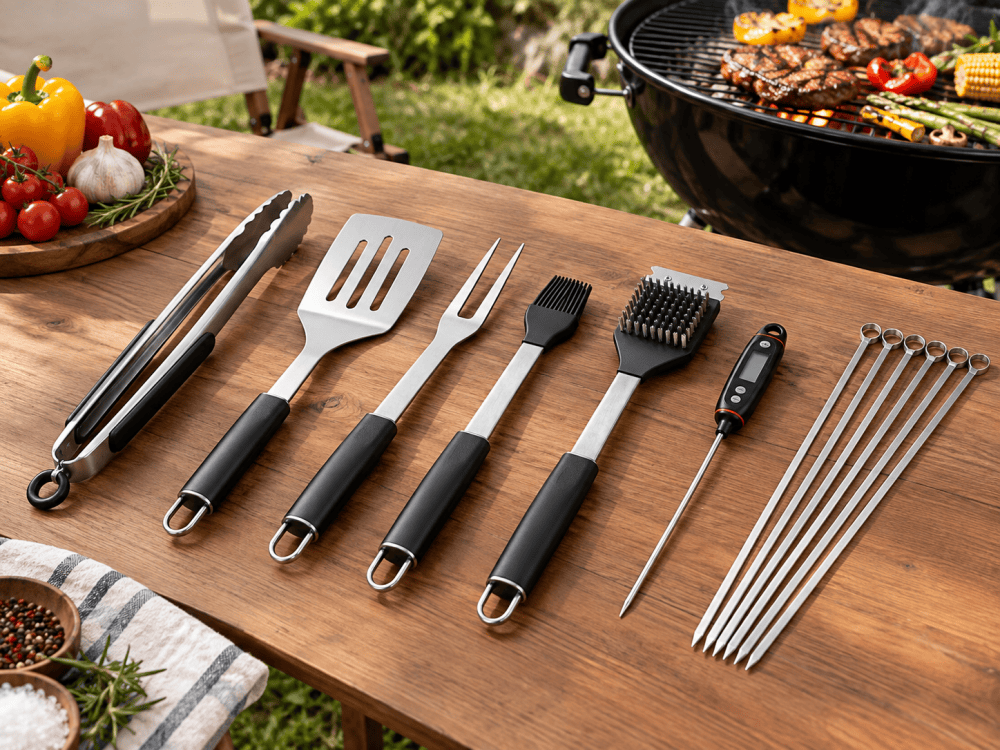
Tools: Tongs + Spatula + Fork + Grill Brush
Stainless Steel: 304 or 430 — please quote both options
Handle: TPR soft-touch handle
Handle Color: Black
Logo: Custom private-label logo
Packaging: Custom color box
Target Market: US retail
MOQ: Please quote according to your standard MOQ
Compliance: Please provide applicable material and food-contact documentation
This type of RFQ allows the supplier to compare material options, tooling, production requirements, packaging, and MOQ instead of providing an unclear price based on an incomplete specification.
304 vs 430 Stainless Steel: Which Should You Choose for BBQ Tools?
| Your Requirement | Material to Consider | Why |
|---|---|---|
| Higher corrosion resistance | 304 | Generally stronger resistance to moisture, salt, and acidic exposure |
| Premium BBQ tool positioning | 304 | Higher material specification and stronger corrosion performance |
| Cost-conscious product positioning | 430 | Generally lower material cost |
| Frequent outdoor exposure | 304 | More suitable when corrosion exposure is demanding |
| Lower-corrosion environment | 430 can be considered | May provide an appropriate balance between performance and cost |
| Private-label BBQ tools | 304 or 430 | Depends on target market, product positioning, specifications, and budget |
FASAKA BBQ Tools: OEM & Private Label Material Options
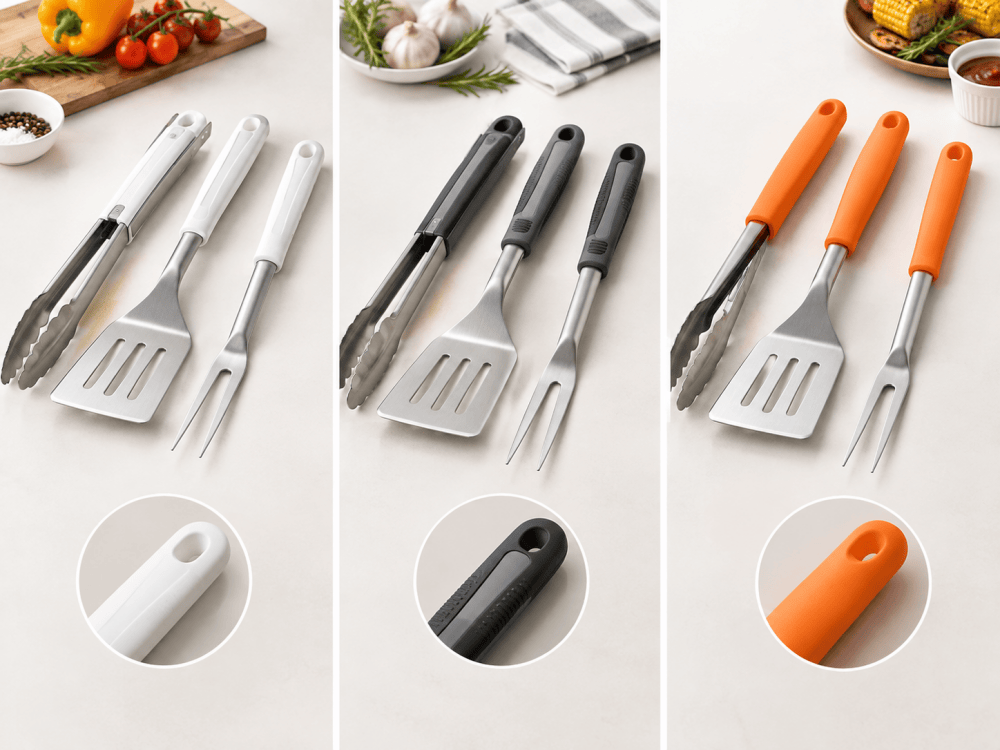
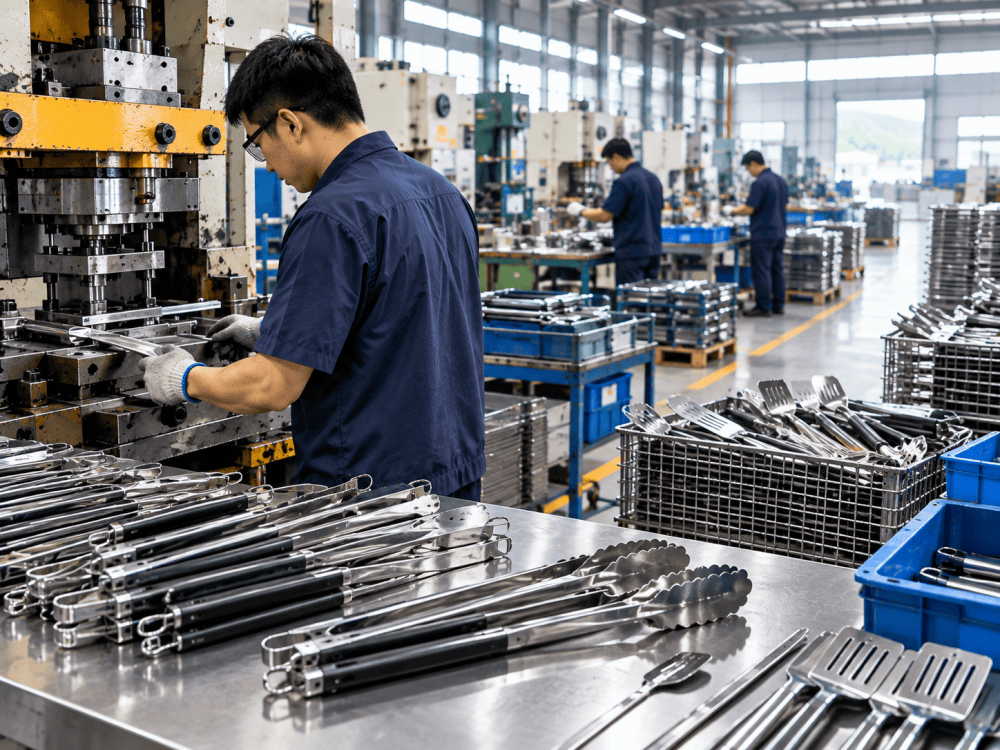
FASAKA supplies BBQ tools and BBQ tool sets for B2B customers, with OEM, ODM, and private-label support. For buyers comparing 304 vs 430 stainless steel BBQ tools, material selection can be discussed together with tool combinations, handle materials, handle colors, logo requirements, packaging, and target-market specifications.
A BBQ tool project can be developed around different combinations of stainless steel components and handle materials depending on the required product positioning, application, and purchasing requirements.
When requesting a quotation, buyers can provide the desired stainless steel grade, tool combination, dimensions, handle specification, logo, packaging, target market, and estimated quantity so the supplier can evaluate the complete project rather than quoting only a generic BBQ tool set.
FAQ: 430 vs 304 Stainless Steel BBQ Tools
304 generally offers higher corrosion resistance, so it can be more suitable for BBQ tools exposed to moisture, salt, acidic food residues, and frequent cleaning. However, 430 can be appropriate for applications where corrosion exposure is lower and cost control is important.
Yes, 430 can be used for BBQ tools. The suitability depends on the tool design, exposure conditions, required corrosion resistance, product positioning, and material specification.
Generally, yes. 430 has lower corrosion resistance than 304 in many wet, salty, or acidic environments, so it can be more susceptible to staining or corrosion under demanding conditions.
Yes. 430 stainless steel is ferritic and is normally magnetic. This can provide a quick indication during a basic inspection, although magnetism alone should not be treated as definitive material-grade verification.
304 is generally non-magnetic, although manufacturing processes such as cold working can cause some magnetic response. Therefore, a magnet test alone cannot conclusively identify 304.
304 generally has a higher material cost than 430 because of its alloy composition, particularly its nickel content. The final BBQ tool price also depends on thickness, construction, handle materials, tooling, quantity, and packaging.
Yes. For an OEM project, buyers can ask the supplier to quote the same BBQ tool design using both grades. This makes it easier to compare material cost, product positioning, and performance requirements.
Specify the stainless steel grade, material thickness, tool dimensions, handle material, surface finish, logo, packaging, target market, quantity, and required compliance documentation. A clear specification helps reduce misunderstandings during quotation and production.
304 vs 430 BBQ Tool Buyer Checklist
- Define the intended BBQ tool application.
- Evaluate moisture, salt, acid, and cleaning exposure.
- Choose 304 or 430 based on actual use conditions.
- Specify the stainless steel grade in the purchase order.
- Confirm material thickness and construction.
- Define handle material and handle design separately.
- Request material documentation when the grade is critical.
- Confirm MOQ and lead time.
- Confirm logo and packaging requirements.
- Request applicable compliance documentation for the target market.
- Approve a sample before mass production when appropriate.
Looking for Custom 304 or 430 Stainless Steel BBQ Tools?
FASAKA supports OEM, ODM, and private-label BBQ tool projects. Share your preferred stainless steel grade, tool combination, handle requirements, packaging, and target quantity with our team.
Request a Quote