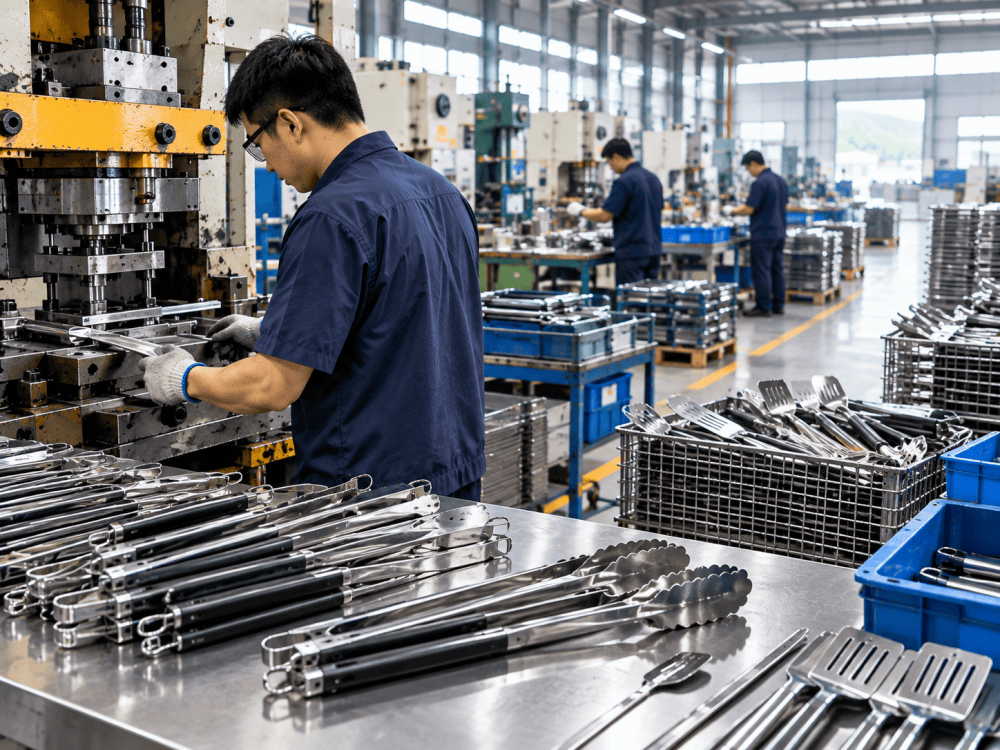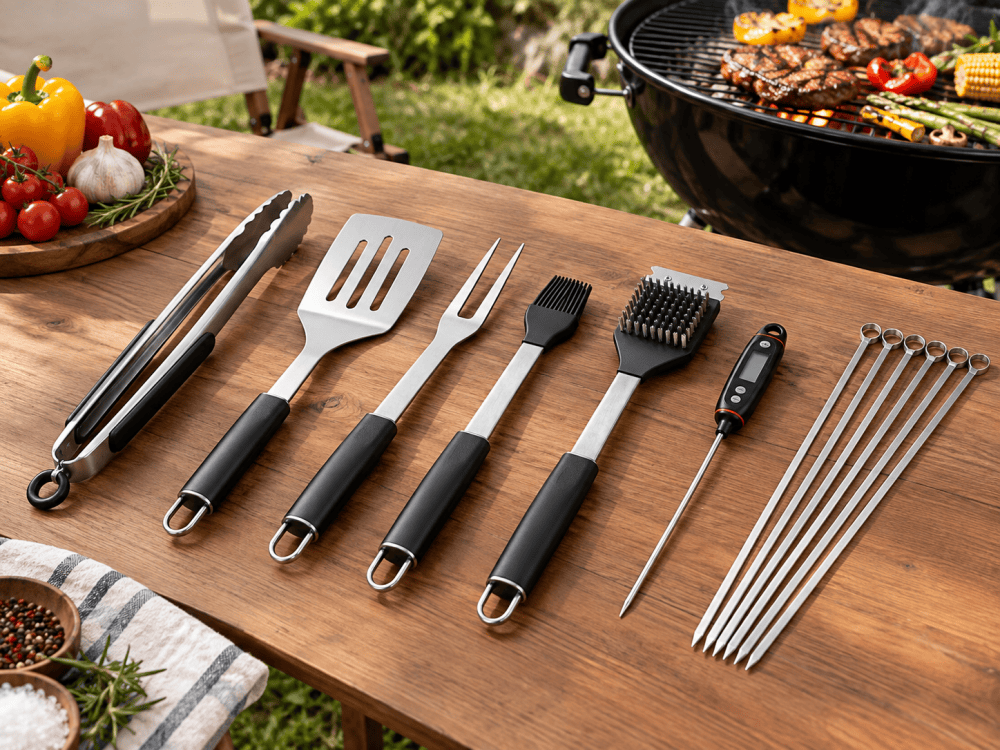



PP vs TPR vs Silicone Handles for BBQ Tools: What Are the Differences?
PP vs TPR vs Silicone Handles for BBQ Tools: What Are the Differences?
When sourcing BBQ tools, the handle material affects more than appearance. It can influence grip, comfort, heat exposure, durability, product positioning, customization, and manufacturing cost. For B2B buyers developing BBQ tool sets, choosing between PP, TPR, and silicone handles is therefore an important part of product specification.
But which material should you choose? The answer depends on the BBQ tool design, expected heat exposure, target price, grip requirements, and OEM specifications. There is no single handle material that is automatically the right choice for every BBQ product.
PP is generally a rigid and cost-conscious option for BBQ tool handles. TPR provides a softer, rubber-like grip and is useful for ergonomic designs. Silicone is often considered when soft-touch handling and higher temperature resistance are important.
For OEM and private-label BBQ tools, the material should be selected together with the tool construction, heat exposure, handle design, target market, packaging, and compliance requirements.
PP vs TPR vs Silicone: Quick Comparison
The following comparison gives B2B buyers a practical starting point. Actual performance depends on the specific material grade, formulation, handle structure, thickness, molding process, and intended use.
- Firm handle structure
- Lightweight
- Wide color options
- Flexible injection-molding designs
- Suitable for value-oriented products
- Rubber-like feel
- Good grip potential
- Suitable for ergonomic handles
- Flexible colors and textures
- Useful for soft-touch designs
- Soft and flexible surface
- Good grip potential
- Strong temperature resistance for suitable grades
- Premium tactile feel
- Suitable for heat-focused designs
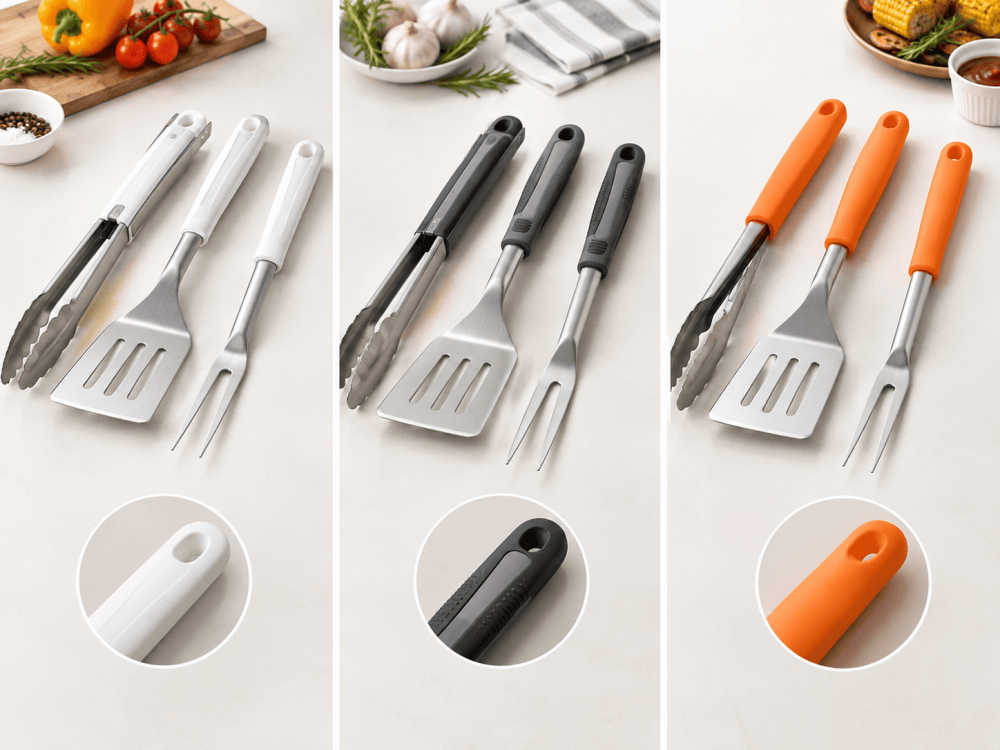
PP vs TPR vs Silicone BBQ Tool Handles
| Factor | PP | TPR | Silicone |
|---|---|---|---|
| Material type | Thermoplastic polymer | Thermoplastic elastomer / rubber-like material | Silicone elastomer |
| Handle feel | Hard and rigid | Soft and rubber-like | Soft and flexible |
| Grip | Good with suitable texture | Good to very good depending on formulation and texture | Good to very good depending on formulation and texture |
| Flexibility | Low | High | High |
| Heat performance | Grade and design dependent | Highly formulation dependent | Generally strong for suitable grades |
| Typical positioning | Practical / economical | Comfort / grip focused | Premium / heat focused |
| Color customization | Wide range | Wide range | Wide range |
| OEM customization | Yes | Yes | Yes |
1. What Are PP Handles for BBQ Tools?
PP stands for polypropylene, a thermoplastic polymer widely used in consumer and food-related products. For BBQ tools, PP can provide a relatively rigid, lightweight handle with many options for shape, color, and surface texture.
A PP handle can be molded into ergonomic forms and can include grooves, ribs, or other surface features designed to improve handling. This makes PP a practical option for many BBQ tongs, spatulas, forks, and other tools.
Advantages of PP BBQ Tool Handles
Is PP Heat Resistant Enough for BBQ Tools?
This depends on the specific PP grade and how the handle is positioned relative to the heat source. It is not accurate to assign one universal temperature limit to all PP handles.
Commercial PP grades can have different melting points and service-temperature ranges. For example, different PP grades published by plastics suppliers can have different recommended service conditions. This is why B2B buyers should request the actual material specification rather than approving a product based only on the word "PP."
When evaluating a PP BBQ tool handle, ask the manufacturer:
- What PP grade is being used?
- What temperature range is specified for the material?
- How close can the handle be to the grill?
- Is the handle expected to contact or be exposed to direct heat?
- How long is the expected heat exposure?
2. What Are TPR Handles for BBQ Tools?
TPR stands for thermoplastic rubber. TPR combines thermoplastic processing characteristics with a softer, rubber-like feel.
For BBQ tools, TPR is often considered when the buyer wants a handle that feels softer in the hand than a conventional rigid plastic handle.
Why Choose TPR for BBQ Tool Handles?
- Soft-touch feel: TPR can make a handle feel more comfortable during repeated use.
- Grip: Its rubber-like surface can provide useful traction.
- Ergonomic design: TPR can be used for shaped grip zones and overmolded components.
- Color flexibility: Different colors and textures can support private-label product development.
- Design differentiation: A soft-touch handle can visually and physically differentiate a product from basic rigid-plastic BBQ tools.
Is TPR Suitable for High-Temperature BBQ Applications?
TPR performance is highly dependent on its formulation. "TPR" does not describe one single material with one universal temperature rating.
Different TPR compounds can have different hardness, elasticity, temperature performance, and chemical resistance. Therefore, buyers should ask the supplier for the specific TPR grade or technical specification.
For B2B sourcing: If a supplier tells you that a BBQ handle is "TPR" but does not provide any material specification or temperature information, ask for more details before finalizing the product specification.
3. What Are Silicone Handles for BBQ Tools?
Silicone is an elastomer known for flexibility and temperature resistance. It is widely used in products where a soft surface and resistance to elevated temperatures are important design requirements.
For BBQ tools, silicone can be used to create soft-touch handles, grip sections, or other components designed around comfort and heat exposure.
Advantages of Silicone BBQ Tool Handles
- Temperature resistance: Suitable silicone grades can maintain useful properties at relatively high temperatures.
- Soft grip: Silicone provides a flexible, rubber-like surface.
- Good tactile feel: The material can support a more premium product experience.
- Design flexibility: Silicone can be molded into ergonomic shapes and textured surfaces.
- Color options: Silicone can be produced in different colors for private-label product designs.
Does Silicone Always Have Better Heat Resistance?
Silicone generally offers strong temperature resistance compared with many conventional thermoplastics, but buyers should still check the exact grade and intended application.
For example, WACKER's silicone rubber information describes different silicone grades and temperature performance rather than treating all silicone materials as identical.
Therefore, a buyer should request:
- Specific silicone grade
- Continuous-use temperature
- Short-term or peak temperature capability
- Recommended application conditions
- Applicable food-contact documentation
Which Is More Heat Resistant: PP, TPR, or Silicone?
This is one of the most common questions buyers ask when comparing BBQ tool handle materials. However, the answer should not be based only on the material name.
| Material | General Heat Consideration | What the Buyer Should Confirm |
|---|---|---|
| PP | Moderate and strongly grade-dependent | PP grade, service temperature, handle thickness, distance from heat source |
| TPR | Highly formulation-dependent | TPR grade, hardness, temperature rating, direct heat exposure |
| Silicone | Generally strong temperature resistance for suitable grades | Silicone grade, continuous-use temperature, peak exposure, application conditions |
Important: A BBQ tool handle can experience much lower or higher temperatures depending on its distance from the grill, exposure time, tool construction, and cooking conditions. The temperature rating of the raw material should therefore be considered together with the complete product design.
PP vs TPR vs Silicone: Which Has the Best Grip?
Grip is another major difference between rigid plastic and elastomer-based handle materials. However, grip does not depend on material alone.
Handle texture, hardness, geometry, surface contamination, moisture, and the force applied by the user can all affect how secure a handle feels.
PP Grip
PP provides a relatively hard surface. Manufacturers can improve handling through molded grooves, ridges, textured surfaces, or ergonomic handle geometry.
TPR Grip
TPR provides a softer, rubber-like surface and can be useful when a BBQ tool is designed around comfortable, non-slip handling.
Silicone Grip
Silicone can also provide a soft and high-grip surface. Texturing the silicone can further change the tactile experience.
| Grip Requirement | Material to Consider | Design Focus |
|---|---|---|
| Firm and structured grip | PP | Handle shape and molded texture |
| Soft-touch grip | TPR | Hardness, texture, ergonomic shape |
| Soft grip with heat-focused design | Silicone | Silicone grade, texture, thickness, heat exposure |
Which Handle Material Is Suitable for Different BBQ Tools?
There is no universal rule that one handle material should be used for every BBQ tool. The appropriate choice depends on the tool structure and the expected operating conditions.
| BBQ Tool | PP | TPR | Silicone | Main Considerations |
|---|---|---|---|---|
| BBQ Tongs | Suitable | Suitable | Suitable | Grip, leverage, heat exposure, handle length |
| BBQ Spatula | Suitable | Suitable | Suitable | Rigidity, grip, connection structure |
| BBQ Fork | Suitable | Suitable | Suitable | Grip, balance, metal-to-handle connection |
| Grill Brush | Suitable | Suitable | Suitable | Grip, cleaning force, heat exposure |
| Premium BBQ Set | Suitable | Suitable | Suitable | Appearance, tactile feel, positioning |
How Does Handle Material Affect BBQ Tool Cost?
For B2B buyers, material selection is closely connected to target pricing. However, it would be misleading to say that PP is always the cheapest, TPR is always in the middle, and silicone is always the most expensive.
The actual production cost depends on the material grade, handle size, construction, tooling, production process, order quantity, packaging, and customization requirements.
PP vs TPR vs Silicone for Private Label BBQ Tools
If you are developing a private-label BBQ tool set, the handle material can become part of the product's overall design language.
For example, a buyer targeting a value-oriented retail product may prioritize a rigid, lightweight handle. Another brand may focus on ergonomic soft-touch handling. A premium BBQ set may emphasize both tactile experience and temperature performance.
The important point is that the handle should be developed together with the rest of the BBQ tool.
- Tool combination
- Stainless steel specification
- Handle material
- Handle hardness
- Handle dimensions
- Handle color
- Surface texture
- Logo placement
- Packaging
- Target retail market
What Is an Overmolded BBQ Tool Handle?
Some BBQ tools use more than one material in the handle. This is commonly considered when the product needs a rigid structural component together with a softer grip surface.
Possible constructions include:
- Rigid PP body + TPR grip
- Rigid plastic core + silicone grip
- Metal tool body + polymer handle
- Metal structure + multi-material ergonomic grip
Overmolding can provide additional design flexibility, but it may also increase tooling complexity and production requirements.
For OEM development, ask the supplier whether the proposed handle is a single molded component, a separate grip, or an overmolded construction. This can affect tooling cost, production time, minimum order quantity, and final unit price.
Does a Silicone Handle Mean the BBQ Tool Is Automatically Safer?
No. The word "silicone" by itself does not establish that a finished BBQ tool is suitable for every food-contact application.
Food-contact compliance depends on the specific substance, formulation, intended use, and conditions of use. The same principle applies to PP, TPR, silicone, colorants, additives, coatings, adhesives, and other materials used in the finished product.
For a B2B project, buyers should identify their target market and ask the supplier what applicable food-contact documentation or testing can be provided for the finished product and its relevant components.
Procurement tip: Instead of asking only "Is this handle food grade?", ask for the specific material specification and the compliance documentation applicable to the intended market and use conditions.
What Should You Ask a BBQ Tool Manufacturer Before Choosing the Handle?
A quotation request that only says "BBQ tool set with silicone handle" may not provide enough information for a manufacturer to calculate an accurate quotation.
For a more efficient OEM process, include the following information.
- Tool combination: For example, tongs, spatula, fork, and grill brush.
- Handle material: PP, TPR, silicone, or another specified material.
- Material grade: Ask for the exact grade or technical specification where applicable.
- Hardness: Especially important for TPR and silicone handles.
- Temperature requirement: Describe the expected operating and heat-exposure conditions.
- Handle dimensions: Length, thickness, diameter, shape, and ergonomic requirements.
- Color: Provide a Pantone reference or another agreed color standard when required.
- Logo: Confirm whether the logo should be molded, embossed, printed, laser marked, or otherwise applied.
- Packaging: Specify bulk packaging, color box, gift box, blister packaging, sleeve, or another format.
- MOQ: Confirm MOQ by SKU, color, material, and packaging configuration.
- Sample: Request a pre-production sample before mass production.
- Compliance: Identify the target market and required documentation.
- Lead time: Ask separately about tooling time, sample time, and mass-production lead time.
How to Specify PP, TPR, or Silicone in an OEM RFQ
Instead of sending only a product name, a buyer can provide a more structured specification. For example:
Product: 4-Piece Stainless Steel BBQ Tool Set
Tools: Tongs + Spatula + Fork + Grill Brush
Handle: TPR soft-touch handle
Handle Color: Black
Logo: Custom private-label logo
Packaging: Custom color box
Target Market: US retail
Compliance: Applicable food-contact documentation
MOQ: Please quote according to your standard MOQ
This type of RFQ gives the manufacturer a clearer understanding of the product concept and helps reduce repeated questions during the quotation process.
Which BBQ Tool Handle Material Should You Choose?
The decision should start with the product requirements rather than with a simple ranking of PP, TPR, and silicone.
| Your Priority | Material to Consider | Main Reason |
|---|---|---|
| Rigid and lightweight construction | PP | Provides a firm handle structure and flexible molding options. |
| Soft-touch grip | TPR | Provides a rubber-like feel and can support ergonomic grip designs. |
| Soft grip with higher temperature resistance | Silicone | Suitable silicone grades can provide strong temperature resistance. |
| Cost-conscious product positioning | PP / TPR | Can support different price points depending on the complete construction. |
| Premium tactile experience | TPR / Silicone | Soft-touch surfaces can support comfort and product differentiation. |
| Custom private-label design | PP / TPR / Silicone | All three can be considered for different handle shapes, colors, textures, and constructions. |
How FASAKA Supports Custom BBQ Tool Projects
For B2B buyers, selecting the handle material is only one part of developing a successful BBQ tool. The final product also needs to coordinate the stainless steel tool, handle construction, branding, packaging, quality requirements, and target market.
FASAKA supplies BBQ tools and BBQ tool sets for B2B customers and supports OEM/ODM and private-label projects. Depending on the project, buyers can discuss tool combinations, handle designs, materials, colors, logos, packaging, and other customization requirements.
FASAKA's broader product portfolio also includes kitchen knives, scissors, and other kitchen-related products, which can be useful for buyers developing multiple kitchen and outdoor cooking products through one sourcing program.
Learn more about FASAKA OEM/ODM kitchenware services or explore BBQ tool sets for more product information.
FAQ: PP vs TPR vs Silicone BBQ Tool Handles
Is PP good for BBQ tool handles?
Yes. PP can be a practical option when a BBQ tool needs a rigid, lightweight, and cost-conscious handle. The specific PP grade, handle construction, and expected heat exposure should be evaluated before mass production.
Is TPR good for BBQ tool handles?
TPR can be suitable when grip comfort and a softer touch are important. Because TPR formulations vary, buyers should confirm the specific grade, hardness, and temperature performance with the supplier.
Is silicone better than TPR for BBQ tools?
Not for every application. Silicone can provide strong temperature resistance and a soft-touch surface, while TPR can provide a useful combination of soft grip, flexibility, and design options. The appropriate choice depends on the product requirements and target market.
Which BBQ tool handle material has the best grip?
TPR and silicone can both provide soft, high-grip surfaces. However, actual grip also depends on hardness, surface texture, handle geometry, moisture, grease, and the overall product design.
Can PP, TPR, and silicone BBQ handles be customized?
Yes. Depending on the manufacturing process, these materials can be customized in areas such as shape, color, texture, dimensions, logo placement, and multi-material construction.
Can a BBQ tool manufacturer make a custom handle?
Yes. Custom handle development can include material selection, dimensions, shape, texture, color, logo placement, and overmolded construction. New tooling may be required for customized designs.
What should I ask a BBQ tool supplier about handle materials?
Ask for the exact material or grade, hardness where applicable, temperature performance, food-contact documentation for your target market, handle dimensions, molding process, MOQ, tooling requirements, sample process, and production lead time.
What information should I send for a BBQ tool OEM quotation?
Provide the tool combination, stainless steel specification if available, handle material, handle design, color, logo, packaging, target market, required compliance documentation, estimated order quantity, and any special product requirements.
BBQ Tool Handle Material Selection Checklist
Before approving PP, TPR, or silicone handles for a BBQ tool project, confirm these points:
- 1. Tool application: What BBQ tool will use the handle?
- 2. Heat exposure: How close will the handle be to the grill or other heat source?
- 3. Material grade: What exact PP, TPR, or silicone grade is being proposed?
- 4. Grip requirement: Does the product need a rigid, soft-touch, or highly textured grip?
- 5. Product positioning: Is the product designed around value, comfort, or premium positioning?
- 6. Construction: Is the handle single-material or overmolded?
- 7. Customization: What color, texture, logo, and shape are required?
- 8. Compliance: What documentation is required for the target market?
- 9. MOQ: What is the MOQ for the selected material, color, and packaging?
- 10. Sample: Has a pre-production sample been tested and approved?
The goal is not simply to choose between PP, TPR, and silicone. The goal is to match the handle material and construction with the actual requirements of the BBQ tool and the market it will serve.
Looking for Custom BBQ Tools?
FASAKA supports OEM/ODM and private-label BBQ tool projects for B2B customers. Share your required tool combination, handle material, handle design, logo, packaging, MOQ, and target market with our team.
Request a BBQ Tool Quote