





What Are the Most Popular Types of Stainless Steel Kitchen Accessories?
Stainless steel kitchen accessories cover a wide range of products used for food preparation, cooking, serving, cleaning, and kitchen organization. Common categories include cooking utensils, kitchen tongs, knives, kitchen scissors, whisks, strainers, mixing bowls, and storage accessories. Each category serves a different purpose, so the right product selection depends on cooking habits, kitchen layout, durability requirements, and budget.
Stainless steel is widely used in kitchenware because many stainless steel grades offer good corrosion resistance, strength, and a smooth surface that is relatively easy to clean. However, performance depends on the alloy, product construction, surface finish, and care instructions. Not every stainless steel product has the same resistance to rust, staining, heat, or chemical exposure.
This guide explains the main types of stainless steel kitchen accessories, their key features, where they are used, and what distributors, retailers, importers, and private-label buyers should consider when sourcing them.
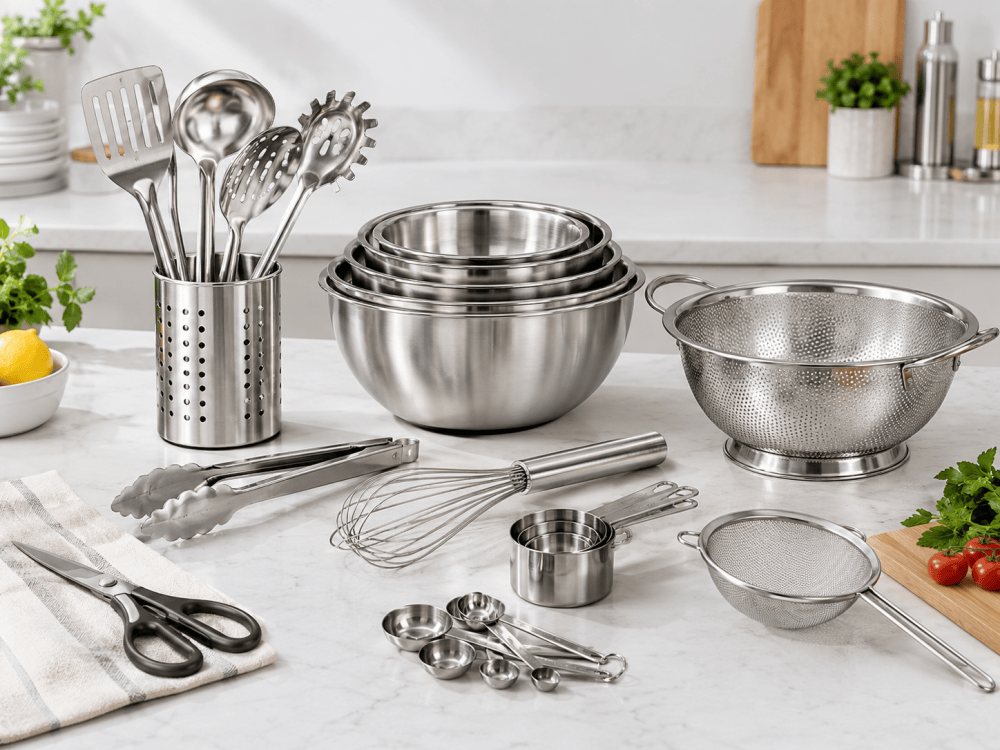
1. Overview: Main Types of Stainless Steel Kitchen Accessories
| Product Category | Typical Products | Main Function | Common Use Scenarios |
|---|---|---|---|
| Cooking utensils | Turners, ladles, serving spoons, skimmers | Stirring, flipping, lifting, and serving food | Everyday cooking, frying, boiling, serving |
| Kitchen tongs | Food tongs, serving tongs, locking tongs | Gripping and turning food | Grilling, frying, buffet service, salads |
| Knives and kitchen scissors | Kitchen knives, utility knives, kitchen shears | Cutting, trimming, and food preparation | Meat, vegetables, herbs, packaging and prep tasks |
| Whisks and mixing tools | Balloon whisks, flat whisks, mixing tools | Whisking, blending, and incorporating air | Eggs, sauces, dressings, batters |
| Strainers and colanders | Fine-mesh strainers, colanders, skimmers | Draining, rinsing, and filtering | Pasta, vegetables, stock, flour and dry ingredients |
| Mixing and preparation bowls | Stainless steel mixing bowls and nested bowls | Mixing, marinating, and holding ingredients | Baking, meal preparation, food service |
| Measuring tools | Measuring spoons, measuring cups | Measuring ingredient quantities | Baking, recipe preparation, portion control |
| Storage and organization accessories | Utensil holders, racks, hooks, organizers | Keeping tools accessible and workspaces organized | Home kitchens, commercial kitchens, compact spaces |
| Sink and cleaning accessories | Sink strainers, drying racks, selected drain accessories | Supporting washing, draining, and cleanup | Food preparation areas and kitchen sinks |
These categories overlap in some product ranges. For example, a skimmer can be classified as both a cooking utensil and a straining tool. Buyers should classify products by their main function and intended retail category rather than relying on the product name alone.
2. Stainless Steel Cooking Utensils
Stainless steel cooking utensils are among the most practical kitchen accessory categories. They include turners, ladles, serving spoons, slotted spoons, skimmers, and pasta servers. These tools help users handle food during cooking without needing a separate tool for every step.
Turners and spatulas
Features: A broad, flat head helps lift, flip, or transfer food. Slotted designs allow oil or liquid to drain away.
Best for: Eggs, pancakes, burgers, vegetables, and pan-fried foods. The edge shape and flexibility should match the intended cookware and food.
Ladles and serving spoons
Features: Ladles have a deeper bowl for liquids, while serving spoons are designed to transfer portions of food.
Best for: Soups, sauces, stews, rice, vegetables, and buffet service. Bowl capacity and handle length matter when selecting a model.
Slotted spoons and skimmers
Features: Openings in the head allow liquid or oil to drain while food is lifted.
Best for: Removing vegetables from boiling water, lifting dumplings, or retrieving suitable fried foods.
Pasta servers and specialty utensils
Features: Purpose-designed heads help grip, lift, or serve specific foods.
Best for: Pasta, noodles, and other foods that are difficult to handle with a standard spoon.
What should buyers compare?
For stainless steel cooking utensils, review the thickness and rigidity of the working head, handle length, joint construction, edge finish, and overall balance. Thin or poorly finished edges can bend or feel uncomfortable in use, while weak joints may loosen with repeated handling.
Stainless steel utensils can work well with many metal cookware surfaces, but they may scratch nonstick coatings. If the target market commonly uses nonstick pans, buyers may prefer to offer silicone or nylon alternatives alongside stainless steel products.
3. Stainless Steel Kitchen Tongs
Kitchen tongs provide a controlled grip on food without requiring users to hold it directly. They are available in different lengths, tip shapes, and locking designs, making them useful for both home cooking and professional food service.
- Cooking tongs: Used to turn or transfer food in pans, ovens, and on grills, depending on the product's heat rating and construction.
- Serving tongs: Often designed for salad, bread, buffet items, or shared dishes.
- Fine-tip tongs: Useful for handling smaller pieces of food or carrying out more precise plating tasks.
- Locking tongs: A locking mechanism can help keep the tool closed for storage.
Key features: Look at grip control, spring tension, tip alignment, handle comfort, and whether the locking mechanism operates smoothly. Silicone-tipped models may be more suitable for cookware that needs extra surface protection, while all-metal tips are often selected for durability and direct food handling.
Best use scenarios: Grilling, turning meat, handling vegetables, serving salads, and transferring food during meal preparation. For commercial buyers, different lengths and tip styles can support different cooking and serving tasks.
4. Stainless Steel Kitchen Knives and Kitchen Scissors
Knives and kitchen scissors are cutting tools rather than general-purpose accessories, but they are important parts of many stainless steel kitchen tool collections. The steel grade, blade geometry, heat treatment, handle design, and manufacturing quality all affect performance.
Stainless steel kitchen knives
Kitchen knives are designed for tasks such as chopping vegetables, slicing meat, trimming ingredients, and preparing fruit. Different blade shapes serve different purposes, so a product range may include chef's knives, utility knives, paring knives, and slicing knives.
When evaluating a knife, buyers should consider edge sharpness, edge retention, corrosion resistance, handle comfort, balance, and sharpening requirements. Stainless steel does not automatically mean a blade will stay sharp indefinitely; performance depends on the specific steel and manufacturing process.
Explore FASAKA's kitchen knife product range for related product information.
Stainless steel kitchen scissors
Kitchen scissors are designed for cutting tasks that may be inconvenient with a knife, such as trimming herbs, cutting food packaging, or handling certain poultry-preparation tasks when the tool is specifically designed for that purpose. Some models include additional features, but not every pair is intended for cutting bones or hard materials.
Important details include blade alignment, pivot stability, grip comfort, cutting action, and ease of cleaning. Buyers should also confirm whether the blades can be separated for cleaning and whether the product is suitable for dishwasher use rather than assuming these features are standard.
See FASAKA kitchen scissors for more information about this product category.
5. Stainless Steel Whisks and Mixing Tools
Whisks use wire loops to blend ingredients and, in suitable recipes, incorporate air. Stainless steel wire is commonly used because it can provide a lightweight structure while resisting corrosion under normal kitchen conditions.
- Balloon whisks: Their rounded wire shape is useful for whisking eggs, cream, and other mixtures that benefit from air incorporation.
- Flat whisks: Their lower profile can be convenient for stirring sauces in shallow pans or reaching into corners.
- Compact whisks: Smaller designs are useful for dressings, small portions, and limited storage space.
Key features: Check wire thickness, the security of the connection between wires and handle, handle comfort, and how easily the tool can be cleaned. A whisk with too few or overly stiff wires may not suit every mixing task, while poorly secured wires can become loose during use.
Best use scenarios: Beating eggs, mixing dressings, combining sauces, preparing batters, and blending dry or liquid ingredients. For baking-focused assortments, whisks can be grouped with measuring spoons, measuring cups, and mixing bowls.
6. Stainless Steel Strainers and Colanders
Strainers and colanders are used to separate food from liquid, rinse ingredients, or filter mixtures. Although they serve related purposes, their structures are different enough that buyers should treat them as distinct products.
| Type | Design Characteristics | Common Applications | Buying Considerations |
|---|---|---|---|
| Fine-mesh strainer | Fine wire mesh supported by a rim and handle | Straining sauces, rinsing small ingredients, sifting suitable dry ingredients | Mesh fineness, rim stability, handle strength, cleaning access |
| Perforated colander | A bowl-shaped body with drainage holes | Draining pasta and rinsing vegetables or fruit | Capacity, hole size, base stability, handles and drainage |
| Cooking skimmer | A shallow or perforated head attached to a handle | Lifting suitable foods from hot liquid or oil | Handle length, head rigidity, grip and intended heat exposure |
Fine-mesh strainers are more appropriate when small particles must be retained, while perforated colanders are generally more convenient for draining larger quantities. A product's material thickness, mesh quality, welds, and finished edges should be checked before bulk purchasing.
7. Stainless Steel Mixing Bowls
Stainless steel mixing bowls are used for combining ingredients, marinating food, preparing salads, and holding ingredients during cooking. They are also useful in baking because they can accommodate a range of mixing tasks without being tied to one recipe.
Common design variations include deep bowls, wide bowls, nesting sets, bowls with lids, and models with non-slip bases or measurement markings. These features are not universal, so buyers should confirm the actual specifications of each model.
Key features: Bowl capacity, wall thickness, rim finish, base stability, stackability, and ease of cleaning. Nested sets can help reduce storage space, while multiple capacities can serve different stages of food preparation.
Best use scenarios: Mixing cake ingredients, tossing salads, marinating meat, holding chopped vegetables, and organizing ingredients before cooking.
For B2B assortments, bowls can be sold individually or combined into sets with measuring tools and whisks. Set sizes should reflect the target market's storage habits, typical household size, and price range.
8. Stainless Steel Measuring Cups and Spoons
Measuring cups and spoons help users follow recipes and portion ingredients consistently. Stainless steel versions are often selected for their rigid structure and reusable design.
Measuring cups typically handle larger quantities, while measuring spoons are useful for smaller amounts of dry or liquid ingredients. Sets may include several capacities, engraved or stamped measurement markings, and connecting rings for storage.
What to check:
- Whether the stated capacities are accurate and clearly identified.
- Whether measurement markings remain legible during normal use and cleaning.
- Whether the handles feel secure and comfortable.
- Whether the set includes the sizes required by the intended market.
- Whether the cups and spoons can be stored together without becoming difficult to separate.
For retailers and private-label brands, a well-organized set can be easier to merchandise than unrelated individual tools. However, the number of pieces should reflect real use rather than simply increasing the advertised set size.
9. Stainless Steel Kitchen Storage and Organization Accessories
Storage and organization products support the way kitchen tools are arranged, accessed, and maintained. This category can include utensil holders, wall hooks, racks, shelving accessories, and selected countertop organizers.
Utensil holders and countertop organizers
These products keep frequently used tools within reach. Buyers should compare capacity, base stability, drainage or ventilation where relevant, edge finishing, and the dimensions of the holder relative to common utensils.
Wall-mounted racks and hooks
Wall-mounted storage can free up counter space and make tools easier to locate. Important factors include mounting method, load suitability, corrosion resistance in the intended environment, and compatibility with the target kitchen layout.
Drying racks and sink-side accessories
Drying racks and sink-side accessories help organize washed dishes, utensils, and selected kitchen items. Product selection should consider drainage, stability, available space, cleaning access, and exposure to water. Products used in persistently wet areas need suitable materials and finishes for that environment.
Important distinction: Stainless steel kitchen storage products do not all have the same function or material requirements. A countertop utensil holder, a wall rack, and a sink accessory should be assessed according to their expected load, moisture exposure, installation method, and cleaning routine.
10. How to Choose the Right Stainless Steel Kitchen Accessories
The best accessory depends on the task it must perform. A product that is suitable for a home baking setup may not be the most practical choice for a busy restaurant kitchen or a value-focused retail set.
| Use Scenario | Recommended Categories | What Matters Most |
|---|---|---|
| Everyday home cooking | Turners, ladles, tongs, knives, kitchen scissors | Comfort, practical sizes, easy cleaning and versatile use |
| Baking and recipe preparation | Whisks, mixing bowls, measuring cups and spoons | Measurement clarity, capacity options and mixing performance |
| Food washing and draining | Colanders, fine-mesh strainers, sink strainers | Hole or mesh size, drainage, stability and cleaning access |
| Grilling and outdoor cooking | Suitable cooking tongs and purpose-designed tools | Reach, grip, construction and stated heat suitability |
| Compact kitchens | Nesting bowls, stackable tools, hanging racks | Space efficiency, storage method and easy access |
| Commercial food preparation | Task-specific utensils, tongs, strainers and bowls | Repeated-use durability, cleaning requirements and workflow |
| Retail kitchen tool sets | Coordinated cooking utensils or baking tool assortments | Useful product combinations, packaging, price positioning and shelf appeal |
11. What Should B2B Buyers Check Before Sourcing Stainless Steel Kitchen Accessories?
For importers, wholesalers, distributors, retailers, and private-label brands, selecting stainless steel kitchen accessories involves more than comparing appearance and unit price. Product specifications, intended use, quality consistency, packaging, and order requirements should be evaluated together.
1. Verify the stainless steel grade and intended use
Ask the manufacturer to identify the stainless steel grade used in each relevant component and provide supporting material documentation where available. Different parts of the same product may use different materials. A product described as stainless steel should not automatically be assumed to be made entirely from one stainless steel grade.
For food-contact products, verify applicable food-contact requirements for the destination market and the specific product. Do not rely on the term "food grade" alone as proof of compliance.
2. Review construction and finishing
Inspect joints, welds, rivets, pivots, handles, edges, and surface finishes as appropriate for the product. Sharp burrs, loose connections, uneven finishes, or unstable components can affect both usability and perceived quality.
3. Match product features to the market
Consider whether the target customers prioritize basic functionality, compact storage, premium finishes, multi-piece sets, or specialized designs. A product with additional features is not necessarily better if those features increase cost without solving a real customer problem.
4. Confirm cleaning and care instructions
Dishwasher suitability, disassembly, resistance to staining, and compatibility with cleaning agents vary by product design and materials. Confirm these details with the manufacturer and ensure that packaging or product documentation communicates the correct care instructions.
5. Evaluate customization and packaging options
For OEM and private-label projects, discuss available handle designs, product dimensions, finishes, set combinations, logos, and retail packaging. Confirm which options are technically available, along with minimum order quantities, sample procedures, lead times, and packaging specifications before finalizing the order.
6. Request samples and written specifications
Before placing a large order, evaluate representative samples against the agreed specifications. For repeat orders, retain approved samples or written reference specifications to help maintain consistency between production batches.
Learn more about FASAKA's OEM and ODM kitchenware services or contact the team to discuss product requirements.
12. Are All Stainless Steel Kitchen Accessories Made from the Same Material?
No. Stainless steel is a family of alloys rather than a single material. Different grades have different compositions and properties, and the most suitable choice depends on the product's function, manufacturing method, expected environment, and cost target.
For example, a cutting blade, a mixing bowl, a wire whisk, and a storage rack have different performance requirements. Buyers should assess the grade and construction against the actual use rather than assuming that every product needs the same specification.
It is also important to distinguish between stainless steel and other components. Some accessories combine stainless steel with plastic, silicone, wood, or other materials. The complete product should be evaluated, including handles, coatings, joints, and any components that contact food.
13. Frequently Asked Questions
What are the most popular types of stainless steel kitchen accessories?
Common categories include cooking utensils, kitchen tongs, knives, kitchen scissors, whisks, strainers, colanders, mixing bowls, measuring tools, and kitchen organization accessories. Popularity varies by market, retail channel, and customer needs.
What are stainless steel kitchen accessories used for?
They support food preparation, cooking, mixing, measuring, draining, serving, and kitchen organization. The exact function depends on the product, such as using tongs to grip food or a colander to drain pasta and rinse vegetables.
Are stainless steel kitchen tools durable?
Many stainless steel tools offer good strength and corrosion resistance, but durability depends on the alloy, construction, thickness, joints, finish, and maintenance. Stainless steel products can still stain, corrode, bend, or wear if they are poorly made or used outside their intended conditions.
Are stainless steel kitchen accessories dishwasher-safe?
Some are dishwasher-safe, but this should not be assumed for every product. Handles, coatings, adhesives, wood components, and product construction can affect cleaning suitability. Follow the manufacturer's care instructions for the specific item.
Which stainless steel kitchen accessories are best for small kitchens?
Nesting mixing bowls, compact measuring sets, stackable tools, and wall-mounted racks can help reduce clutter. Before buying, check the product's dimensions and storage requirements rather than relying on the advertised piece count alone.
What should wholesalers look for when buying stainless steel kitchen accessories?
Wholesalers should compare material specifications, construction quality, product function, sample consistency, packaging, minimum order quantities, lead times, customization options, and destination-market requirements. These factors provide a more complete basis for supplier evaluation than unit price alone.
Can stainless steel kitchen accessories be customized for private-label brands?
Customization may include product dimensions, handle design, surface finish, logo placement, set combinations, and retail packaging. Availability depends on the manufacturer's capabilities and the specific product. Buyers should confirm tooling requirements, minimum order quantities, sample approval, and production timelines before proceeding.
Conclusion
The most useful stainless steel kitchen accessories are those that match specific preparation, cooking, serving, cleaning, or storage needs. Cooking utensils, tongs, knives, kitchen scissors, whisks, strainers, bowls, measuring tools, and organization products each serve a different purpose and should be selected according to their intended use.
For B2B buyers, a successful product assortment balances practical functionality, appropriate material specifications, reliable construction, market demand, and packaging requirements. Evaluating each product category on its own merits helps create a more useful and commercially relevant kitchenware range.
Looking for a Kitchenware Manufacturing Partner?
FASAKA is a brand under DKS Enterprises Co., Ltd., a manufacturer and supplier of knives and scissors, BBQ tools, and kitchenware based in Yangjiang, Guangdong, China. If you are evaluating kitchenware products for wholesale or a private-label project, contact our team to discuss your requirements and confirm suitable product options.
Explore OEM & ODM Services Contact FASAKA