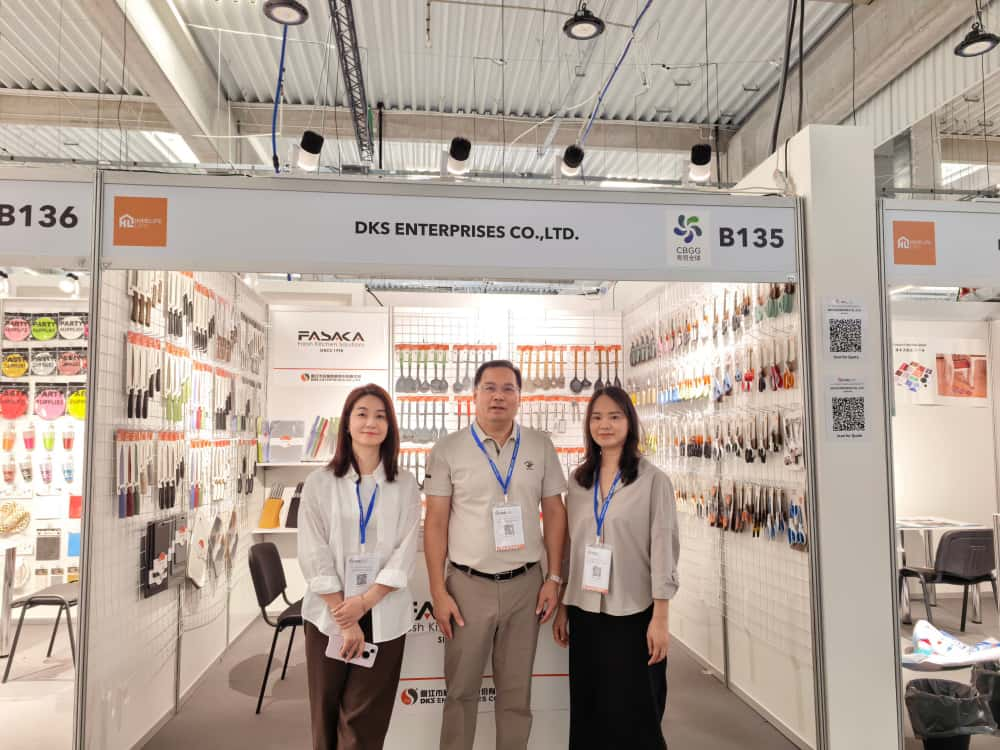




Sourcing Kitchen Knives, Scissors, Kitchen Utensils & BBQ Tools at the Canton Fair: A Buyer’s Guide to OEM & ODM
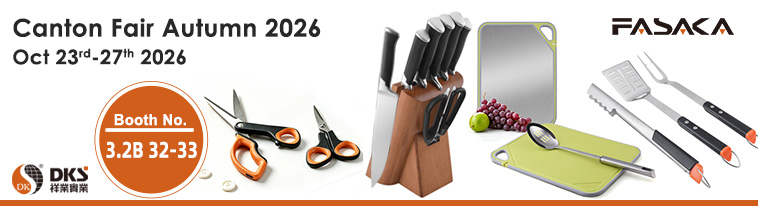
The Canton Fair gives international buyers an opportunity to compare Chinese suppliers, examine products in person, and discuss potential OEM and ODM projects. For importers, wholesalers, retailers, and private-label brands, however, the challenge is not simply finding products that look attractive at a booth. It is determining which suppliers can meet the requirements of a specific market, price point, product range, and purchasing plan.
This becomes especially important when sourcing multiple kitchenware categories, including kitchen knives, scissors, kitchen utensils, and BBQ tools. These products may share a retail channel, but their material specifications, performance requirements, packaging needs, and quality checks can be quite different.
Start with a clear product brief, compare suppliers using consistent quotation requirements, inspect category-specific product details, and evaluate samples against written specifications before placing a bulk order. For OEM and ODM projects, confirm customization scope, tooling costs, packaging requirements, production lead time, and quality acceptance criteria before approving the project.
This guide explains how to turn a trade fair conversation into a structured sourcing decision, with practical checklists for kitchen knives, scissors, kitchen utensils, and BBQ tools.
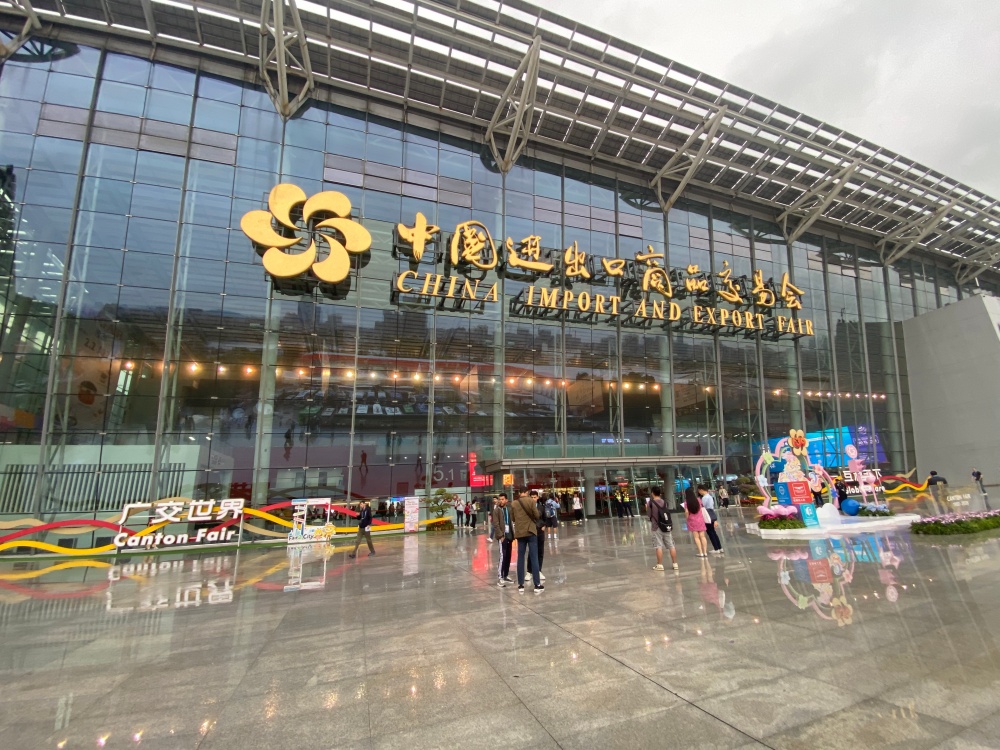
1. Prepare a Sourcing Brief Before Visiting the Canton Fair
One common sourcing mistake is visiting booths without a defined purchasing plan. Buyers may collect catalogs and quotations, but later discover that the offers are based on different specifications, packaging formats, or order quantities. The prices then become difficult to compare.
Before the fair, prepare a short sourcing brief for each product category you intend to purchase. It does not need to be a finalized specification sheet. Its purpose is to give every potential supplier the same starting point.
| Information to Prepare | What Buyers Should Define | Why It Matters |
|---|---|---|
| Target market | Destination country or region and intended sales channel | Influences product requirements, packaging, labeling, and applicable compliance checks. |
| Product scope | Product category, intended use, size, material, and preferred design | Prevents suppliers from quoting products that are not directly comparable. |
| Target price | Target landed cost or target supplier price, with currency and Incoterm clearly stated | Helps determine whether the proposed specification and packaging fit the business model. |
| Order plan | Estimated quantity per SKU and total expected order volume | Allows suppliers to quote against realistic quantities and clarify MOQ requirements. |
| Branding | Logo, retail packaging, color, label, and barcode requirements | Identifies customization costs and artwork preparation needs early. |
| Timeline | Sample approval date, target shipment date, and selling season | Helps determine whether the development and production schedule is realistic. |
Define the product before asking for the price
For example, asking for a quotation for a kitchen knife set is not specific enough. A supplier may quote a basic stainless steel set with a simple color box, while another may quote a set with different blade specifications, improved handles, a knife block, and customized retail packaging.
Both quotations may be valid, but they do not describe the same product. Before comparing prices, define the number of pieces, intended use, key materials, handle design, accessories, packaging, and order quantity.
A practical product brief
- Product: Five-piece kitchen knife set
- Market: Specify the destination market
- Materials: Define the required blade and handle materials, or request supplier proposals
- Packaging: Retail color box with the buyer's branding
- Quantity: Request prices at several realistic order quantities
- Customization: Logo, packaging artwork, and any required product changes
- Evaluation: Sample quality, consistency, quotation terms, and delivery schedule
2. Compare Suppliers Using the Same Quotation Requirements
A lower unit price does not automatically mean a better sourcing opportunity. Differences in materials, product dimensions, packaging, included accessories, inspection arrangements, and shipping terms can make two quotations appear comparable when they are not.
Use a standardized request for quotation (RFQ) for each shortlisted supplier. Ask every supplier to quote the same product specification and quantity tiers wherever possible.
| Comparison Item | Questions to Ask | What to Record |
|---|---|---|
| Product specification | Are the materials, dimensions, components, and construction identical? | Confirmed specification and any deviations |
| Unit price | Which quantity does the price apply to? What is included? | Price, currency, quantity tier, and exclusions |
| Trade terms | Which Incoterm and named place are quoted? What payment terms apply? | Incoterm, named place, payment terms, and validity period |
| MOQ | Is the MOQ per product, color, design, or customized SKU? | MOQ for standard and customized products |
| Customization | Can the supplier add a logo, change colors, or develop packaging? | Available options, setup charges, and artwork requirements |
| Samples | Are samples available? Are sample and courier charges refundable or creditable? | Sample cost, dispatch estimate, and approval process |
| Production | What is the estimated lead time after specification and artwork approval? | Estimated production time and conditions |
| Quality control | What inspections and acceptance criteria can be agreed upon? | Inspection stages, defect criteria, and documentation |
| Compliance | Which documents or test reports are relevant to the product and destination market? | Document type, scope, date, and product coverage |
Be precise when reviewing trade terms. For example, an EXW quotation and an FOB quotation may allocate costs and responsibilities differently. Do not compare them as if they cover the same delivery scope. Confirm the exact Incoterm, named place, and version used in each quotation.
Use a weighted supplier scorecard
Price should be one part of the decision, not the entire decision. Buyers can use a simple internal scorecard to compare shortlisted suppliers consistently.
| Evaluation Category | Suggested Weight | Evidence to Review |
|---|---|---|
| Product fit and sample quality | 30% | Physical samples, specifications, performance checks, and consistency |
| Commercial competitiveness | 25% | Comparable quotations, price tiers, MOQ, and total project cost |
| Production and delivery planning | 20% | Lead-time estimates, capacity information, and scheduling clarity |
| Customization and communication | 15% | Response quality, specification confirmation, and artwork coordination |
| Quality and compliance support | 10% | Inspection procedures and relevant, verifiable documents |
These weights are an illustrative starting point, not an industry standard. Adjust them to reflect your product risk, target market, and business priorities. Treat essential compliance or safety requirements as pass/fail conditions rather than allowing a high commercial score to compensate for a failure.
3. What to Inspect in Each Kitchenware Category
Kitchen knives, scissors, kitchen utensils, and BBQ tools should not be evaluated using exactly the same checklist. Each category has different performance characteristics and potential failure points. At the Canton Fair, use the physical samples to identify what needs to be specified and tested before production.
3.1 Kitchen Knives: Blade, Handle, Construction, and Consistency
For kitchen knives, visual appearance alone is insufficient. A polished blade and attractive handle do not prove that the knife meets the intended performance or durability requirements.
- Blade material: Confirm the exact steel grade and any material claims that must appear in the product specification.
- Blade dimensions: Record blade length, thickness, shape, and other dimensions relevant to the intended use.
- Hardness and heat treatment: If specified, request the agreed hardness range and supporting verification method.
- Edge performance: Evaluate cutting performance using a consistent test method appropriate to the knife type.
- Handle construction: Check material, fit, gaps, comfort, and the attachment between handle and blade.
- Balance and finish: Examine balance, surface finish, visible defects, and consistency across samples.
- Packaging and protection: Check blade protection, retail presentation, and whether the packaging protects the product during transport.
Questions to ask the supplier:
- Which exact blade material and handle material are used in this model?
- Which specifications can be guaranteed for bulk production?
- How is edge performance or hardness checked, if these are part of the agreed specification?
- Can the supplier provide the same model with different handles, packaging, or set combinations?
Do not accept a broad description such as “high-quality stainless steel” as a complete specification. Record the exact material grade where relevant, and agree on measurable acceptance criteria for the characteristics that matter to your market.
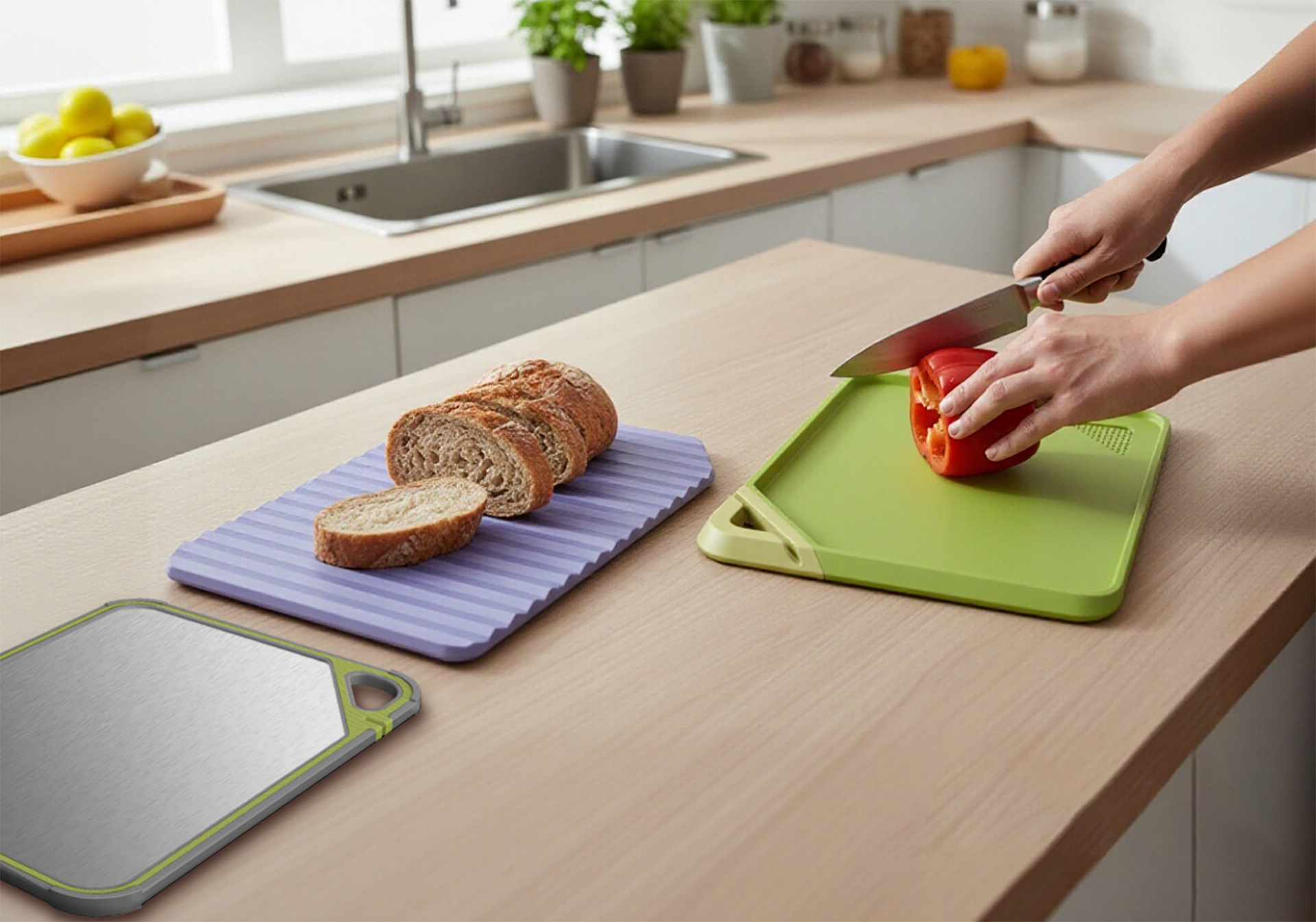
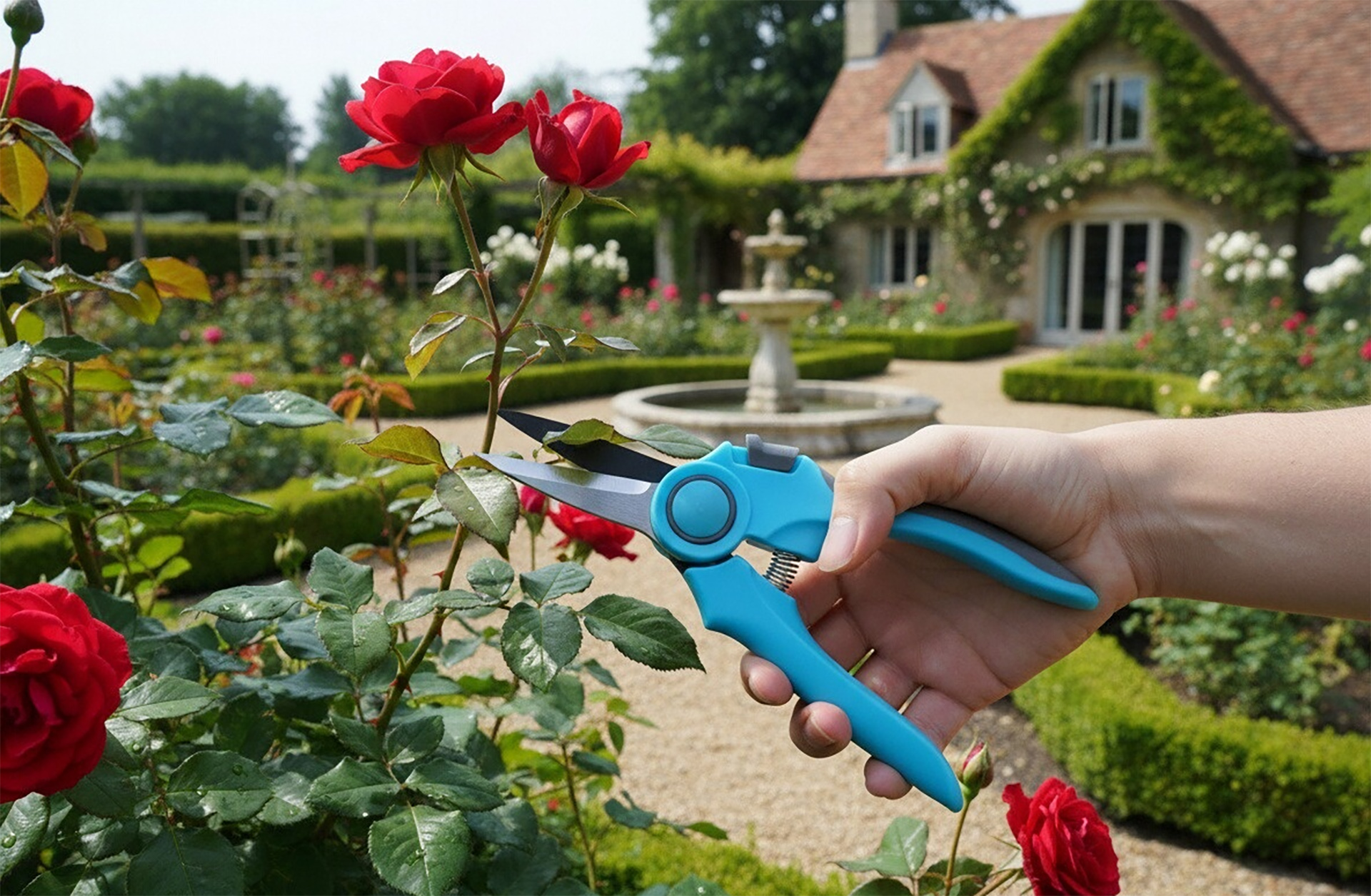
3.2 Scissors: Cutting Performance, Alignment, and Joint Structure
Scissors can look similar on a display but perform differently when used. Blade alignment, pivot construction, cutting action, and handle comfort should all be assessed.
- Intended application: Confirm whether the scissors are designed for kitchen, household, fabric, or another use.
- Blade alignment: Inspect the meeting point of the blades and look for visible gaps or uneven contact.
- Cutting action: Test representative materials suitable for the intended product, using a repeatable method.
- Opening and closing: Check whether the movement is smooth and consistent, without excessive looseness or resistance.
- Pivot structure: Examine the rivet or screw, joint stability, and any adjustment requirements.
- Handle design: Review grip comfort, edge finish, finger space, and material quality.
- Cleaning and maintenance: For products intended to be disassembled or cleaned, confirm the intended procedure and design limitations.
Questions to ask the supplier:
- What materials are used for the blades, pivot, and handles?
- What cutting performance is expected for the intended application?
- How does the supplier control blade alignment and opening resistance?
- Can the same design be supplied with different handle colors or private-label packaging?
When testing samples, avoid relying on a single quick cut. Test the scissors across the relevant working range and record any sticking, uneven cutting, excessive play, or discomfort.
3.3 Kitchen Utensils: Material Suitability, Heat, and Cookware Compatibility
Kitchen utensils cover a broad range of products, such as spatulas, turners, ladles, serving tools, and cooking sets. The correct inspection points depend on the material, design, and intended cooking conditions.
- Material identification: Confirm the specific material for each component, including the working end, handle, and connecting parts.
- Heat resistance: Check the stated temperature range and the test method or supporting evidence for any heat-resistance claims.
- Cookware compatibility: Determine whether the utensil is intended for nonstick, stainless steel, or other cookware surfaces.
- Joint strength: Inspect the connection between the head and handle, especially for multi-piece or assembled products.
- Shape and function: Check edge flexibility, scoop depth, length, and usability for the intended cooking task.
- Cleaning requirements: Confirm dishwasher suitability or hand-washing requirements where applicable.
- Food-contact requirements: Identify the rules applicable to the destination market and request documentation that matches the actual material and product.
Questions to ask the supplier:
- What is the material of each component, rather than just the overall product description?
- What temperature range is supported by the product specification?
- Is the utensil suitable for the cookware surfaces specified by the buyer?
- Which food-contact documentation or testing is available for the exact product and target market?
A material name by itself is not enough to substantiate every product claim. For example, a utensil's actual heat performance may depend on its formulation, structure, and the materials used in its handle or joints. Confirm claims against relevant product specifications and evidence.
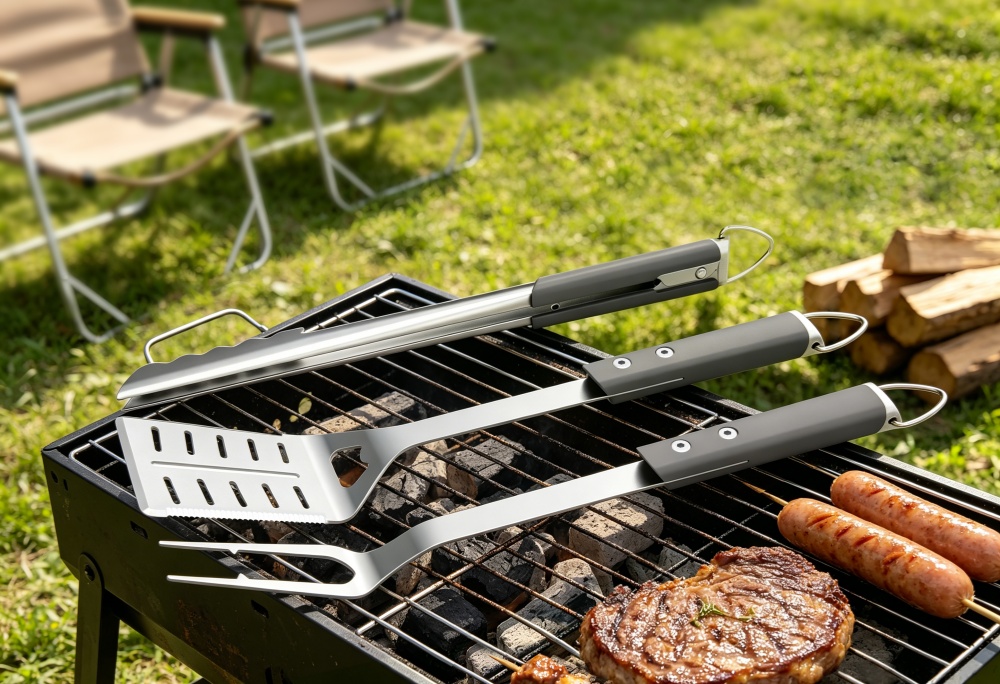
3.4 BBQ Tools: Set Composition, Joint Strength, and Retail Presentation
BBQ tools are frequently sold as sets, so buyers need to evaluate both the individual tools and the complete retail package. A set may include tongs, a spatula, a fork, a basting brush, or other accessories depending on its intended use and price point.
- Set composition: List every included tool, quantity, and accessory. Do not rely only on the set name.
- Dimensions: Confirm overall length, working-end dimensions, thickness, and other critical measurements.
- Material: Specify the material and grade of metal components where applicable, plus the materials used for handles and accessories.
- Joint strength: Inspect rivets, welds, hinges, and other connections for stability and finish.
- Tool function: Test tong grip and opening action, spatula rigidity, fork stability, and other functions relevant to each tool.
- Handle design: Review grip comfort, heat-exposure considerations, storage loops, and any locking mechanisms.
- Retail packaging: Confirm the box, insert, product arrangement, labels, barcodes, and protection during transport.
Questions to ask the supplier:
- Can the tool combination be adjusted to create different set sizes or price tiers?
- Are the handles, finishes, and packaging customizable?
- What are the MOQ and cost implications of changing the set composition?
- Can the supplier provide a final packaging sample showing the complete set and all accessories?
For BBQ sets, the packaging can influence both retail presentation and shipping efficiency. Compare the packed dimensions, packaging protection, and total set contents alongside the unit price.
4. OEM vs. ODM vs. Ready-Made Products: Which Route Fits Your Project?
Not every private-label project needs a completely new product design. Choosing the appropriate development route can reduce unnecessary development work and make the purchasing process easier to manage.
| Sourcing Route | Typical Approach | Main Advantages | Points to Confirm |
|---|---|---|---|
| Ready-made product | Select an existing model with limited or no product changes. | Often the simplest route for testing demand and establishing an initial product range. | Stock availability, standard MOQ, logo options, packaging options, and product consistency. |
| Private label on an existing model | Use an existing product with buyer branding or customized packaging. | Can create a branded product without redesigning every product component. | Logo setup, artwork, packaging MOQ, sample approval, and any restrictions on customization. |
| OEM project | Produce to buyer-defined specifications, with the exact scope agreed between both parties. | Supports product differentiation and more specific requirements. | Technical drawings, material specifications, tooling, ownership of designs, testing, and development costs. |
| ODM project | Adapt a supplier's existing design or develop a product using the supplier's design and development resources. | Can help buyers develop a product concept without designing every detail independently. | Design changes, customization boundaries, exclusivity, intellectual property, development fees, and lead time. |
OEM and ODM are not always used in exactly the same way by every supplier. Instead of relying only on the label, ask the supplier to define what it will design, what the buyer must provide, which changes are possible, and who owns the resulting designs and tooling.
When an existing product is the better choice
Consider an existing model when the primary goal is to establish a new category, test demand, or build a retail assortment with limited changes. If the product already meets the required specification, adding a logo or customized packaging may be sufficient.
When product development may be justified
A development project may be appropriate when existing products do not meet important requirements, such as a specific size, construction, material combination, ergonomic feature, or retail presentation. Before proceeding, confirm whether the expected differentiation justifies the additional cost, time, and project complexity.
Do not request a fully customized product simply because customization is available. First identify the business problem that customization solves. If a standard product meets the requirements, compare the cost and timeline of branding an existing model against the cost and timeline of developing a new one.
5. Understand MOQ, Tooling, Packaging, and the Real Project Cost
MOQ is one of the most important commercial details to clarify at the Canton Fair, especially when buyers want several products, colors, or packaging versions. A supplier may have different minimum quantities for standard products, customized products, printed packaging, and newly developed components.
Always ask what the MOQ applies to. It may be calculated per model, color, design, packaging version, or SKU rather than across the entire purchase order.
Separate recurring costs from one-time costs
| Cost Type | Examples | Questions to Clarify |
|---|---|---|
| Product cost | Unit price of each knife, scissor, utensil, or BBQ tool | Which specification and order quantity does the price cover? |
| Branding and packaging | Logo application, printed boxes, inserts, labels, and barcodes | Are there separate setup fees, printing charges, or minimum print quantities? |
| Development and tooling | New molds, dies, fixtures, or product-specific development work, where required | Is the cost applicable? Who owns the tooling, and are maintenance or storage fees involved? |
| Samples and testing | Sample preparation, courier fees, laboratory testing, or third-party inspection | Which charges are included, optional, refundable, or payable separately? |
| Logistics and import | Freight, insurance, customs duties, taxes, and destination handling where applicable | Which costs are excluded from the supplier's quotation? |
To compare offers accurately, calculate the expected total cost using the same assumptions. A lower quoted unit price may not be the more economical choice if it requires expensive packaging setup, a higher MOQ, or additional development costs.
How to manage MOQ across multiple SKUs
For buyers sourcing multiple categories, the most useful question is not simply whether a supplier accepts a small order. It is how the supplier applies minimum quantities to each item and which parts of the order can be combined.
Ask these questions:
- Is MOQ calculated separately for every SKU, color, or packaging design?
- Can different products share the same outer carton or shipping arrangement?
- Can standard products and customized products be included in one purchase order?
- Can the buyer begin with standard packaging and introduce customized packaging after demand has been validated?
- Which cost reductions are available at higher quantity tiers?
Do not assume that combining categories automatically reduces MOQ. Different products may have different production processes, components, packaging suppliers, and minimum requirements. Request a written breakdown for the actual product mix.
6. Move from Fair Samples to Approved Production Specifications
A sample displayed at a trade fair is useful for evaluation, but it should not automatically be treated as the final approved production standard. Buyers need to confirm whether the sample is a standard model, a customized prototype, or a representative production sample.
Use a defined approval process before authorizing mass production.
Step 1: Record the sample identity
Assign a reference number to each sample and record the supplier, model, material, dimensions, color, accessories, and packaging. Take photographs of important features and retain the sample where practical.
Step 2: Test the intended function
Use a repeatable evaluation method for the product category. This may include knife cutting performance, scissor cutting action, utensil functionality, or BBQ tool strength and handling. Define pass/fail criteria instead of relying only on general impressions.
Step 3: Confirm the final specification
Document the agreed materials, dimensions, construction, finish, color, components, branding, packaging, and relevant test requirements. Record any changes requested after the initial sample.
Step 4: Approve branding and packaging
Check logo placement, artwork, text, barcodes, labels, inserts, and packaging dimensions. Confirm which artwork version is approved and how changes will be controlled.
Step 5: Agree on production quality criteria
Define acceptable dimensions, functional performance, appearance, packaging, and defect classifications where relevant. Agree on inspection timing, sampling arrangements, and how nonconforming goods will be handled.
Step 6: Confirm the production schedule
Confirm when the lead time begins, such as after sample approval, artwork approval, deposit receipt, or another agreed milestone. Clarify the estimated completion date and the conditions that could affect it.
For products subject to destination-market requirements, verify the applicable rules before finalizing the specification. Request documents that correspond to the actual product, material, model, and intended market. A general company certificate or an unrelated test report is not a substitute for product-specific evidence when such evidence is required.
7. Questions to Ask Before Leaving a Supplier's Booth
Trade fair conversations can be brief, so focus on questions that help you decide whether the supplier deserves further evaluation. The goal is not to ask every possible question at once, but to leave with enough information for a meaningful follow-up.
- Which products in your range best match our target market and price position?
- Which models are standard products, and which require development or customization?
- What are the MOQ and price tiers for our expected quantities?
- Which materials and specifications are available for the selected models?
- What logo and retail packaging options can be quoted?
- What are the sample costs and estimated sample lead times?
- What information is needed to prepare a complete quotation?
- What is the estimated production lead time after all required approvals?
- Which quality-control steps and relevant compliance documents can be provided?
- Who will be the contact person for quotations, samples, and order follow-up?
Before moving to the next booth, record the supplier's name and contact details, the exact models discussed, any promised documents, quotation deadlines, and agreed follow-up actions. Product photographs alone are rarely enough to reconstruct the details of a conversation later.
8. Follow Up After the Canton Fair: Turn Comparisons into a Decision
The work after the fair is just as important as the booth visits. Once you return, organize the information, remove offers that do not meet essential requirements, and identify which suppliers should proceed to quotation, sample evaluation, or further technical discussion.
| Stage | Buyer Action | Expected Output |
|---|---|---|
| Within the first few days | Organize supplier contacts, photographs, product codes, and meeting notes. | A traceable shortlist of suppliers and products |
| Quotation stage | Send the same specification and quantity assumptions to shortlisted suppliers. | Comparable written quotations and identified gaps |
| Sample stage | Request samples for the products with the strongest commercial and technical fit. | A sample evaluation record and follow-up questions |
| Approval stage | Resolve specification, packaging, compliance, and quality-control questions. | An agreed product specification and approval record |
| Order planning | Confirm quantity, price, payment terms, Incoterm, lead time, and inspection arrangements. | A purchase order or contract aligned with the approved requirements |
A practical supplier follow-up email
After the fair, send a concise email that identifies the exact products and information you need. A specific request is more likely to produce a useful quotation than a general message asking for a catalog and price list.
Subject: Follow-Up on Kitchenware Sourcing Discussion at the Canton Fair
Hello [Supplier Name],
It was a pleasure meeting your team at the Canton Fair. We are currently evaluating suppliers for our kitchenware product range and would like to review the products discussed at your booth.
Please provide the following information for the selected models:
- Product specifications, materials, dimensions, and available variations
- Unit prices at the requested quantity tiers
- MOQ for standard products and customized SKUs
- Logo application and retail packaging options, including any additional charges
- Sample costs and estimated sample lead times
- Estimated mass-production lead times after approval
- Relevant quality-control information and product compliance documents for our target market
Our initial product requirements are attached for your reference. Please identify any items that differ from the requested specifications so that we can compare quotations accurately.
We look forward to reviewing your proposal and discussing the next steps.
Best regards,
[Your Name]
[Company Name]
9. When Does Multi-Category Sourcing Make Sense?
Kitchen knives, scissors, kitchen utensils, and BBQ tools can complement one another in a broader kitchenware or household product range. For some buyers, evaluating multiple categories during one sourcing trip can make product-line planning more efficient.
However, the right sourcing strategy depends on the business model and supplier capabilities. A buyer should not assume that one supplier can meet every requirement simply because several categories appear in the same catalog.
Scenario 1: Expanding an existing product range
A wholesaler already selling kitchen knives may want to add scissors, utensils, or BBQ accessories. The priority is to compare new products against the existing range in terms of target price, packaging, customer demand, and quality requirements.
Scenario 2: Developing a private-label collection
A retailer may want consistent branding across several categories. The sourcing brief should define which elements must be consistent, such as logo treatment, packaging style, color palette, or retail presentation, while allowing product specifications to differ where necessary.
Scenario 3: Building a seasonal BBQ assortment
A buyer preparing for a seasonal selling period may need several BBQ tools, different set configurations, and retail-ready packaging. In this case, product availability, sample approval, packaging readiness, and the production schedule should be evaluated together.
When considering a multi-category supplier, confirm the actual product range, manufacturing or sourcing arrangements, quality responsibilities, and order coordination process. Ask which categories are handled directly and which, if any, involve external partners. Evaluate the arrangement against your own requirements rather than relying on the breadth of a product catalog alone.
10. Common Sourcing Mistakes to Avoid
Comparing unit prices before confirming specifications
Two similar-looking products may use different materials, dimensions, components, or packaging. Confirm these differences before judging which quotation is more competitive.
Assuming one MOQ applies to the entire order
Minimum quantities may vary by SKU, color, customization, or packaging version. Request a breakdown based on the actual assortment you intend to buy.
Approving a sample without documenting its specifications
A sample approval should establish a clear reference for bulk production. Record the approved model, materials, dimensions, finish, packaging, and relevant acceptance criteria.
Requesting customization before validating demand
New tooling, revised components, and customized packaging may increase costs and extend lead times. Determine which changes are commercially necessary before committing to development.
Accepting unsupported quality or compliance claims
Request relevant evidence and check that it matches the actual product and target market. Define the inspection requirements and acceptance criteria in writing.
Leaving follow-up responsibilities unclear
Record the contact person, information required, next action, and expected response date. This makes it easier to distinguish active opportunities from contacts that are unlikely to progress.
Frequently Asked Questions
What should I prepare before sourcing kitchenware at the Canton Fair?
Prepare a product brief covering the target market, intended use, materials, dimensions, expected quantities, target price, packaging, customization needs, and required delivery schedule. This gives different suppliers a consistent basis for quotation.
How can I compare kitchenware suppliers fairly?
Use the same product specifications, quantity tiers, packaging assumptions, and quotation terms. Compare total project costs as well as sample quality, production planning, customization options, and relevant quality documentation.
Should I choose OEM, ODM, or an existing product?
Choose an existing product when it already meets your requirements. Consider private labeling for branding changes, OEM for production against buyer-defined specifications, and ODM when you want to develop or adapt a supplier's design. Confirm the actual scope, costs, lead time, and intellectual-property terms with the supplier.
What should I check when sourcing kitchen knives?
Check the specified blade material, dimensions, handle construction, cutting performance, finish, consistency, and packaging. Where hardness or other measurable performance characteristics matter, define the required criteria and verification method before production.
What is the most important question to ask about MOQ?
Ask whether the MOQ applies per product, SKU, color, design, or packaging version. Then request price tiers and a breakdown of any additional costs for customization, packaging, samples, or development.
How do I reduce the risk of quality differences between samples and bulk orders?
Approve a clearly identified sample, document the final specification, define measurable acceptance criteria, and agree on inspection arrangements before production. Keep the approved sample or an appropriate reference record where practical.
Can I source kitchen knives, scissors, utensils, and BBQ tools from one supplier?
It depends on the supplier's actual product range, production arrangements, and quality-control capabilities. Evaluate each category separately and confirm who is responsible for specifications, production, inspection, and delivery.
Meet FASAKA at Canton Fair Spring 2026
We warmly welcome international buyers, importers, distributors, and retail partners to visit DKS Enterprises Co., Ltd. at the Canton Fair Spring 2026.
Discover our kitchenware range, including kitchen knives, scissors, kitchen utensils, and BBQ tools. Meet our team to discuss product specifications, private-label opportunities, OEM and ODM projects, and your wholesale sourcing requirements.
Exhibition: Canton Fair Spring 2026
Date: April 23–27, 2026
Booth: 3.2G33–34
Company: DKS Enterprises Co., Ltd.
Location: Guangzhou, China
FASAKA — Fresh Kitchen Solutions
www.fasaka.com | www.kitlucy.com
Planning Your Next Kitchenware Sourcing Project?
Whether you are expanding an existing product range, developing private-label products, or evaluating multiple kitchenware categories, a clear sourcing brief makes supplier discussions more productive.
FASAKA offers a starting point for exploring kitchen knives, scissors, kitchen utensils, and BBQ tools for wholesale and B2B sourcing discussions. Share your target products, market, estimated quantities, and customization requirements to begin a more focused conversation.
Visit the FASAKA website to explore the product range and discuss your sourcing requirements.